
Dog bite coverage can depend on the policy, insured persons, residence, dog ownership or custody, location, exclusions, notice, other insurance, and the insurer’s investigation. A declaration page alone is not the full contract, and an oral statement is not a substitute for a written position. The coverage file should connect each disputed issue to the […]
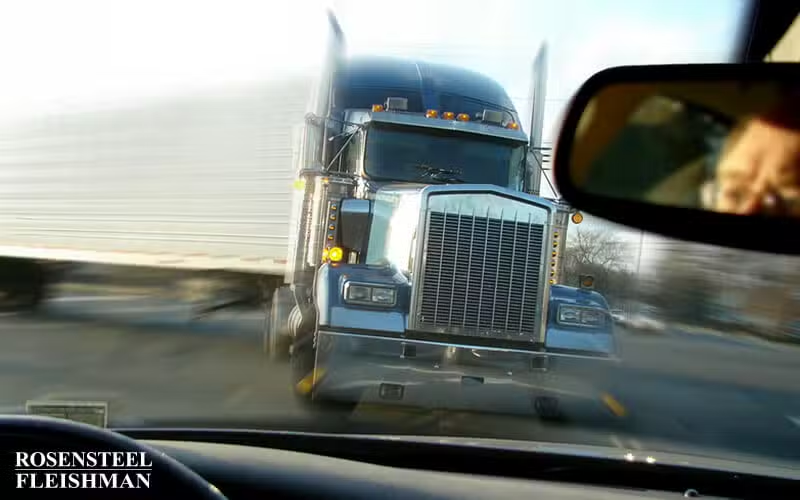

Pickup trucks, box trucks, moving trucks, dump trucks, delivery vehicles, tractor-trailers, utility vehicles, and trucks carrying passengers or hazardous material can operate under different facts and rules. Classification should begin with the vehicle and trip, not the label used in a crash report or advertisement.
The word truck does not establish commercial-motor-vehicle status, interstate commerce, CDL coverage, or which federal rule applies.
Record the classification facts
- Vehicle identification, make, configuration, registered and actual weight, ratings, trailer, and seating capacity
- Cargo, quantity, packaging, hazardous-material status, origin, destination, route, and customer
- Personal or business purpose, compensation, employer, contractor, carrier, authority, lease, and ownership
- Driver license class, endorsements, restrictions, medical status, and assigned task
- Intrastate or interstate movement and the evidence supporting that conclusion
Use the federal definitions with the actual operation
49 C.F.R. § 390.5T contains definitions used in the Federal Motor Carrier Safety Regulations, including terms relevant to covered vehicles, employers, employees, carriers, and commerce. The exact language and cross-references should be reviewed for the date and operation.
Weight alone may not answer the question. Passenger capacity, hazardous material, combination ratings, cargo, commerce, and exceptions can matter depending on the rule being considered.
Check general applicability and exceptions
49 C.F.R. § 390.3 addresses general applicability and specified exceptions. Other parts can contain their own scope provisions, definitions, and exceptions. State requirements may also apply even when a particular federal provision does not.
Do not use CDL status as the universal test
49 C.F.R. § 383.3 addresses applicability of the commercial-driver-license rules and listed exceptions. A vehicle or operation can fall within one safety provision without producing the same answer under every CDL, hours, inspection, maintenance, or insurance rule.
Build a rule-applicability table
- Rule or requirement under review
- Defined vehicle, person, carrier, cargo, or operation
- Facts that bring the event within scope
- Potential exception and the evidence needed to evaluate it
- Relevant time period, required record, actual record, and unresolved issue
Then investigate the collision mechanism
Classification determines which records or duties may be relevant; it does not prove why the collision occurred. Reconstruct speed, following distance, lane use, observation, braking, steering, vehicle condition, cargo, weather, road geometry, and third-party conduct.
The related truck-collision cause guide explains how evidence can test competing causal hypotheses.
Preserve records based on the classification map
- Title, registration, authority, lease, bill of lading, dispatch, route, fuel, toll, scale, and payment records
- Driver license, qualification, medical, training, log, inspection, and work-history records
- Tractor, trailer, maintenance, repair, defect, telematics, camera, and event-data records
- Cargo, passenger, loading, securement, hazardous-material, and emergency-response records
- Native data, metadata, system definitions, clocks, custody, and retention settings
Avoid overbroad regulatory claims
State the factual premise and cite the rule before saying a requirement applies. If weight, route, cargo, carrier identity, or commerce is disputed, label the conclusion provisional. Keep a regulatory issue separate from breach and separate again from collision causation.
Rosensteel Fleishman Car Accident & Injury Lawyers provides information about classification and investigation of Charlotte truck collisions.
Sources
Additional Car Accidents Personal Injury Trucking Accidents Articles
How to Document Balance Problems During Motorcycle Crash Recovery
Balance problems may affect walking, stairs, transfers, bathing, driving, work, and other daily tasks. The cause and treatment require medical evaluation. The claim file should accurately record reported symptoms, clinical findings, provider instructions, function, and change over time. A balance record should identify the person’s exact sensation, trigger, duration, associated symptom, task affected, safety response, […]
How to Investigate Right of Way in a North Carolina Turning Crash
A turning crash may involve a left turn, right turn, U-turn, merge, driveway entry, lane change, pedestrian crossing, or more than one movement. Right of way depends on the actual roadway controls and sequence, so the file should begin with a diagram and time sources. The intersection file should map each road user’s approach, lane, […]
How to Preserve Shared-Fault Evidence After a North Carolina Slip and Fall
A slip-and-fall dispute may involve the condition of the property and what the injured person, owner, occupier, contractor, or employee knew or did. Evidence should be organized by element and source rather than divided into a favorable file and an unfavorable file. The responsibility file should preserve the condition, creation and notice evidence, inspection and […]



