
Accidents involving floor mats rarely seem serious at first. Most people assume a mat is there to improve safety, not create a hazard. Yet when a mat is curled at the edges, improperly secured, or placed on a slick surface, it can quickly become the cause of a painful fall. In Charlotte, these incidents often […]
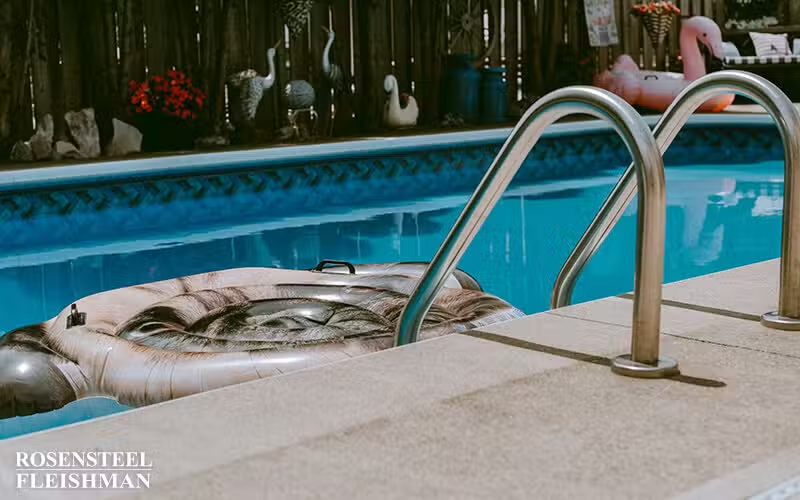

Summertime in North Carolina means warm temperatures. The hot temperatures draw more and more residents of North Carolina to public and private pools. Enjoying time at the pool is a great way to have a respite from the warm weather. Sadly, pool accidents and deaths occur at an alarming rate during these summer months. According to the Center for Disease Control and Prevention, there are more than 3,500 fatal drownings every year, and more than 60,000 people in the United States required emergency room treatment for injuries sustained while swimming in a pool. Pool owners, whether in a public setting, private club, or private residence, could be held liable for the deaths and injuries sustained by visitors to their pool.
Pools in any setting are considered to be part of the property on which they are located; meaning that in most cases premises liability rules will apply. Premises liability is the set of laws used to determine who is liable when a particular piece of the premises causes an injury. In 1998 the North Carolina Supreme Court abolished the distinction between licensee and invitee in premises liability cases. The abolishment of this distinction means that landowner and lawful visitors to the property all have the same standard of care. The standard requires that landowners must exhibit reasonable care to protect any lawful visitor from injury. Under the standard of reasonable care regarding swimming pools, landowners need to maintain the property, clean up spills, and ensure the safety of all visitors through warnings of potential dangers that would not be obviously apparent to a reasonable person. Negligence in meeting these standards can cause the pool owner to held liable for any injuries or death on their property. However, there are significant differences between the duties of care required at private pools compared to public pools.
The owner of a private pool has the duty to warn guests or lawful visitors of any dangers that are not obvious. Certain risks, like slippery surfaces around the pool, and diving from inappropriate places, are apparent to any reasonable person and most likely would not create liability for a pool owner in the event of an injury. The private pool owner does have the duty to repair faulty equipment such as a broken ladder or diving board or warn guests of their defectiveness. Faulty equipment creates a risk that a reasonable person does not assume when they enter a pool. Additionally, private pool owners must provide care to children in and around their pool. The pool owner has a duty to adequately supervise children, or provide a barrier such a fence or pool cover to stop children from entering the pool without supervision as children, and reasonable adults are held to a different standard.
Public pool owners have an even higher degree of care owed to the patrons of their pool. North Carolina is a negligence per se state, which means that if required equipment or supervision are not met causing, an accident, then an inference of negligence may be created. Public pools in Mecklenburg County have laws requiring that a lifeguard is on duty when a pool has a depth of five feet or greater and that those lifeguards survey the pool area regularly for anyone in distress. The owner of the public pool can also be held liable for failing to provide emergency safety equipment should an injured invitee need said equipment. In addition to the safety equipment that should be present, public pool owners must maintain equipment such as ladders, diving boards, and drains. Failing to provide all safety measures, warnings, and proper equipment can cause both public and private pool owners to found liable in the case of injury or death.
In public and private pools, children have the largest occurrence of injuries and death. Negligent supervision at pools makes children more susceptible to injuries and accidental drownings. Parents could sue entitles or individuals if their negligent supervision caused an accident involving their child. Negligent supervision can be complex to decipher as required supervision varies due to context. Different activities, level of risk, and experience of the children taking part in the activity all play a factor in determining whether or not the supervision was negligent. Private pool owners can be found to be negligent in their supervision if they do not give adequate warnings of the depth of the pool, or if they fail to ascertain if a child can swim before permitting them to enter the pool. However, in most cases of children being injured or drowning in a pool, the child was last seen in the home and had been out of sight for less than five minutes. Negligence on the part of the supervisors can cause children to wander out of sight and towards the pools where the child can become injured or accidentally drown.
In the case of public pools being negligent in their supervision, it is most likely that the attending lifeguard was negligent, not adequately trained, or equipped. No lifeguard is perfect, but a lifeguard is generally required to act in a way that a reasonable lifeguard of the same age and with the same training would act. Lifeguards have a specific standard when arriving at work. Lifeguards are required to be attentive, rested, and not come to work under the influence of drugs or alcohol. Lifeguards who do not maintain a watch on swimmers or other people in the water, take unauthorized breaks, do not have the proper equipment, or are not adequately trained can all lead to the lifeguard or pool owner being found liable for negligent supervision in the case of injury or death.
It is tragic when a trip to the pool results in injuries or death. Pool owners open themselves up to be held liable for injuries that occur at their pools if they keep an unsafe pool area, have unsafe pool equipment, or poorly trained lifeguards. Owners who have the proper equipment and warning signs, but are negligent in their supervision are also open to liability. Swimming pools can be full of hazards and have the potential for severe injury and even death if proper precautions are not met and consistently maintained.
If you or a loved one was injured in a pool accident please contact one of our personal injury lawyers. We will go over all of you options and answer your questions. There is no fee for an initial consultation.
Additional Personal Injury Premises Liability Articles
How Long-Term Damages Are Calculated in Truck Accident Injury Claims
After a serious truck accident in Charlotte, the physical injuries are often only part of the problem. What tends to create lasting stress is the uncertainty about the future. Medical bills may continue for months. Work responsibilities may shift or stop altogether. A once predictable income can suddenly feel unstable. These long term consequences are […]
When to Contact a Lawyer After a Bicycle Accident in Charlotte
A bicycle accident can interrupt daily life in an instant. One moment you are riding through Charlotte traffic, and the next you are dealing with injuries, damaged equipment, insurance calls, and unanswered questions. Even collisions that seem minor at first can lead to lingering pain, unexpected medical bills, and missed time from work. It is […]
How Medical Evidence Is Used in Head Injury Accident Claims
After a car accident involving a head injury, confusion often lingers long after the crash scene has cleared. You may leave the hospital with discharge papers, follow up instructions, and more questions than answers. Head injuries are especially unsettling because symptoms do not always show up immediately. Headaches, memory lapses, mood changes, and difficulty concentrating […]