
Highway crashes do not always happen during predictable rush hour congestion or in the middle of heavy commuter traffic. In North Carolina, a collision may occur late at night, during an off-peak afternoon, or on a relatively open stretch of interstate where traffic conditions initially appear straightforward. Claims arising from these crashes can still become […]
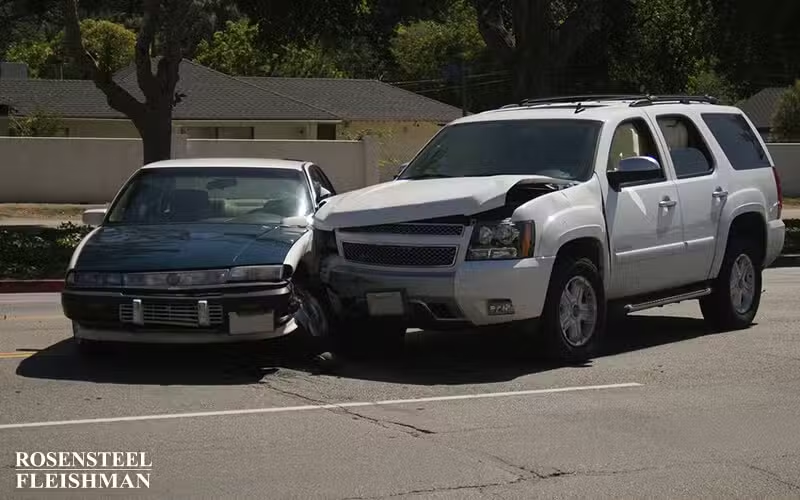

Punitive damages do not compensate a person for medical expenses, lost income, pain, or another ordinary loss. North Carolina law treats them as a separate remedy intended to punish egregiously wrongful conduct and deter similar conduct. A crash involving an impaired driver can present a punitive-damages issue, but the label “impaired” does not by itself establish every required element.
Evidence of impairment can be important, but impairment, a charge, or a conviction does not replace the civil proof required for compensatory and punitive damages.
Establish compensatory liability first
North Carolina Chapter 1D requires liability for compensatory damages and an aggravating factor related to the same injury. The aggravating factor must be fraud, malice, or willful or wanton conduct, and it must be established by clear and convincing evidence. Willful or wanton conduct means more than gross negligence under the statutory definition.
- Driver conduct, collision sequence, duty, breach, causation, injury, and compensatory damages documented independently of the punitive demand
- Alleged aggravating conduct identified precisely instead of inferred from the severity of the injury
- Evidence tied to the defendant and the relevant time, with source, collection method, completeness, and admissibility questions recorded
- Criminal accusation, administrative license action, civil allegation, admitted fact, expert opinion, and final adjudication kept separate
Build an impairment record from more than one label
- Officer observations, body-worn video, dash camera, field-sobriety documentation, chemical-analysis record, warrant or consent record, and chain-of-custody material
- Witness observations, receipts, surveillance, messages, social posts, location data, vehicle data, and the time between consumption, driving, collision, and testing
- Medication, substance, dosage, timing, reported symptoms, competing explanation, and qualified opinion evaluated without medical speculation
- Driving behavior, speed, lane use, traffic control, braking, crash sequence, post-collision conduct, and earlier related conduct considered only when legally relevant
Apply the cap exception accurately
Chapter 1D generally limits a punitive award under G.S. 1D-25. G.S. 1D-26 provides that the subsection 1D-25(b) cap does not apply to injury or harm arising from operation of a motor vehicle when the defendant’s actions would give rise to one of the listed impaired-driving offenses. The exception removes that statutory cap; it does not eliminate the other liability, aggravating-factor, proof, procedure, or review requirements.
Separate the driver from another defendant
G.S. 1D-15 does not permit punitive damages against a person solely through vicarious liability. It requires participation in the aggravating conduct; for a corporation, the statute addresses participation or condonation by officers, directors, or managers. Ordinary derivative responsibility for a driver and a punitive claim against an owner or employer therefore require separate analysis.
The published Court of Appeals decision in Chappell v. Webb illustrates a record involving impaired driving, negligent entrustment, compensatory damages, and punitive damages. Its result turns on the evidence and procedural record in that case; it is not a substitute for applying Chapter 1D to a different event.
Do not confuse an award with insurance payment
Whether punitive damages may be awarded and whether a policy covers an award are different questions. The related guide to auto-insurance coverage for punitive damages in North Carolina explains why the policy language, exclusions, insured, conduct, applicable law, and procedural posture must be reviewed separately.
Preserve time-sensitive evidence
- Send appropriately scoped preservation requests before video, electronic records, receipts, and device data are overwritten or discarded
- Keep the complete native file, metadata, export method, custodian, date received, and any edited courtroom copy as separate records
- Obtain the complete crash and criminal-case record through lawful channels; do not assume that a summary contains every relevant item
- Track compensatory evidence, aggravating-factor evidence, amount evidence, insurance evidence, and criminal evidence in separate indexes
Rosensteel Fleishman Car Accident & Injury Lawyers provides general information about consulting a Charlotte car-accident lawyer after a crash involving an impaired driver. Liability, impairment evidence, punitive damages, insurance, defenses, deadlines, and recoverable damages depend on the actual record and current law.
Sources
Additional Car Accidents Articles
Left Turn Gap Judgment Errors When Visibility or Road Design Plays a Role
What happens when a driver begins a left turn and another vehicle suddenly changes lanes? The available opening can disappear almost instantly. In Charlotte traffic, this type of conflict may occur near multilane intersections where drivers must monitor oncoming vehicles, traffic signals, pedestrians, and vehicles moving between lanes at the same time. These crashes can […]
Multi Policy Insurance Considerations When One Policy Does Not Cover Every Loss
Insurance coverage after a serious car accident is not always limited to one policy. A collision may involve liability coverage, underinsured motorist coverage, medical payments coverage, an employer’s commercial policy, or another source of compensation. Identifying each applicable policy can affect how losses are documented, how negotiations develop, and whether a proposed resolution fairly reflects […]
What Happens When Vehicle Damage Appears Later Despite an Initial Inspection
Damage found days or weeks after a collision can complicate an insurance claim, especially when the cause of the crash or responsibility for the repairs remains disputed. A vehicle may look drivable during an initial roadside review in Charlotte, yet later show suspension problems, electrical faults, alignment issues, or damage hidden beneath exterior panels. When […]


