
Highway crashes do not always happen during predictable rush hour congestion or in the middle of heavy commuter traffic. In North Carolina, a collision may occur late at night, during an off-peak afternoon, or on a relatively open stretch of interstate where traffic conditions initially appear straightforward. Claims arising from these crashes can still become […]
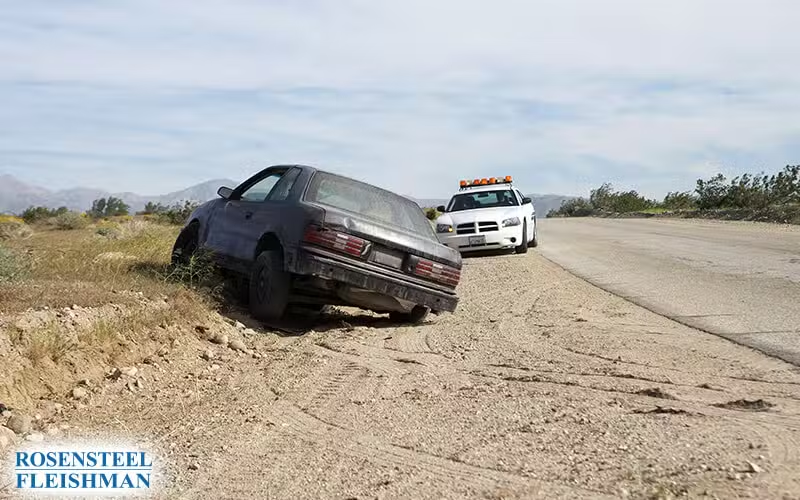

A crash during a police pursuit can involve several agencies, multiple vehicles, changing radio channels, supervisory decisions, and records created at different times. A useful review starts by identifying who initiated, monitored, joined, continued, limited, or ended the pursuit and which record documents each event.
A policy records how an agency expected pursuit decisions to be made; it does not prove which decisions occurred or decide civil responsibility.
Identify every agency and vehicle
- Initiating agency, primary unit, assisting unit, supervisor, communications center, investigating agency, fire or emergency response agency, and roadway owner
- Law-enforcement vehicle number, plate, VIN when available, officer or operator, dashboard-camera identifier, body-camera identifier, and mobile-data terminal
- Fleeing vehicle, uninvolved vehicle, pedestrian, property owner, tow operator, and emergency vehicle kept as separate roles
- Incident number, crash-report number, dispatch event number, pursuit-report number, internal-review number, and court case number recorded without assuming they describe the same file
Preserve the policy version in effect
The U.S. Department of Justice COPS Office and NHTSA published Vehicular Pursuits: A Guide for Law Enforcement Executives on Managing the Associated Risks in 2023. It provides policy and reporting recommendations for agencies to consider. It is not a substitute for the identified agency’s policy or North Carolina law.
- Policy title, policy number, effective date, revision date, superseded version, definitions, and distribution record
- Initiation criteria, prohibited or restricted circumstances, risk factors, supervisor role, intervention methods, termination criteria, medical response, reporting, and review provisions
- Training bulletin, acknowledgement, lesson plan, qualification record, vehicle or equipment instruction, and policy exception when relevant
- Actual policy text preserved rather than a press summary, later revision, or witness recollection of the rule
Build a decision-and-communication timeline
- Initial observation, attempted stop, activation of lights or siren, pursuit announcement, stated reason, vehicle description, direction, traffic, weather, and speed reports
- Supervisor acknowledgement, authorization, monitoring, restrictions, requests for resources, route changes, intervention decisions, termination order, and confirmation of termination
- Computer-aided dispatch entries, radio traffic, automatic vehicle location data, in-car system events, body-camera and dashboard-camera files, and 911 communications
- Collision, medical response, scene control, vehicle recovery, officer report, pursuit report, crash report, and later supervisory or administrative review tied to their own timestamps
Distinguish public information from restricted records
North Carolina General Statute 132-1.4 treats criminal-investigation and criminal-intelligence records differently from ordinary public records, while identifying categories of information that are public unless another law applies. Its current text also addresses 911 communications, broadcast agency communications, possible temporary withholding, and limited retention of certain recordings. The exact record and requested form matter.
G.S. 132-1.4A separately governs recordings made by or for law-enforcement agencies. It distinguishes disclosure for viewing or listening from release of a copy, sets request procedures and decision factors, and contains additional provisions for recordings depicting death or serious bodily injury. A body-camera or dashboard-camera request should therefore not be treated as an ordinary public-record request.
Read the after-action record cautiously
- Reviewer, review date, materials considered, policy provisions cited, factual findings, training recommendation, equipment issue, and corrective action recorded exactly
- Missing file, overwritten data, redaction, withheld section, privilege claim, retention schedule, or pending investigation documented rather than interpreted as proof of misconduct
- Agency policy compliance kept separate from traffic-law compliance, negligence, causation, immunity, admissibility, and damages
- Later disciplinary, criminal, administrative, or civil action treated as a separate proceeding with its own standard and record
The related guide to personal-injury claims involving North Carolina cities and police explains why identifying the defendant, capacity, governmental function, immunity issue, notice, insurance, and deadline can require analysis beyond the pursuit record itself.
Rosensteel Fleishman Car Accident & Injury Lawyers provides general record-organization information for people who may later consult a Charlotte car accident lawyer. Record access, retention, immunity, duty, policy effect, negligence, causation, defenses, and damages depend on current law and the complete facts.
Sources
Additional Car Accidents Articles
Left Turn Gap Judgment Errors When Visibility or Road Design Plays a Role
What happens when a driver begins a left turn and another vehicle suddenly changes lanes? The available opening can disappear almost instantly. In Charlotte traffic, this type of conflict may occur near multilane intersections where drivers must monitor oncoming vehicles, traffic signals, pedestrians, and vehicles moving between lanes at the same time. These crashes can […]
Multi Policy Insurance Considerations When One Policy Does Not Cover Every Loss
Insurance coverage after a serious car accident is not always limited to one policy. A collision may involve liability coverage, underinsured motorist coverage, medical payments coverage, an employer’s commercial policy, or another source of compensation. Identifying each applicable policy can affect how losses are documented, how negotiations develop, and whether a proposed resolution fairly reflects […]
What Happens When Vehicle Damage Appears Later Despite an Initial Inspection
Damage found days or weeks after a collision can complicate an insurance claim, especially when the cause of the crash or responsibility for the repairs remains disputed. A vehicle may look drivable during an initial roadside review in Charlotte, yet later show suspension problems, electrical faults, alignment issues, or damage hidden beneath exterior panels. When […]




