After a serious truck crash, checking for joint injuries early can reduce the risk of untreated damage becoming harder to manage. The force of a collision may injure cartilage, ligaments, tendons, bones, or the joint capsule even when swelling and pain seem manageable at first. In Charlotte, anyone experiencing stiffness, weakness, instability, or reduced movement […]
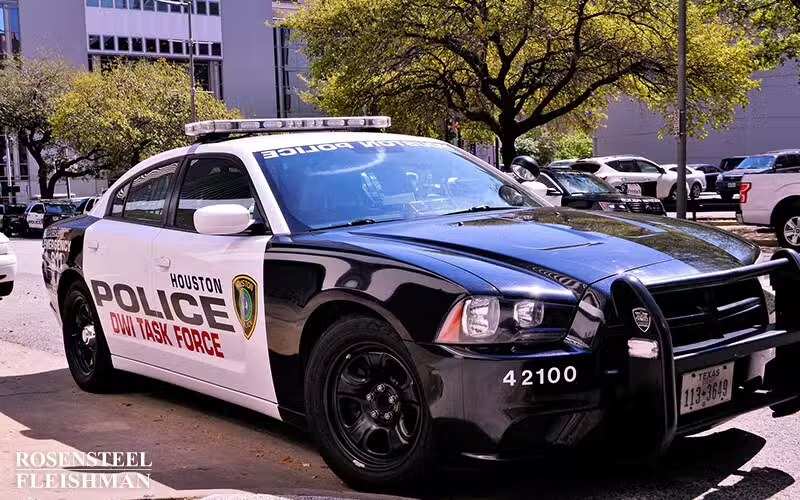

An injury involving a police officer, city vehicle, city property, State agency, or federal employee cannot be evaluated under one generic “Tort Claims Act.” The public entity, employee, capacity in which a person is sued, function, insurance, alleged conduct, and legal theory determine the forum, immunity rules and deadlines.
A claim against the State, a city, an officer individually, or the United States follows a different immunity and procedure analysis even when the same event is involved.
Identify every public and private actor
- State department or agency, county, city, police department, sheriff, public authority, federal agency, contractor or private employer
- The officer or employee’s actual employer, position, assignment, scope of work and whether the claim is official-capacity, individual-capacity or both
- Governmental or proprietary function, discretionary or ministerial act, vehicle ownership, mutual-aid role and insurance or risk-pool arrangement
- Negligence, gross negligence, intentional tort, state constitutional, federal constitutional, statutory or contract theory
City claims are not automatically State Tort Claims Act cases
G.S. 160A-485 allows a city to waive governmental immunity through liability insurance or qualifying risk-pool participation, but only to the extent described by the statute and applicable coverage. The policy, exclusions, limits, endorsements, reserve resolution and function involved must be examined. The existence of a city employee or police department does not by itself establish waiver.
State-agency negligence uses the Industrial Commission path
G.S. 143-291 gives the North Carolina Industrial Commission authority to hear qualifying negligence claims against State departments, institutions and agencies. It does not generally convert city or federal claims into Industrial Commission matters. G.S. 143-299 contains the filing periods for State Tort Claims Act injury and wrongful-death claims.
Individual officers present a separate immunity question
Public-official immunity can protect a North Carolina public official from individual liability for mere negligence in discretionary governmental duties, subject to fact-specific limits. The published Bartley v. City of High Point decision addresses allegations of malice in an individual-capacity claim involving an officer. It does not mean that alleging malice automatically defeats immunity; the factual and procedural record matters.
Federal paths must also be separated
The U.S. Department of Justice explains that Standard Form 95 and administrative presentation are used for qualifying Federal Tort Claims Act matters. A federal constitutional claim under 42 U.S.C. § 1983 is a different cause of action with different defendants, immunities, proof and remedies. Section 1983 addresses action under color of state law; it is not the vehicle for a negligence claim against the United States.
Preserve the event and immunity record early
- Dispatch, CAD, radio, 911, body-camera, dash-camera, surveillance, vehicle and event-data records
- Policies, training, pursuit or response classification, incident and use-of-force reports, diagrams, photographs and witness information
- Personnel identity, employer, assignment, mutual-aid agreement, contracts, vehicle ownership, insurance, risk-pool and indemnity records
- Medical records, causation evidence, damages, administrative notices, claim forms, delivery proof and every potentially applicable deadline
The related North Carolina emergency-vehicle claim guide focuses on warning signals, right-of-way, due regard, reckless disregard and collision evidence. This page remains the owner of defendant classification, immunity and forum.
Rosensteel Fleishman Car Accident & Injury Lawyers provides information about consulting a personal injury lawyer in Charlotte for a claim involving a North Carolina city or police officer when the correct defendant, notice, forum, immunity and evidence-preservation steps must be identified promptly.
Sources
Additional Personal Injury Articles
Highway Accident Overview for Crashes Outside Typical Traffic Patterns
Highway crashes do not always happen during predictable rush hour congestion or in the middle of heavy commuter traffic. In North Carolina, a collision may occur late at night, during an off-peak afternoon, or on a relatively open stretch of interstate where traffic conditions initially appear straightforward. Claims arising from these crashes can still become […]
When Second Opinion Considerations Dog Bite Cases May Matter During Ongoing Recovery
In Charlotte, the financial effects of a dog bite may extend beyond the bills generated immediately after the incident. Early records might reflect an emergency room visit, prescriptions, and basic follow-up care, while later records may include additional appointments, testing, therapy, scar evaluations, or other services selected by the injured person and their medical providers. […]
Home Exercises Bicycle Recovery Records Can Help Explain Progress After Disputed Injuries
Home exercise records can provide useful context when several people or organizations disagree about how an injured cyclist is recovering. A bicycle accident may involve the rider, a driver, insurance companies, medical providers, employers, and sometimes witnesses or additional parties. When each person has different information, small gaps in communication can make it harder to […]