A lasting disability affects more than a claim file. Learn how to connect the collision timeline with documented changes in work, household responsibilities, and expenses without treating assumptions as evidence.
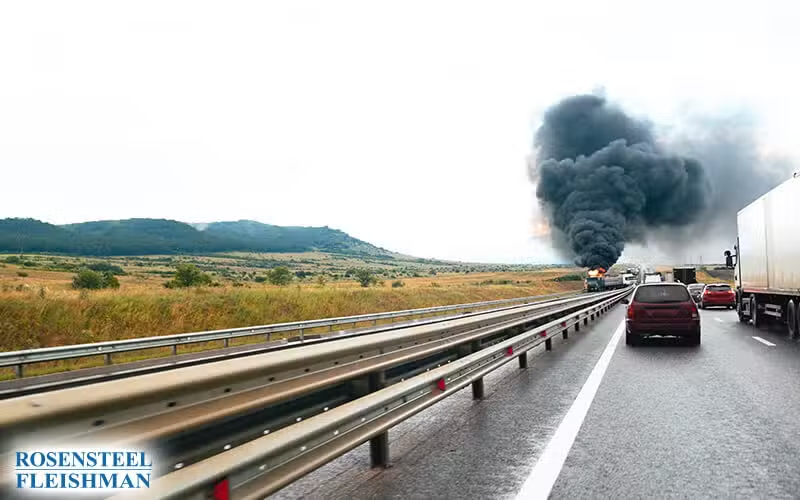

When a commercial truck stops on a traveled lane or highway shoulder, the warning investigation begins with the reason for the stop, its exact position, traffic direction, road geometry, lighting, visibility, and timeline. Hazard flashers, reflective triangles, fusees, liquid-burning flares, lamps, vehicle conspicuity material, and other warnings should be documented separately because each has a different function and evidentiary history.
A triangle or flare found after impact does not establish when, where, or by whom it was placed, whether it remained visible, or whether its position affected a driver’s opportunity to respond.
Reconstruct the stop before assessing warning placement
- Truck and trailer identity, dimensions, load, conspicuity material, lamp condition, hazard-flasher operation, and power state
- Reason for stop, first loss of speed, shoulder entry, final position, lane encroachment, disabled condition, traffic stop, loading, emergency, and restart attempt
- Roadway, lane, shoulder, median, curve, hillcrest, ramp, work zone, intersection, grade, surface, lighting, weather, traffic flow, and posted controls
- Driver, passenger, dispatcher, roadside service, law enforcement, tow, witness, 911, app, message, ELD, telematics, camera, and vehicle-data timestamps
- Warning-device type, quantity, manufacturer, markings, condition, storage location, placement point, orientation, visibility, recovery point, and custodian
Apply the stopped-vehicle rule to the actual location
49 C.F.R. § 392.22 addresses emergency signals for specified commercial motor vehicles stopped on the traveled portion or shoulder of a highway for a cause other than a necessary traffic stop. It distinguishes immediate hazard-flasher use from placement of warning devices and contains general and location-specific placement provisions and exceptions. Identify the road configuration, traffic direction, vehicle position, device type, light conditions, and timing before stating what the section required.
Use photographs and records already obtained lawfully. Do not return to a traveled lane or shoulder, move warning devices, or test damaged electrical or safety equipment to document a claim. Authorized investigators should handle scene measurements and equipment testing under an appropriate access and preservation protocol.
Preserve a scaled scene map rather than estimating placement from memory. Record the truck reference point, lane and shoulder edges, device positions, distances, curve or hillcrest, obstructions, sight line, background lighting, grade, impact point, debris, tire marks, and every location from which a driver or witness observed the stopped vehicle.
Confirm the equipment carried before the stop
49 C.F.R. § 393.95 addresses emergency equipment, including fire extinguishers, spare fuses in specified circumstances, and warning devices for stopped vehicles, with specifications and restrictions that can depend on the vehicle and cargo. Obtain inspection reports, equipment inventories, purchase and replacement records, driver reports, cab and storage photographs, and the physical devices.
49 C.F.R. § 392.7 states that a commercial vehicle may not be driven unless the driver is satisfied that listed equipment is in good working order, including emergency equipment. Determine what was checked, accessible, reported, replaced, or missing rather than inferring the pretrip result from a later scene.
Separate placement from visibility and response
- Preserve original photographs and video with metadata, exposure, time, camera position, zoom, flash, and any enhancement recorded
- Test flashers, lamps and reflective devices only under a documented protocol that accounts for impact damage, lost power, repairs, and changed orientation
- Identify whether devices were struck, dragged, displaced by air wake, moved by responders, picked up, replaced, or absent when the first image was made
- Reconstruct observer speed, lane, sight line, attention, contrast, glare, traffic, perception, braking, steering, and available escape path
- Keep rule applicability, equipment availability, placement, visibility, driver response, participant conduct, and collision causation as separate findings
The related truck lighting and conspicuity guide explains how vehicle lamps, wiring, reflective material, environmental visibility, and observation opportunity are examined independently from portable warning-device placement.
Rosensteel Fleishman Car Accident & Injury Lawyers provides information about truck-accident claims involving stopped-vehicle warning evidence. A missing or displaced device should not substitute for a complete event and response analysis.
Sources
Additional Trucking Accidents Articles
Reducing Reinjury Risk With Physical Therapy After a Truck Crash in Charlotte
Concerns about reinjury involve medical questions that claim records cannot answer. Learn how to organize physical therapy documentation, practical expenses, and scene evidence without drawing unsupported conclusions.
When Mobility Loss After a Charlotte, NC Truck Crash Has No Clear Diagnosis
An unclear diagnosis does not prevent a family from recording practical changes after a truck crash. Keep observations, added expenses, and unanswered claim questions separate.
How Insurers Review Worsening Pain After a Truck Crash
An early insurance review may start with an incomplete account. Dated records can help explain later changes in pain, work limitations, and expenses without treating symptoms as proof of an injury.