
Highway crashes do not always happen during predictable rush hour congestion or in the middle of heavy commuter traffic. In North Carolina, a collision may occur late at night, during an off-peak afternoon, or on a relatively open stretch of interstate where traffic conditions initially appear straightforward. Claims arising from these crashes can still become […]
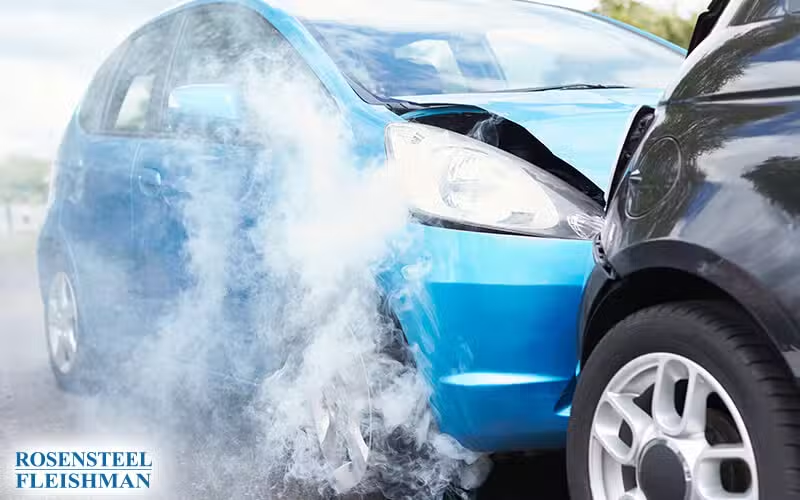

A sideswipe describes a contact pattern; it does not establish which vehicle moved first or whether either driver could safely change position. Two drivers can give different accounts of a lane change, merge, pass, drift, roadway obstruction, or contact after another event. The useful first step is to separate what can be checked from what is only assumed.
Prioritize safety, then document before repair
Emergency care and directions from responders come before collecting information. The North Carolina Department of Insurance’s After an Accident guidance addresses stopping in a safe place, moving the vehicle when needed, exchanging driver and insurance information, obtaining witness contacts, and contacting an insurer or agent. When it is safe to document later, record the available condition before repair, cleaning, part replacement, or vehicle transfer changes it.
- Photograph both vehicles from wide, medium, and close views, including the full length and height of contact, panels, doors, mirrors, wheels, tires, lights, trim, and visible paint or material transfer.
- Label the travel direction, lane markings, merge or exit area, shoulder, curb, traffic control, lighting, weather, traffic flow, and any obstruction or work zone.
- Keep the report number, witness information, available video source, towing or storage information, and the date and time each photograph, record, or communication was created or received.
- Separate a personal observation from another person’s statement, estimate, or conclusion. Preserve uncertainty rather than filling gaps with a reconstructed account.
The North Carolina lane and movement rules
On a roadway with clearly marked lanes, G.S. 20-146 says a vehicle must be driven as nearly as practicable entirely within a single lane and not moved until the driver has first determined the movement can be made safely. G.S. 20-154 separately addresses starting, stopping, or turning from a direct line, including safety and signaling requirements when another vehicle may be affected.
Those rules do not decide every collision from a diagram alone. G.S. 20-154 also says a violation of that section is not negligence per se. A fact-specific review may therefore compare lane geometry, the sequence of movements, mirrors and sight lines, signals, traffic conditions, physical contact marks, video, and witness accounts rather than treating a citation, signal, scrape direction, or point of contact as a complete answer.
Use the crash report as one record
The NCDMV DMV-349 Instructional Manual shows that a crash report uses distinct fields for units, drivers, movement, damage, narrative, diagram, and contributing circumstances. Those entries can help locate the records and statements at issue. Compare them with photographs, video, witnesses, vehicle condition, and any later supplement or correction; a report narrative or diagram is not a substitute for the underlying records.
Build a sideswipe contact map
- Mark where each vehicle was reported to be before contact and identify the source for that statement.
- Map the first known contact area, its height and length, and any visible mirror, wheel, tire, door, light, trim, paint, or material marks.
- Note what may have changed the vehicles’ positions, such as a merge, pass, roadway obstruction, brake, turn, or earlier impact.
- Identify what remains unknown or disputed and which record could clarify it.
A collision may raise questions about responsibility, injuries, and insurance, but no general article can determine those questions for a particular event. Information about a Charlotte car-accident claim is available when a fact-specific review is needed.
Sources
Additional Car Accidents Articles
Left Turn Gap Judgment Errors When Visibility or Road Design Plays a Role
What happens when a driver begins a left turn and another vehicle suddenly changes lanes? The available opening can disappear almost instantly. In Charlotte traffic, this type of conflict may occur near multilane intersections where drivers must monitor oncoming vehicles, traffic signals, pedestrians, and vehicles moving between lanes at the same time. These crashes can […]
Multi Policy Insurance Considerations When One Policy Does Not Cover Every Loss
Insurance coverage after a serious car accident is not always limited to one policy. A collision may involve liability coverage, underinsured motorist coverage, medical payments coverage, an employer’s commercial policy, or another source of compensation. Identifying each applicable policy can affect how losses are documented, how negotiations develop, and whether a proposed resolution fairly reflects […]
What Happens When Vehicle Damage Appears Later Despite an Initial Inspection
Damage found days or weeks after a collision can complicate an insurance claim, especially when the cause of the crash or responsibility for the repairs remains disputed. A vehicle may look drivable during an initial roadside review in Charlotte, yet later show suspension problems, electrical faults, alignment issues, or damage hidden beneath exterior panels. When […]



