
Highway crashes do not always happen during predictable rush hour congestion or in the middle of heavy commuter traffic. In North Carolina, a collision may occur late at night, during an off-peak afternoon, or on a relatively open stretch of interstate where traffic conditions initially appear straightforward. Claims arising from these crashes can still become […]
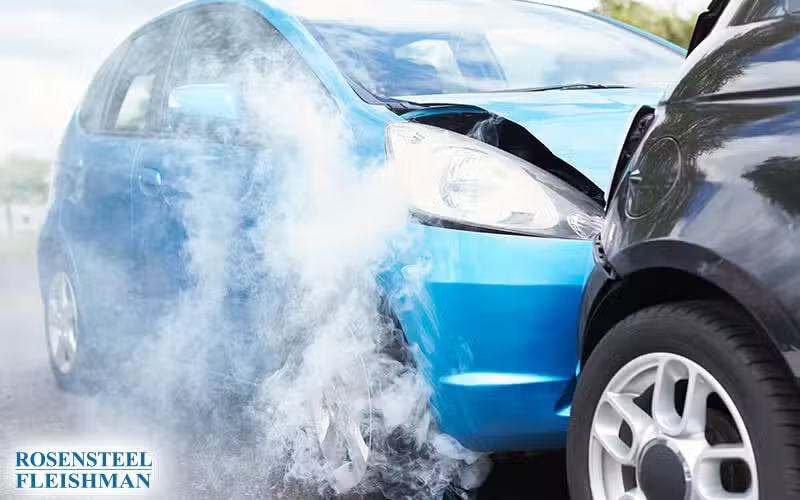

Higher speed can increase the energy involved in a collision and the distance traveled while a driver perceives and responds to a hazard. Those safety relationships do not establish why a particular collision occurred or determine responsibility for it.
Why speed changes the consequences of a crash
The Federal Highway Administration explains that crash severity increases with individual vehicle speed and that kinetic energy rises with the square of velocity. The relationship is real, but the outcome of a specific collision can also involve vehicle mass, direction, restraint use, intrusion, road users, and the nature of the impact.
NHTSA identifies longer stopping distance after a driver perceives danger and greater potential for loss of vehicle control among the consequences of speeding. It is more precise to say that higher speed increases the distance traveled during perception and response and leaves less time before reaching a fixed hazard; it does not change a person’s inherent reaction time.
How to read North Carolina speeding-related statistics
NCDOT’s 2024 Speeding Fact Sheet reports that speeding was a contributing factor in approximately 5.3% of reportable motor-vehicle crashes in North Carolina that year, with 378 people killed and 7,897 people injured in speed-related crashes. The fact sheet defines speeding as exceeding the authorized limit or a safe speed for the conditions and describes it as a contributing circumstance reported by law-enforcement officers.
- Treat the figures as a 2024 statewide snapshot, not a current count or prediction for every road or driver.
- Read “speeding-related” as a reported contributing-factor category, not proof that speed was the sole cause of any crash.
- Check the population: the fact sheet concerns reportable motor-vehicle crashes and speed-related fatality data, not every trip or all near misses.
- Keep statewide counts separate from a conclusion about the speed, fault, injury cause, or legal result in one collision.
A separate question after an individual crash
Public-safety statistics explain why speed management matters. They are different from the question of how a posted limit relates to the weather, visibility, surface, traffic, and other conditions on a road. The related guide to posted speed limits and safe speeds for North Carolina conditions addresses that separate roadway-rule question.
Information about a Charlotte car-accident claim is available when a collision requires a fact-specific review. A general safety article cannot determine responsibility, causation, coverage, or damages.
Sources
Additional Car Accidents Articles
Left Turn Gap Judgment Errors When Visibility or Road Design Plays a Role
What happens when a driver begins a left turn and another vehicle suddenly changes lanes? The available opening can disappear almost instantly. In Charlotte traffic, this type of conflict may occur near multilane intersections where drivers must monitor oncoming vehicles, traffic signals, pedestrians, and vehicles moving between lanes at the same time. These crashes can […]
Multi Policy Insurance Considerations When One Policy Does Not Cover Every Loss
Insurance coverage after a serious car accident is not always limited to one policy. A collision may involve liability coverage, underinsured motorist coverage, medical payments coverage, an employer’s commercial policy, or another source of compensation. Identifying each applicable policy can affect how losses are documented, how negotiations develop, and whether a proposed resolution fairly reflects […]
What Happens When Vehicle Damage Appears Later Despite an Initial Inspection
Damage found days or weeks after a collision can complicate an insurance claim, especially when the cause of the crash or responsibility for the repairs remains disputed. A vehicle may look drivable during an initial roadside review in Charlotte, yet later show suspension problems, electrical faults, alignment issues, or damage hidden beneath exterior panels. When […]




