
Work disruptions after a bicycle injury can involve more than missed paychecks. Separating employment support expenses, lost income, and future earning concerns helps make the financial picture clearer.
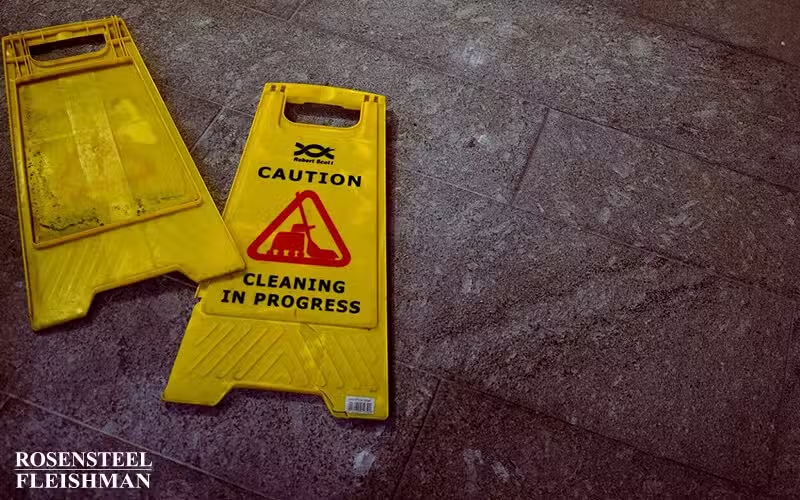

North Carolina’s 1998 decision in Nelson v. Freeland changed the common-law framework used for lawful visitors on property. Before Nelson, duties often turned on whether a visitor was classified as an invitee or licensee. The North Carolina Supreme Court replaced that distinction for lawful visitors with a reasonable-care standard while preserving a different framework for trespassers.
Nelson changed the duty categories for lawful visitors; it did not create automatic liability for every property injury.
What happened in Nelson v. Freeland
The published opinion in Nelson v. Freeland, reported in volume 349 of the North Carolina Reports, arose after the defendant asked the plaintiff to come to his home. The plaintiff alleged that he tripped over a stick while approaching the residence and was injured. The lower courts analyzed his status under the former licensee rules.
The Supreme Court concluded that the invitee-licensee distinction should no longer control duties to lawful visitors. It adopted a standard requiring reasonable care in the maintenance of premises for the protection of lawful visitors. The court did not erase every other element of negligence or decide that a land controller guarantees visitor safety.
Lawful entry is only the first question
- Who owned, occupied, operated, maintained, or controlled the exact area or condition?
- What physical condition or activity allegedly caused the event?
- Did the responsible person create the condition or have actual or constructive notice of it?
- What inspection, repair, warning, barrier, lighting, cleanup, or access measure was reasonable under the circumstances?
- Did the alleged failure cause the incident and the injury claimed, and what defenses are supported by the record?
A lawful visitor can be a social guest, customer, contractor, delivery person, tenant’s guest, or another person permitted to enter. The reason for the visit, expected route, property use, visitor characteristics known or reasonably foreseeable, and control of the area may affect what reasonable care required.
Notice and duration remain important
Nelson did not eliminate the need to connect the defendant with the condition. If a defendant did not create it, the inquiry may turn on actual or constructive notice. Video, inspection records, receipts, work orders, cleaning schedules, weather, employee locations, complaints, prior events, and witness timelines can show when a condition arose and what opportunity existed to respond.
A later photograph can document appearance but may not establish duration or the earlier lighting, traffic, weather, or obstruction. Record the condition and surroundings promptly, then preserve the evidence in its original form.
Visibility and visitor conduct are separate issues
Whether a condition was open and obvious, whether a warning was adequate, and whether the visitor used reasonable care require the actual viewpoint and circumstances. Contrast, lighting, route, familiarity, distraction created by the setting, obstructions, crowd movement, urgency, footwear, and the purpose of the visit may be relevant.
North Carolina contributory-negligence principles can make the visitor’s conduct significant. That issue should be evaluated alongside the owner or occupier’s conduct, not used as a substitute for investigating creation, notice, control, warnings, and reasonable precautions.
Trespassers remain a different category
North Carolina’s Trespasser Responsibility Act generally limits duties to trespassers and lists defined exceptions involving specified conduct and circumstances. Nelson did not merge trespassers into its lawful-visitor rule. Entry status, age, route, prior use, the possessor’s knowledge, and the type of condition can matter under Chapter 38B.
Control can matter more than title ownership
- Deeds, leases, management agreements, maintenance contracts, vendor scopes, and allocation of repair duties
- Keys, access control, staffing, inspection authority, repair authority, budgets, and actual day-to-day operation
- The exact boundary between tenant, landlord, common-area, contractor, and adjacent-property control
- Notices, requests, complaints, prior repairs, recurring conditions, and communications among responsible parties
- Insurance policies and contractual indemnity preserved separately from proof of negligence
Use the broader guide for the full premises framework
The related North Carolina premises-liability guide addresses lawful visitors, creation and notice, obvious conditions, trespassers, control, contributory negligence, and preservation across different property events. This page focuses on the Nelson v. Freeland change and what that decision did not decide.
Rosensteel Fleishman Car Accident & Injury Lawyers provides information about consulting a Charlotte premises-liability lawyer about duties to a lawful visitor. Control, notice, reasonable care, causation, defenses, deadlines, insurance, and damages depend on the particular property and evidence.
Sources
Additional Personal Injury Articles
Reassessing Road Risks Before Returning to Motorcycle Riding After a Crash in Charlotte
Reconsidering motorcycle travel after a crash means separating road concerns from assumptions about fault. Clear records can help connect everyday transportation decisions with unresolved claim questions.
Charlotte Distracted Driving Crashes and Their Effects on Work and Family
When a crash disrupts more work and family responsibilities than expected, dated records can help explain what changed. Keep observations about distraction separate from records of daily consequences.
How Experts Review Evidence Linking Medical Errors to Permanent Injuries
A lasting limitation does not, by itself, establish medical negligence. Evidence review separates questions about the care provided, the cause of the harm, and the support for describing an injury as permanent.




