
Highway crashes do not always happen during predictable rush hour congestion or in the middle of heavy commuter traffic. In North Carolina, a collision may occur late at night, during an off-peak afternoon, or on a relatively open stretch of interstate where traffic conditions initially appear straightforward. Claims arising from these crashes can still become […]
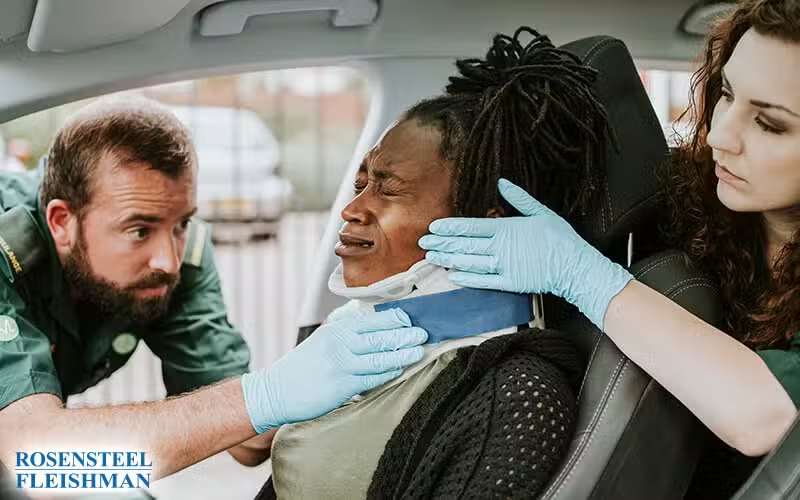

Reporting a collision is not one task. A driver may have duties at the scene, an obligation to notify law enforcement, a need to obtain the investigating agency’s report, and separate notice requirements under an insurance policy. Keeping those tracks separate helps prevent an assumption that one telephone call completed everything.
A Charlotte crash-reporting file should answer four different questions: whether immediate law-enforcement notice was required, which scene duties applied, where the official report can be requested, and which separate insurer notices remain due.
Determine whether the crash is reportable
G.S. 20-4.01 defines a reportable crash to include a motor-vehicle crash resulting in death or injury, total property damage of at least $1,000, or property damage of any amount to a vehicle seized under the cited statute. At the scene, the full injury and repair picture may be unknown. Do not use a quick visual estimate as the only reason to avoid contacting the appropriate agency.
Handle safety and scene duties first
G.S. 20-166 addresses stopping, remaining at a reportable crash, assistance, information exchange, unattended property, and circumstances involving significant injury risk. Call for emergency help, follow lawful instructions, and do not let evidence collection create another danger.
- Record the exact location, time, direction of travel, vehicles, drivers, owners, passengers, witnesses, plates, licenses, and insurance information.
- Preserve wide scene views, traffic controls, lanes, sight lines, debris, marks, vehicle positions, damage surfaces, and original photo or video files.
- Write down the responding agency, officer or investigator, event or report number, tow destination, and any instruction about moving or leaving.
- Seek appropriate medical evaluation and record symptom onset without guessing about diagnosis or cause.
Notify the proper law-enforcement agency
G.S. 20-166.1 requires the driver involved in a reportable crash to notify the appropriate law-enforcement agency immediately by the quickest means of communication. Inside a city or town, the statute identifies the city or town police department. The statute also addresses unattended vehicles, the officer’s investigation and report, and the information included in reportable-crash data.
Treat a parked-vehicle collision separately
A collision with a parked or unattended vehicle carries information and timing requirements even when the event is not otherwise reportable. Record what was damaged, the steps taken to locate the owner, the notice left or delivered, any law-enforcement contact, mailing proof when applicable, and photographs showing the notice and vehicle.
Request the report from the correct source
The N.C. Division of Motor Vehicles crash-report page explains current request methods, privacy limits, redacted and unredacted access, forms, identification, and processing. A report is an important index to the event, but compare names, vehicles, diagram, narrative, insurance information, and supplements with photographs, witnesses, video, measurements, and later records.
Separate the police report from the insurance claim
The North Carolina Department of Insurance accident checklist advises contacting the insurer or agent and identifies information commonly needed for a claim. Record each policy notice, claim number, adjuster, request, document supplied, response, and coverage position. A police report does not replace contractual notice, and an insurer’s fault position is not the same as a court determination.
Review the file for accuracy and missing evidence
Create a one-page discrepancy list rather than writing on the only copy of a report. Identify misspelled names, wrong vehicles, omitted witnesses, diagram issues, missing supplements, uncertain statements, and evidence obtained later. Ask the appropriate source about a correction or supplemental process; do not alter an official record yourself.
Use a complete first-days checklist
The related North Carolina first-steps guide connects reporting with safety, identity, scene evidence, vehicle preservation, medical chronology, insurer notice, privacy, and a follow-up audit.
Rosensteel Fleishman Car Accident & Injury Lawyers provides information about reporting and documenting Charlotte car accidents.
Sources
Additional Car Accidents Articles
Left Turn Gap Judgment Errors When Visibility or Road Design Plays a Role
What happens when a driver begins a left turn and another vehicle suddenly changes lanes? The available opening can disappear almost instantly. In Charlotte traffic, this type of conflict may occur near multilane intersections where drivers must monitor oncoming vehicles, traffic signals, pedestrians, and vehicles moving between lanes at the same time. These crashes can […]
Multi Policy Insurance Considerations When One Policy Does Not Cover Every Loss
Insurance coverage after a serious car accident is not always limited to one policy. A collision may involve liability coverage, underinsured motorist coverage, medical payments coverage, an employer’s commercial policy, or another source of compensation. Identifying each applicable policy can affect how losses are documented, how negotiations develop, and whether a proposed resolution fairly reflects […]
What Happens When Vehicle Damage Appears Later Despite an Initial Inspection
Damage found days or weeks after a collision can complicate an insurance claim, especially when the cause of the crash or responsibility for the repairs remains disputed. A vehicle may look drivable during an initial roadside review in Charlotte, yet later show suspension problems, electrical faults, alignment issues, or damage hidden beneath exterior panels. When […]


