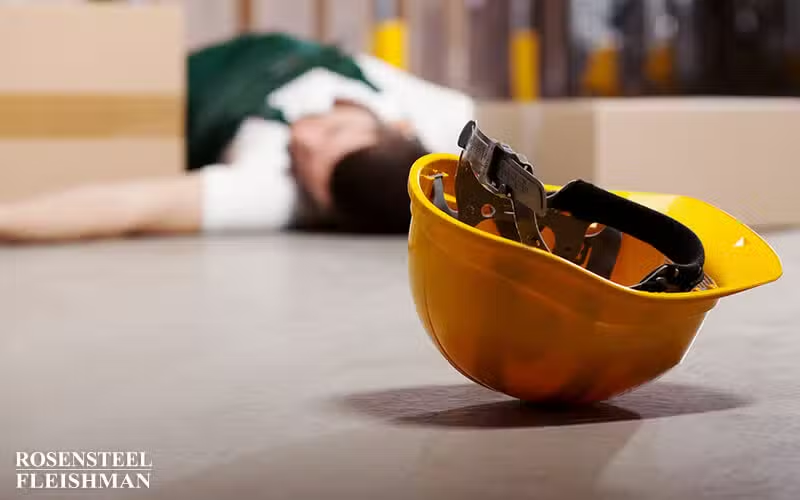
Losing a loved one in a workplace accident is one of the most difficult experiences a family can face. In addition to the emotional shock and grief, there are immediate practical concerns that demand attention. Questions about income replacement, funeral expenses, and long term financial stability often surface within days. During this time, it is […]

It is impossible to guarantee anyone’s safety at work. Workplace accidents happen all the time. Some accidents result in only minor injuries and very little time missed from work. Some are more serious and a substantial amount of time is missed from work. In the worst of cases, someone is killed as a result of a workplace accident. In all of these cases, the injured worker (or the beneficiary of the deceased worker) could be eligible for workers’ compensation.
Workers’ compensation is insurance that the majority of North Carolina employers with 3 or more employees must have. There are some employers that do not have to have workers compensation including, but not limited to, federal government employees working in North Carolina, certain domestic workers and certain railroad employees.
Workers’ compensation insurance is intended to cover the costs of workplace accidents. Typically, workers’ compensation covers medical bills (doctors visits, hospital visits, prescriptions, surgery, rehabilitation) and lost wages. Assuming an employee is eligible to receive workers' compensation, lost wages are payable only under certain circumstances. For example, if an employee suffers a minor injury and will return to work in less than 7 days, no lost wages will be paid. If an employee will be out of work for more than 7 days, lost wages will be paid starting on the 8th day.
All jobs have risks of injury. An employee who spends their day doing data input might be at risk for carpal tunnel syndrome. Certain jobs however are inherently more dangerous than others. In those jobs, the risk of severe injury or death is higher. For example, an electrician who works with electricity daily, or a construction worker working on a building 30 stories in the air, is at greater risk of suffering a severe or deadly workplace accident. To mitigate these dangers, construction site safety regulations are crucial in ensuring that workers are protected from potential hazards. These regulations encompass proper training, protective gear, and safety protocols that must be followed at all times. By adhering to these guidelines, employers can significantly reduce the likelihood of accidents and create a safer work environment for all personnel involved.
In 2019 (the most recent national data available) the U.S. Department of Labor’s Bureau of Labor Statistics (BLS) reported that there were 2.8 million non-fatal workplace injuries or illnesses in the US, and 5,333 fatal workplace injuries. This equates to 2.8 injuries per 100 full time workers and 3.5 deaths per 100,000 full-time workers. It also equates to 1 worker dying every 99 minutes due to a workplace injury. While the number of injuries and illnesses has essentially remained the same for the past 3 years, the number of deaths in 2019 represents a 2% increase from 2018.
BLS reported that of the 2.8 million non-fatal workplace illness and injuries reported for 2019, 69,000 of them occurred in North Carolina. Of the 5,333 fatal workplace injuries in 2019, 186 occurred in North Carolina. These statistics mirror the trends at the national level. At both levels, non-fatal injury statistics have remained relatively stable while fatal injury numbers have increased.
Some of the most dangerous jobs, those which can lead the filing of workers’ compensation claims are: worker safety risks in the cotton industry pose significant threats to laborers, often leading to severe health complications and injuries. Many workers face exposure to hazardous chemicals and demanding physical conditions that can result in chronic ailments. Addressing these risks is crucial for improving working conditions and ensuring the well-being of those employed in cotton production.
Construction Jobs
Not surprisingly this tops the list of most dangerous jobs. The very nature of construction jobs, physical labor (sometimes extreme and under bad weather conditions), along with the tools needed to complete the job (including power tools and all types of heavy machinery) make construction jobs inherently dangerous. Construction workers are also at an increased risk of falls because oftentimes they are working at great heights, and may be using ladders or scaffolding. Even seemingly less dangerous jobs, like the flagger standing on the side of the road and not operating any machinery, is at an increased risk of severe injury because they could be hit by a car or truck not paying attention or exceeding the speed limit.
Transportation Jobs
Truck drivers spend large chunks of time on the road, therefore increasing their risk of being injured or killed in a car accident. From the size of the tractor trailer to road conditions to other drivers, truck driving is one of the more hazardous occupations. Injuries sustained in accidents are not the only injury truck drivers are at an increased risk for. They often suffer from injuries like back trouble from sitting for extended periods of time and from loading and unloading the truck.
One staggering statistic from the Occupational Safety and Health Administration (OSHA) relates to taxi drivers; and it does not refer to the risk of getting into a car accident. OSHA estimates that the chance of a taxi driver being murdered is 20 times higher than any other job in the country.
Piloting, including commercial and private airplanes, military aircraft and helicopters, is one of the most dangerous transportation jobs. While flying is generally considered safer than driving, aircraft accidents most often result in the death of the pilot. While large commercial airplane crashes are uncommon, smaller, private aircraft accidents are on the rise.
FIshing Jobs
Fishing jobs often entail long hours in unpredictable weather conditions. Risks involved with fishing include: machinery accidents, slips and falls, boating accidents, and falling overboard.
Logging
Logging involves working with large, heavy machinery and cutting down very large trees. Often loggers work in remote areas where there is limited cell phone service, which makes it difficult for emergency personnel to get to them timely if there is an accident.
Law Enforcement and Emergency Services Personnel
Police officers, corrections officers, security guards, firefighters, and EMT’s risk their safety daily. They may be faced with life threatening situations, over which they have no control, multiple times a day.
Police officers, in particular, are tasked with enforcing laws and often are called upon to intervene in highly-charged situations. They have no way of knowing how the people they are interacting with will react, or whether there is a weapon or drugs involved.
Firefighters are tasked with running into burning buildings. In addition to the risk of being burned, buildings that are unstable due the fire could collapse. Chemicals could explode.
If you are injured on the job, or a loved one is killed on the job, it is important that you discuss your claims with an experienced Charlotte, North Carolina workers’ compensation attorney. Understanding the workers compensation benefits in Charlotte can be complex, but having knowledgeable legal support can make a significant difference in the outcome of your claim. An attorney can guide you through the nuances of applying for these benefits and help ensure you receive the compensation you deserve. It's crucial to act promptly, as there are deadlines for filing claims and appealing decisions that you should not overlook.
Call Our Charlotte, North Carolina Workers’ Compensation Attorneys
The Charlotte, NC lawyers at Rosensteel Fleishman Car Accident & Injury Lawyers are experienced workers’ compensation lawyers.They are available to discuss your workers’ compensation injury or the loss of your loved one due to a fatal workplace injury and to help you navigate the legal process during a difficult time. Please contact our office at 704-714-1450. There is no fee for an initial consultation.
Additional Workers Compensation Articles
Eye injuries at work can change daily life in ways people do not expect. Vision affects how you drive, read, work, and even move through your own home. When an accident on the job leads to blurred sight, light sensitivity, or partial vision loss, the physical impact is only part of the concern. Medical appointments, […]
An eye injury at work can shift your focus instantly from routine tasks to medical uncertainty. Whether caused by flying debris, chemical exposure, or blunt force trauma, damage to the eye often brings more than physical discomfort. Workers frequently worry about vision changes, medical expenses, time away from work, and how their income may be […]
A workplace head injury can disrupt every part of daily life. What may begin as a sudden blow to the head on a construction site, in a warehouse, or even inside an office can quickly develop into persistent headaches, memory lapses, dizziness, and difficulty concentrating. Many injured workers in Charlotte find themselves unsure about what […]