
A denied car accident claim should be reviewed from the denial letter outward. The useful question is not whether the claimant disagrees, but which stated responsibility, coverage, medical, expense, notice, or documentation issue remains unresolved and what reliable record may answer it. A reconsideration packet should connect the exact denial reason to the new or […]
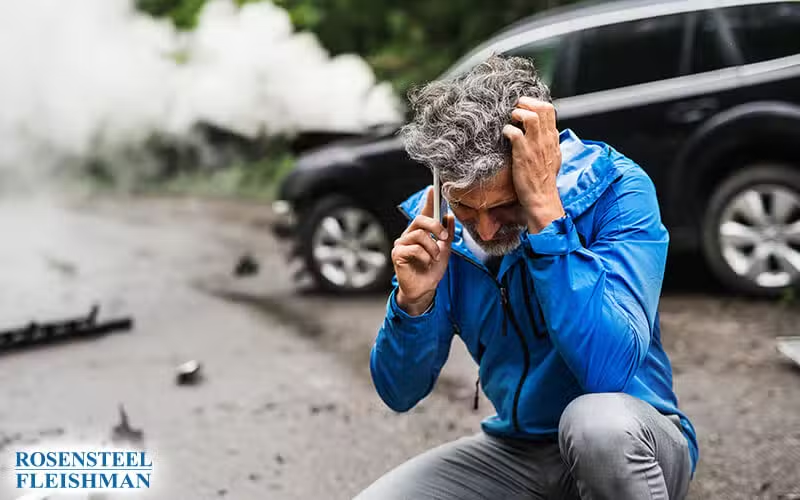

A pileup can involve an initiating collision, secondary impacts, evasive maneuvers, road blockage, and injuries that do not arise from the same contact. Assigning one percentage to the event before building the sequence can hide separate duties and causes.
Multi-vehicle liability should be reconstructed as a sequence of vehicle-specific acts and impacts, with a separate proof map for each driver, each collision, each claimed injury, and each responding policy.
Create a vehicle and person index
Record each driver, owner, passenger, employer, carrier, vehicle, plate, policy, tow destination, damage surfaces, final position, and witness. Use consistent identifiers across the diagram, chronology, photographs, medical record, and insurance matrix.
Build the impact sequence
- Vehicle movement, lane, direction, speed evidence, spacing, steering, braking, and perception opportunity
- First contact, later contacts, rotations, push events, debris, marks, intrusion, and final position
- Traffic controls, congestion, construction, weather, surface, lighting, grade, curve, and sight distance
- Occupant seat, posture, restraints, felt impacts, body movement, immediate symptoms, and emergency response
Apply duties to each movement
G.S. 20-152 addresses reasonable and prudent following distance. G.S. 20-154 addresses starting, stopping, turning from a direct line, backing, safety, and signaling. Other duties may apply depending on speed, lane, right-of-way, impairment, equipment, and roadway facts.
Test concurrent causes
A sudden stop may be followed by unsafe following; a lane change may combine with excess speed; a disabled vehicle may combine with inadequate warning; an initial impact may place another vehicle in a driver’s path. For each act, identify the duty, evidence, timing, avoidability, causal role, and supported contrary account.
Preserve independent evidence
Obtain original photographs and video, witness accounts, 911 and dispatch, body-camera, traffic and business video, vehicle inspections, event data, telematics, fleet records, phone or app evidence when justified, road and signal records, weather, tow, repair, and storage materials. Document source, metadata, custody, alteration, and missing intervals.
Use reports as an index, not the entire proof
The N.C. Division of Motor Vehicles explains report requests. Compare the report and diagram with supplements, statements, images, measurements, citations, and later evidence. NHTSA’s crash-investigation system illustrates the value of combining vehicle, scene, occupant, and medical evidence.
Map injury causation by person and impact
For each claimant, connect seat and movement, contact, immediate response, symptom onset, examinations, diagnoses, treatment, baseline, restrictions, recovery, and later events. Do not assume the first or largest visible vehicle impact caused every claimed condition.
Build the policy matrix
List liability, employer or commercial, UM/UIM, medical-payments, collision, umbrella, rideshare, and household coverage for each relevant person and vehicle. Record notices, reservations, coverage positions, limits, payments, and releases.
Study the rear-impact sequence
The related rear-end collision guide explains following distance, lead-vehicle conduct, chain impacts, physical evidence, reports, and medical chronology.
Rosensteel Fleishman Car Accident & Injury Lawyers provides information about multi-vehicle accident claims in Charlotte.
Sources
Additional Car Accidents Articles
What to Know About Out of Court Accident Settlements
Accident recovery often reaches beyond the person who was hurt, especially when family members or caregivers begin helping with medical visits, transportation, household tasks, and day-to-day decision making. When a claim is resolved through settlement discussions instead of a trial, those family responsibilities can still shape what documentation matters, how losses are understood, and what […]
Injury Assessment Basics After a Crash in Charlotte, NC
Could a person seem mostly fine after a collision and still need extra help days later? Yes, and that is why family members and caregivers often play such an important role after a car accident. Pain, confusion, limited movement, sleep changes, and emotional stress may not appear all at once, so early observations can make […]
How Claim Documentation Supports a Car Accident Case
Why can the first few documents in an insurance claim matter so much after a crash? Because those early records often shape how the insurance company views fault, injuries, vehicle damage, treatment needs, and the value of the claim. In Charlotte, a collision on a busy road like I-77, Independence Boulevard, or South Boulevard can […]



