
As Charlotte continues to grow, more families are seeing teen drivers navigate busier roads, new neighborhoods, school traffic, and changing commute patterns. When a crash happens, the details surrounding what occurred can matter just as much as the damage itself, especially when questions involve a younger driver, incomplete information, and the steps needed to move […]
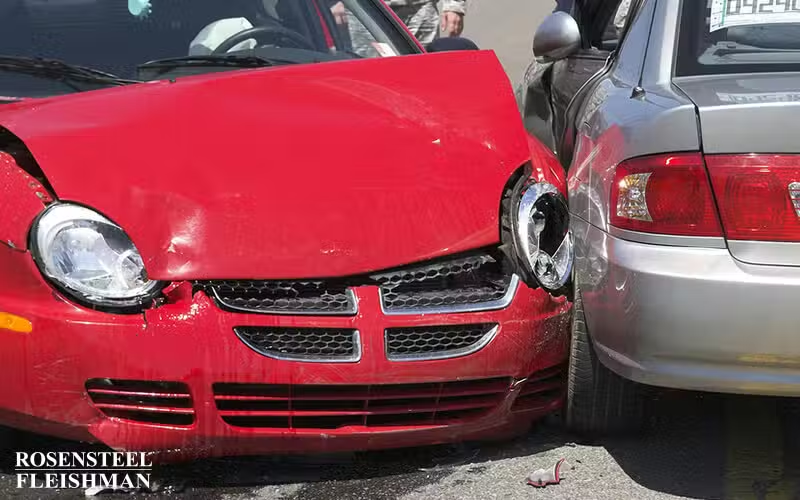

Typically, car accidents result in filing a claim under one or more auto insurance policies. Sometimes, the policy coverage of the person at fault in the accident does not cover all of the damages. In this case, you might be able to collect additionally under your own underinsured motorist coverage. This was the scenario in an opinion issued by the North Carolina Court of Appeals last year, North Carolina Farm Bureau Mutual Ins. Co. v. Paschal. However, an issue arose in that case when determining whether the injured person was covered as a “family member” under the applicable policy.
In that case, 16-year-old Harley Jessup was injured while riding as a passenger in a truck driven by her cousin. The truck ran off the road and Harley was ejected from the truck, sustaining injuries. Harley filed a complaint alleging damages just over $80,000. As a result, her cousin’s insurance policy paid out $30,000 that it covered. For the remainder of the damages, Harley looked to recover under her grandfather’s uninsured motorist coverage, which was issued by the plaintiff.
The plaintiff argued that Harley was not a “family member” of her grandfather, as that term was defined in the insurance policy, and therefore was not covered under the policy. The trial court agreed and granted the plaintiff’s motion for summary judgment. The defendants appealed to the court of appeals.
The court of appeals began its analysis by looking at the language of the insurance policy. The policy covered the “Insured” which was defined as “You [the named insured] or any family member.” Therefore, “the dispositive issue [was] whether the policy issued by Plaintiff covers Harley as a ‘family member’ as that term is defined in the policy.” The policy further defined the term “family member” as follows:
"Family member" means a person related to [the named insured] by blood, marriage or adoption who is a resident of [the named insured’s] household. This includes a ward or foster child.
Because it was not argued whether Harley was related to her grandfather, the question then became whether Harley was a “resident” of her grandfather’s “household.” The policy did not defined either of the terms “resident” or “household.”
The court noted that when insurance companies uses a somewhat ambiguous term to determine who is covered by its policy, it is not the court’s role to limit coverage. Instead, “[a]ll who may, by any reasonable construction of the word, be included within the coverage afforded by the policy should be given its protection.”
The court then examined prior caselaw that looked to define the terms “resident” and “household” and noted that the intent of the policyholder was important. It quoted the following passage from an earlier case:
As observed by our courts, the words “resident,” “residence” and “residing” have no precise, technical and fixed meaning applicable to all cases. “Residence” has many shades of meaning, from mere temporary presence to the most permanent abode. It is difficult to give an exact or even satisfactory definition of the term “resident,” as the term is flexible, elastic, slippery and somewhat ambiguous. Definitions of “residence” include “a place of abode for more than a temporary period of time” and “a permanent and established home” and the definitions range between these two extremes. This being the case, our courts have held that such terms should be given the broadest construction and that all who may be included, by any reasonable construction of such terms, within the coverage of an insurance policy using such terms, should be given its protection.
Our courts have also found . . . that in determining whether a person in a particular case is a resident of a particular household, the intent of that person is material to the question.
In addition, the fact that Harley did not live exclusively with her grandfather was not dispositive because prior caselaw had determined that “[a] minor may be a resident of more than one household for the purposes of insurance coverage.” This reasoning was applicable in a prior case where a minor’s parents lived in separate residences. The evidence in that case supported a finding that “there existed between the father and the minor plaintiff a continuing and substantially integrated family relationship.” Therefore, “the minor plaintiff was as much a resident of her insured father's household as that of her mother.”
The court contrasted that case with another case where it was questionable as to whether a defendant was a resident of his parents’ household. In that case, the defendant was an emancipated person and had enlisted in the Navy. He took all of his belongings with him but referred to his parents’ house as “home” and returned for periodic visits. After leaving the Navy, he lived with his parents for several weeks while looking for a place to live. However, when he enlisted in the Navy, he did not intend to return to live with his parents, and at the time of the collision, neither the defendant nor his parents considered him a resident of the parents’ household. The court in this case determined that there was a material issue of fact as to whether the defendant was a resident of his parents’ household.
In Harley’s case, the evidence showed that Harley lived with her grandfather for periods when her father was in jail. When her father was not in jail, Harley lived with her father in a house owned by her grandfather, located on land connected to her grandfather’s house by contiguous land also owned by her grandfather, and for which her grandfather did not charge any rent. Even when the grandfather was not living with Harley, he saw her almost every day and was a regular participant in her life. In fact, the court described as him “the most constant caregiver in Harley’s life.” The court also distinguished the Navy son case because both Harley and her grandfather considered Harley to be a part of the grandfather’s household. Therefore, the court concluded that Harley was a resident of the grandfather’s household for purposes of the insurance policy and was an “insured” under the policy.
If you have been injured in a car accident, contact an attorney at Rosensteel Fleishman Car Accident & Injury Lawyers (704) 714-1450, to discuss your options.
Additional Car Accidents Articles
Elderly Driver Accident Factors That May Affect a Claim
In Charlotte, a crash involving an older driver can raise sensitive questions about what happened, why it happened, and whether age had any role in the collision. These questions do not automatically decide fault. Liability still depends on evidence, traffic rules, witness statements, police reports, vehicle damage, and the conduct of every driver involved. As […]
Vehicle Recall Issues in Accidents and Their Impact on Fault
How much does a recall matter when a crash happens and everyone is trying to figure out who is responsible? The answer often depends on what the recall involved, whether the vehicle owner knew about it, whether repairs were completed, and whether the defect actually contributed to the collision. Vehicle recall issues in accidents can […]
How Soft Tissue Injuries Are Evaluated After a Crash
Soft tissue injuries can be difficult to sort out after a car crash because they often depend on consistent details, careful medical evaluation, and a clear timeline of symptoms. A person may feel sore right away, feel worse the next morning, or notice pain days later, which can make the claim process more complicated when […]