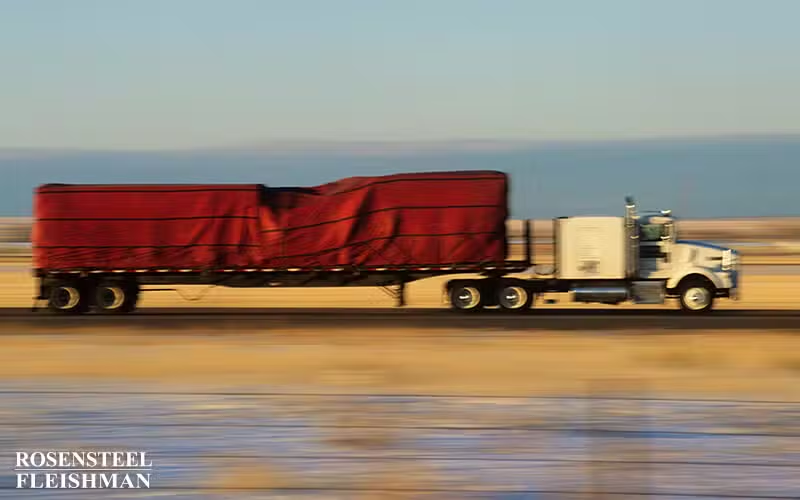
In Charlotte, a truck collision can create questions that take time to answer, especially when the crash involves shifting cargo, overloaded trailers, or improperly secured freight. When someone develops dizziness, poor coordination, or trouble walking afterward, the timing of medical care, evidence collection, and claim review can play a major role in how the case […]

I. Trucks and Truckers
Truckers are among the most borrowed, freelanced, contracted, and shared employees in the world. That’s because truckers tend to be fairly flexible and (often) are experts in their field. They’re in demand, and often it’s demand on short notice. It’s a very common practice in shipping cargoes for several companies, and even several drivers, to be somewhat jointly responsible. This presents a special challenge when dealing with negligence cases; at times these cases can have long-lasting (even explosive) and results. Few people realize just how literally explosive trucking company accidents are, virtually every day.
The driver of the tractor/trailer in this case was John W. P. It was proven by the Charlotte trial attorney that John had left the tractor unit unwatched. As gasoline was being pumped out of the tank trailer, it was proven that he could’ve prevented the explosion and fire by carefully watching the operation. Instead, an out-of-ground storage tank used an apparently defective portable pump, that could not handle the flow. The significant explosion. Injuries, and damage that occurred, however, was not so simple to clean up. Owing to the variety of companies involved (also operating across various state lines), it took the expertise of a Charlotte trial attorney to help explain how to ascertain responsibility and liability.
II. The Blaming Game
Finger-pointing can be legendary in pre-trial discovery: especially, when you have more than one defendant. In a negligence case of this size, an experienced Charlotte trial attorney will dig through the debris on your behalf. Instead of finger-pointing, getting a hand from an experienced Charlotte trial attorney is often the first help in measuring real accountability of these defendants.
Let’s take a look, in this case, of how an experienced trial attorney helped explain to the court how best to portion blame between these on again, off again (sometimes) friendly competitors. There were two major petroleum transporting companies involved in this case. There was Maybelle (John’s actual employer), a North Carolina petrol transport company, and also O’Boyle, a transporter from Virginia. The idea was apparently for Maybelle to get 90% of the total profits. “Apparently,” because the trial attorney here dug under that cover to get at the real agreement.
III. Behind the Scenes: Cost Sharing and the ‘Hole’ Story
A Charlotte trial attorney smartly zeroes in on hidden costs, shared between defendants, in this kind of trucking accident case. Even though the 90/10 split referred to above was important, there were other places where money was being spent 90/10… a kind of legal sinkhole of expenses that evened out the risks and costs between these two companies.
The Charlotte trial attorney soon discovered that the partnership, or more accurately loose written agreement, between Maybelle and O’Boyle was partly a paper necessity. This was because of the North Carolina company (Maybelle) was not approved by the Interstate Commerce Commission for the transport of petrol products across state lines. Even more complicated, they did have permission to haul other products across state lines. But this is where the connection with O’Boyle Oil was forged. O’Boyle was authorized by the ICC to carry petroleum products across state lines.
IV. Joint and several liability: In Good times and Bad.
In this case, on the face of it, the companies agreed that they ‘shared’ liability for the injuries and the damages to the bystanders of the explosion. The issue was how to divide up that ‘joint’ liability.
Maybelle, even though it couldn’t transport goods out of state, often managed to get shipments of goods it acquired, to various parts of the country. This was because of the relationship with an oil company in Mississippi, which also operated in oil company in Virginia; the Virginia location actually had supermarket and fuel pumps to accept shipments. Maybelle had the idea to transport petroleum it acquired from Mississippi, by leasing its own vehicles to O’Boyle, allowing O’Boyle used its license, to distribute the Mississippi oil to the contractor in Virginia.
The result of this complicated dance was that Maybelle claimed to keep 90% of the total revenue, and O’Boyle would receive 10% for letting Maybelle use the franchise license to operate out of North Carolina. The Charlotte trial attorney also discovered an interesting arrangement regarding who and how insurance was to be paid between the two companies. Subsequent discovery showed that there were competing lease agreement terms about who was in charge, and who was responsible for any accidents.
Ironically, Charlotte trial attorney pointed out that “neither of the leases contain provisions” regarding liability. Put in legal terms, it meant the parties had not reached an agreement (or had a legally binding meeting of the minds) in cases such as this explosion. The only discussion about paying damages discovered by the Charlotte trial attorney was that the parties had agreed how to divide up revenues, not risks.
Conclusions:
The public’s attention on the risks of trucking accident explosions refocuses every few years. Usually, because of some particularly cataclysmic event. There was the truck explosion on I -287 a few years ago. At that time, the New York Times reported that the trucking company involved had a “history” of violations of various trucking regulations. While accident facts often change only in location, two of the most common violations are often: failure to inspect cargo tanks, or failing to keep required safety records. Many times, these trucks are taken off the road because of various violations, and the data is hard to get. The history and control of these potentially dangerous or even lethal truck accidents is a good argument for making sure you get great representation by a Charlotte trial attorney. It takes experience to know what records are most important, and sometimes, how to obtain this information from the companies or state/federal enforcement agencies.
In this case, the court ended up by lecturing both trucking companies. “It is an unusual business practice for two companies to enter into an agreement without establishing the terms of liabilities, and that is what obviously happened in this case.” A Charlotte trial attorney can demonstrate parties are not free to escape liabilities implied in an agreement like this, simply by “claiming ignorance of its contents.” This argument was convincing to the court, and is a recipe for why a person needs expert help and any trucking-related accident.
If you, your business or business associate or sublessor—have questions involving insurance claims, your legal rights with obtaining records of trucking-related accident reports or past fines, please contact us. You will speak with an expert Charlotte trial/ trucking accident attorney, who can best answer your questions about how your injuries or rights to damages or recovery may be best addressed. There is never a fee for this initial consultation.
Additional Car Accidents Personal Injury Articles
Energy Levels During Recovery Bicycle Injuries and What They Can Mean for Normal Activities
Charlotte has many areas where bicycle traffic, pedestrian activity, and vehicle congestion overlap, especially near greenways, Uptown streets, campus areas, and neighborhood corridors. After a bicycle accident, a person may expect pain or visible injuries to be the main concern, but changes in energy can also affect how quickly daily routines feel manageable again. Low […]
When to Consult a Workers Compensation Attorney After Unclear Injury Symptoms
Can a work injury still matter if the symptoms are vague, delayed, or hard to explain? Yes, because many workplace injuries do not feel obvious right away, especially when discomfort shows up through poor sleep, stiffness, headaches, nerve sensations, or general body tension that builds over time. For many workers in Charlotte, NC, the first […]
Scar Revision Options Dog Bite Injuries After Healing Changes
What happens when a dog bite heals but leaves a scar that still affects the person months later? For many injury claims in Charlotte, NC, the visible wound is only part of the story. Insurers often look closely at photographs, medical records, treatment timelines, and provider opinions to decide how much weight they give to […]



