
Insurance coverage after a serious car accident is not always limited to one policy. A collision may involve liability coverage, underinsured motorist coverage, medical payments coverage, an employer’s commercial policy, or another source of compensation. Identifying each applicable policy can affect how losses are documented, how negotiations develop, and whether a proposed resolution fairly reflects […]
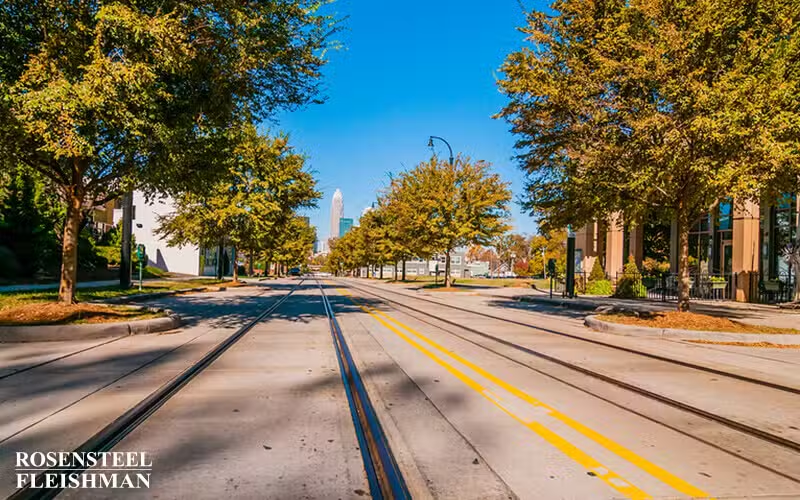

Low-angle sunlight can reduce contrast, obscure a signal or vehicle, and change how quickly a driver perceives a hazard. Whether that condition supports or defeats a negligence argument depends on what the driver could reasonably anticipate and what the driver did before and after visibility changed.
Sun glare is a visibility condition to investigate; it is not an automatic excuse and does not automatically establish negligence.
Separate the glare condition from the legal doctrine
North Carolina's sudden-emergency doctrine concerns a person who, through no fault of that person, is suddenly and unexpectedly confronted with imminent danger requiring immediate action. The published Court of Appeals opinion in Sobczak v. Vorholt explains both the emergency requirement and the requirement that the person seeking the doctrine not have created the emergency through negligence.
A recurring sunrise or sunset at a known direction may present a different foreseeability question from an abrupt, genuinely unexpected event. In Holbrook v. Henley, the Court of Appeals analyzed whether the evidence supported a sudden-emergency instruction in the context of a driver reacting to traffic ahead. The decision illustrates why the doctrine turns on the evidence presented, not the label attached to a condition.
Document what the driver could see and anticipate
- Date, exact time, direction of travel, lane, grade, curve, horizon, obstructions, mirrors, windshield condition, visor position, and eyewear
- Weather, cloud cover, wet pavement, reflections, artificial lighting, signs, signals, brake lights, and contrast at the relevant distance
- How long visibility was reduced, whether the route and condition were familiar, and any earlier opportunity to slow, change position, or increase following distance
- Speed, braking, steering, lane position, following distance, warning, and the sequence from first reduced visibility to impact
Evaluate speed for the actual condition
G.S. 20-141 addresses driving at a speed that is reasonable and prudent under existing conditions and identifies circumstances requiring reduced speed. A posted limit does not answer whether a particular speed was reasonable for the available sight distance, traffic, roadway, and visibility.
Preserve evidence before trying to recreate the view
- Original scene photographs and video with timestamps, locations, direction, lens information, and unedited files
- Traffic-camera, business-camera, dash-camera, vehicle, phone, and navigation records
- Witness descriptions obtained without supplying the desired explanation
- Vehicle inspection, windshield condition, visor and mirror positions, lighting systems, event data, and damage evidence
A later photograph taken from a different lane, height, season, time, or camera setting may not reproduce the driver's view. Record those differences rather than presenting a recreation as an exact match.
Use the general doctrine guide for other emergencies
The related North Carolina sudden-emergency guide addresses the doctrine's general elements and limits. This page keeps the narrower task of analyzing sun glare, visibility, foreseeability, and driver response.
Rosensteel Fleishman Car Accident & Injury Lawyers provides information about consulting a car accident attorney in Charlotte when glare, sight distance, speed, reaction time, or an asserted sudden emergency is disputed.
Sources
Additional Car Accidents Articles
What Happens When Vehicle Damage Appears Later Despite an Initial Inspection
Damage found days or weeks after a collision can complicate an insurance claim, especially when the cause of the crash or responsibility for the repairs remains disputed. A vehicle may look drivable during an initial roadside review in Charlotte, yet later show suspension problems, electrical faults, alignment issues, or damage hidden beneath exterior panels. When […]
How Claim Documentation Supports a Car Accident Case Without Perfect Records
After a car accident in Charlotte, recovery often develops one day at a time, and the records connected to that process may be less complete than expected. A person might visit an emergency room, schedule follow-up care with a family doctor, miss a physical therapy appointment because of pain, or forget to save a receipt […]
Police Report Accuracy After a Crash When Important Details Are Missing
In Charlotte areas where cyclists and pedestrians frequently share the road with drivers, such as Uptown, South End, and busy crossings near greenway access points, a collision can become complicated within seconds. The police report may later serve as an important record, but officers often arrive after the impact and must reconstruct events from statements, […]




