In Charlotte, North Carolina, a motorcycle crash involving movement between lanes can quickly raise questions about visibility, road position, and each driver’s actions. Those questions become even more complicated when an injured rider waits to seek medical care, since an insurance company may examine both the circumstances of the collision and the timing of the […]
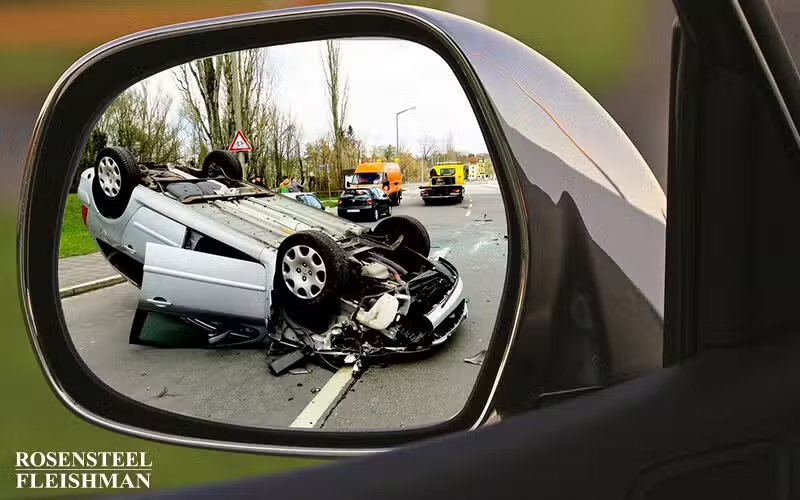

A driver may be legally responsible for a collision while still disputing whether the collision caused every diagnosed condition, treatment, or limitation. Medical causation connects the event to the claimed physical consequences and is often one of the most contested issues in a car-accident trial.
Fault for a collision and medical causation are separate questions. A complete case must address both without assuming that temporal sequence alone proves a medical relationship.
Some injuries require qualified medical explanation
The official North Carolina Reports volume containing Click v. Pilot Freight Carriers, Inc. discusses the distinction between injuries whose cause may be understood through ordinary experience and complicated medical questions requiring qualified testimony. The nature of the condition and the evidence determine the proof needed.
A visible traumatic injury occurring with the collision can present a different causal question from a delayed diagnosis, degenerative spine finding, neurological condition, chronic pain syndrome, or need for later surgery. The more medically complex the connection, the more important a reliable medical explanation becomes.
Rule 702 governs the reliability and fit of opinion testimony
North Carolina Rule of Evidence 702 addresses whether qualified expert testimony will help the factfinder and whether the opinion rests on sufficient facts or data, reliable principles and methods, and reliable application to the case.
A medical credential alone does not answer every causation question. The witness’s qualifications, relevant specialty, factual foundation, methodology, and ability to account for competing explanations all matter.
The evidence needed depends on the medical question
In McCrary v. King Bio, Inc. (2013), a workers’ compensation claimant experienced immediate wrist pain while trying to catch a falling package at work. The Court of Appeals held that expert testimony was not required to establish the connection to that pain on the uncomplicated facts presented. It distinguished proof of the immediate pain from diagnosis of a specific, medically complex condition. The decision was not a product-liability case and does not establish that every later diagnosis can be attributed to an earlier event without qualified medical evidence.
- Symptoms, function, and treatment before the collision
- The collision mechanism, occupant movement, restraint use, vehicle damage, and immediate complaints
- Emergency evaluation, objective findings, diagnoses, treatment recommendations, and response to care
- Any gap in care and the medical or practical reason for that gap
- Later injury, illness, work activity, or other event that could affect the condition
- The treating or reviewing clinician’s basis for distinguishing aggravation from a preexisting condition
Preexisting conditions do not end the inquiry
A person can have an asymptomatic, stable, or previously treated condition before a crash. The question may be whether the collision caused a new injury, aggravated an existing condition, accelerated treatment, or produced no material change. Prior records and imaging can clarify that comparison rather than merely creating a negative inference.
Give accurate histories and preserve uncertainty
Describe your symptoms, history and uncertainty honestly to your healthcare providers. A brief intake note and a later detailed examination may use different words without contradicting each other. Preserve the original records and ask about genuine inaccuracies; do not change an account to make every document sound the same. Treatment decisions should follow medical needs rather than a desired litigation result.
Trial preparation should test the complete causal chain
- Identify each diagnosis and claimed limitation separately
- Match each opinion to the records and information the witness reviewed
- Address plausible alternative causes rather than ignoring them
- Separate treatment necessity from treatment cost and billing evidence
- Use demonstrative evidence only when it accurately reflects the underlying medical record
- Prepare for the distinction between admissibility of an opinion and the weight the jury may give it
Rosensteel Fleishman Car Accident & Injury Lawyers provides information about Charlotte car-accident cases. Medical-causation evaluation should begin early enough to collect prior and current records, preserve collision evidence, identify the right medical questions, and meet filing and disclosure deadlines.
Sources
Additional Personal Injury Articles
How Witness Statements Support an Injury Claim After a Serious Accident
After a serious accident, the people who saw what happened can become an important source of information about the events surrounding an injury. A witness may remember the position of the vehicles, a traffic signal, a driver's behavior, road conditions, or what an injured person said and did immediately afterward. In Charlotte, where crashes may […]
Map and Diagram of Accident Scene Evidence When Photos Are Incomplete
Accident recovery rarely follows a perfectly straight path, especially when early symptoms change or new limitations appear after a person returns to normal routines. In Charlotte, someone injured in a collision may begin with goals such as reducing pain, restoring movement, returning to work, or safely resuming everyday activities, then adjust those goals as doctors […]
Protein Targets After Fall Injury and Supporting Physical Recovery
Poor lighting can make an ordinary walkway difficult to navigate, especially when shadows conceal a spill, uneven flooring, loose debris, or a change in elevation. In Charlotte, visibility problems may arise in apartment stairwells, parking garages, restaurants, retail stores, and other properties used by the public. When a fall causes an injury, the lighting conditions […]