
An auto adjuster may review responsibility, policy coverage, vehicle damage, injury causation, medical expenses, wage loss, and other claimed losses. Not every file contains the same records, and an adjuster’s evaluation is not an independent legal or medical determination. The claimant’s working file should connect each insurer request or conclusion to the exact record provided, […]
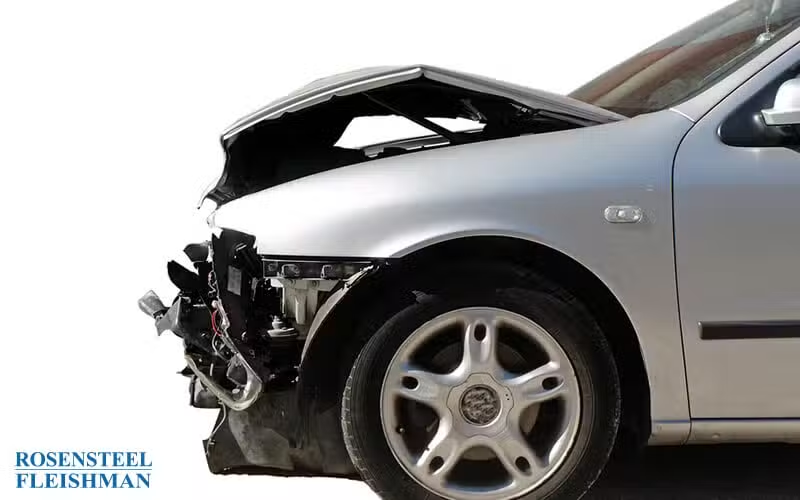

A wrong-way head-on collision requires two timelines: how one vehicle entered or remained in the opposing lane, and how each road user perceived and responded to the danger.
The analysis should identify the roadway design, direction assigned to each lane, entry point, signs and markings, vehicle movements, visibility, speed, response interval, impact sequence, and source for every fact. The final positions alone rarely explain how the conflict began.
North Carolina generally requires travel on the right half of the highway
G.S. 20-146 generally requires a vehicle to use the right half of a highway of sufficient width. The statute lists exceptions for passing, an obstruction, certain three-lane roads, and roads designated for one-way traffic. It also addresses center lanes, multi-lane two-way roads, marked lanes, and official traffic-control devices.
A claimed exception must be matched to the actual road and movement. If an obstruction is asserted, document its location, duration, visibility, the available route around it, and whether the driver yielded to traffic traveling in the proper direction. A citation, lane position, or statutory reference is important evidence, but civil responsibility still requires the applicable rule, breach, causation, defenses, and damages to be evaluated from the complete record.
Determine how the wrong-way movement began
- Ramp, driveway, median opening, intersection, lane transition, construction zone, parking-lot exit, or other entry point
- One-way signs, do-not-enter signs, arrows, lane lines, medians, reflectors, lighting, vegetation, temporary controls, and sight distance as they existed at the time
- Navigation instructions, phone activity, impairment evidence, distraction, unfamiliarity, fatigue, medical-event evidence, and witness observations without treating any one explanation as established
- Speed, steering, braking, lane position, turn signals, headlamps, horn use, and opportunities to recognize and correct the direction of travel
- Prior complaints, work orders, traffic-control changes, construction plans, inspection records, and the entity responsible for a disputed roadway feature
Evaluate the other driver’s response separately
A driver traveling in the assigned direction may have only seconds to brake, steer, warn, or choose an escape path. That response should be measured from the first reasonable opportunity to perceive the danger, not from hindsight after the collision. Speed, lookout, distraction, available shoulder or lane space, nearby traffic, and vehicle capability remain relevant.
In Holbrook v. Henley, reported in volume 118 of the North Carolina Court of Appeals Reports, the court described the threshold questions for a sudden-emergency instruction: an emergency requiring immediate action and an emergency not created by the actor’s own negligence. The related guide to North Carolina’s sudden-emergency doctrine examines that instruction. This page keeps the focus on reconstructing a wrong-way head-on event.
Preserve evidence from both approaches
- Original dash-camera, business, residential, traffic, transit, and witness-phone video with native files, metadata, and clock references
- Vehicle event data, infotainment, navigation, telematics, phone records obtained through a lawful process, diagnostic data, and post-crash inspections
- Road measurements, grade, curve, lighting, weather, surface, tire marks, gouges, debris, damage, occupant positions, restraints, and final rest
- 911 calls, dispatch records, officer observations, witness locations, contemporaneous statements, later corrections, and supplemental reports
- Alternative timelines that state their speed, distance, perception, response, and vehicle-performance assumptions
Use the crash report as a map to sources
The current NCDMV DMV-349 Instructional Manual explains the identities, roadway fields, sequence, contributing-circumstance codes, diagram, and narrative used in North Carolina crash reports. Compare each entry with its underlying source. A code or officer conclusion does not replace video, measurements, vehicle data, witness evidence, or the governing legal analysis.
Rosensteel Fleishman Car Accident & Injury Lawyers provides general information about consulting a North Carolina car-accident attorney after a wrong-way head-on collision. Evidence access, possible parties, fault, defenses, insurance, causation, damages, and deadlines depend on the specific event.
Sources
Additional Car Accidents Articles
How to Preserve Accurate Information When Language Access Is Needed After a Crash
When people involved in a crash do not share the same language, a small translation choice can change a description of direction, timing, pain, prior condition, or responsibility. The solution is not to make every statement longer. It is to preserve who said what, in which language, through which interpreter or translation method, and when. […]
How a Traffic Citation Fits Into a North Carolina Car Accident Claim
A traffic citation and a car accident injury claim are related but different matters. A citation identifies an alleged traffic offense and follows its own court process. An injury claim can involve responsibility, causation, damages, insurance coverage, and defenses. The existence or absence of a citation should not replace a review of the complete collision […]
Why a North Carolina Car Accident Claim Review Changes Over Time
An early car accident claim review is based on an incomplete record. Vehicle damage may not be fully inspected, medical findings may still be developing, bills may not be reconciled, wage information may be missing, and insurers may be investigating responsibility or coverage. A later evaluation can change because the evidence changed—not merely because time […]


