
Highway crashes do not always happen during predictable rush hour congestion or in the middle of heavy commuter traffic. In North Carolina, a collision may occur late at night, during an off-peak afternoon, or on a relatively open stretch of interstate where traffic conditions initially appear straightforward. Claims arising from these crashes can still become […]
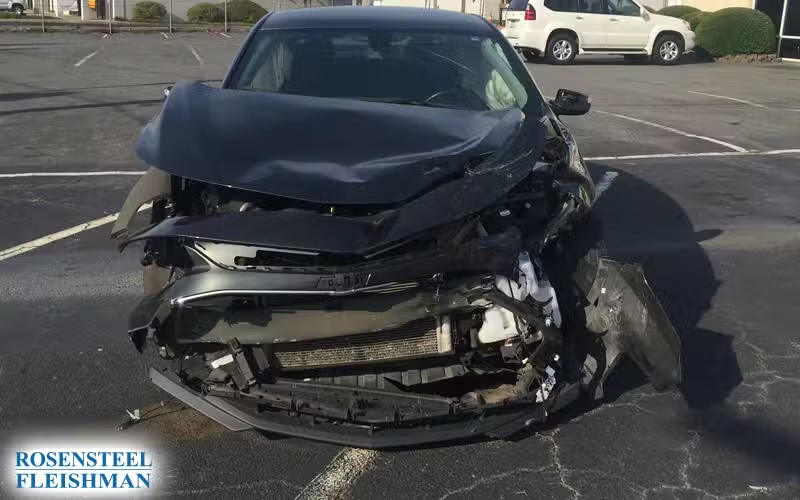

Not every collision presents the same need for legal representation. A person with a property-only issue, agreed facts, complete records, and time to manage the claim faces a different decision from someone with serious injury, disputed responsibility, disappearing evidence, multiple parties, uncertain coverage, or court papers.
The representation decision should be made from a task-and-risk inventory: list what must be done, which deadlines and evidence are at risk, what the person can reliably handle, what a proposed lawyer would handle, and how fees and expenses change the possible net result.
Address urgent safety, evidence, and deadline work first
- Appropriate medical attention, crash reporting, vehicle location, photographs, video, witnesses, and physical or electronic evidence that may disappear
- Driver, owner, employer, product, roadway, insurer, and other potentially relevant identities
- Every notice requirement, policy condition, claim number, government procedure, filing period, hearing, response, or document already received
- Property, transportation, income, medical, benefit, lien, reimbursement, and privacy issues that need immediate organization
G.S. 1-52 contains several three-year limitations provisions, including identified personal-injury and property claims. Other claims, parties, contracts, government processes, and federal rules may differ. Do not postpone a deadline review because an insurer is investigating or discussing the claim.
Use complexity rather than injury labels
A collision described as minor can still involve disputed facts, unavailable video, several policies, prior medical conditions, a commercial vehicle, a child, a person who died, an out-of-state party, or a signed release. A serious injury can create medical-causation, future-care, wage, lien, expert, and settlement-finality questions. Identify the actual work rather than deciding from a repair estimate or diagnosis label alone.
Assess whether self-management is realistic
- Can the person preserve originals, maintain a deadline calendar, obtain records, reconcile bills and payments, and communicate factually without guessing?
- Can the person identify all parties and policies, evaluate contrary evidence, respond to requests, and keep property and injury issues separate?
- Can the person evaluate an offer by gross amount, net amount, release scope, unresolved future needs, liens, reimbursement, and alternatives?
- If litigation begins, can the person comply with filing, service, pleadings, discovery, evidence, hearings, mediation, and trial requirements?
Define the proposed scope before comparing fees
North Carolina Rule of Professional Conduct 1.2 addresses objectives, means, settlement authority, and reasonable limits on the scope of representation. Ask whether the engagement includes property damage, injury claims, health or auto benefits, liens, pre-suit work, filing, discovery, experts, mediation, trial, appeal, and collection. Record excluded tasks and who will handle them.
Compare fees, expenses, and net result
Rule 1.5 addresses fees and expenses and requires a signed writing for a contingent fee agreement with identified terms. Review percentages at different stages, responsibility for expenses, the order of deductions, referral or fee sharing, termination, liens, reimbursement, and the written closing calculation. A contingent fee is not accurately described as simply “no cost unless you win.”
Verify the individual lawyer and ask operational questions
The North Carolina State Bar provides license and lawyer-search resources. Its before-you-hire guide supplies questions about experience, credentials, malpractice insurance, references, fees, staffing, communication, and case handling. Verify the individual lawyer’s active status and ask who is responsible for each important task.
Leave the consultation with a written decision record
- Immediate risks and the first three actions, with owner and due date
- Accepted and excluded scope, staffing, communication method, expected response practice, and client decisions
- Fee method, expenses, deductions, possible net-result scenarios, and termination or transition terms
- Evidence or legal questions that remain uncertain and when the representation decision will be revisited
Understand the self-managed alternative
The related self-managed North Carolina car-accident claim guide maps evidence, parties, coverage, property and injury files, insurer communications, evaluation, releases, deadlines, and clear pause points for reassessing whether outside help is needed.
Rosensteel Fleishman Car Accident & Injury Lawyers provides information about representation options for Charlotte car accident claims.
Sources
Additional Car Accidents Articles
Left Turn Gap Judgment Errors When Visibility or Road Design Plays a Role
What happens when a driver begins a left turn and another vehicle suddenly changes lanes? The available opening can disappear almost instantly. In Charlotte traffic, this type of conflict may occur near multilane intersections where drivers must monitor oncoming vehicles, traffic signals, pedestrians, and vehicles moving between lanes at the same time. These crashes can […]
Multi Policy Insurance Considerations When One Policy Does Not Cover Every Loss
Insurance coverage after a serious car accident is not always limited to one policy. A collision may involve liability coverage, underinsured motorist coverage, medical payments coverage, an employer’s commercial policy, or another source of compensation. Identifying each applicable policy can affect how losses are documented, how negotiations develop, and whether a proposed resolution fairly reflects […]
What Happens When Vehicle Damage Appears Later Despite an Initial Inspection
Damage found days or weeks after a collision can complicate an insurance claim, especially when the cause of the crash or responsibility for the repairs remains disputed. A vehicle may look drivable during an initial roadside review in Charlotte, yet later show suspension problems, electrical faults, alignment issues, or damage hidden beneath exterior panels. When […]



