
A crash involving only one vehicle does not always mean the driver bears all responsibility. A family dealing with injuries, medical bills, vehicle damage, and missed work may discover that a careless driver, a defective vehicle component, unsafe road conditions, or another outside factor contributed to what happened. Understanding these possibilities can help someone in […]
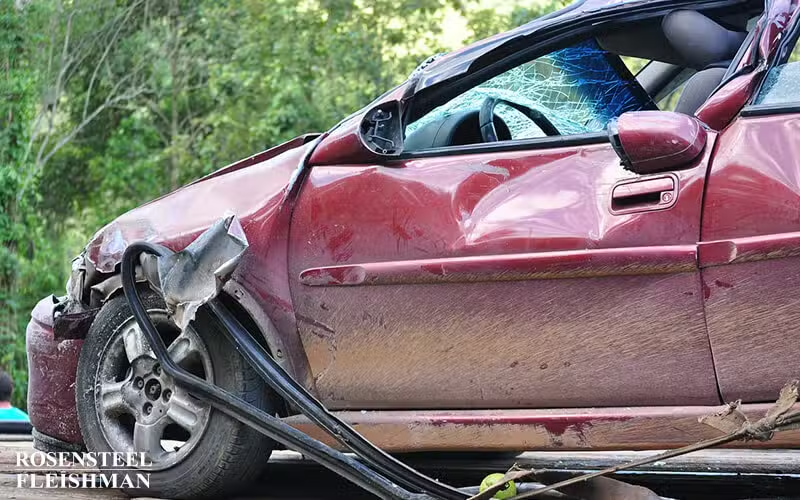

A person usually proves negligence with evidence about what a driver did or failed to do. Res ipsa loquitur can permit an inference from the nature of an occurrence in a narrow class of cases when direct proof of the precise negligent act is unavailable and the surrounding circumstances reasonably point to negligence.
Res ipsa loquitur is a limited circumstantial-evidence doctrine, not an automatic finding of fault whenever a vehicle leaves the road.
What the doctrine does and does not do
- It concerns an inference from circumstantial evidence; it does not eliminate the need to prove causation, injury, damages, and any other required issue
- The occurrence must be the kind that ordinarily would not happen without negligence when the relevant circumstances are considered
- The evidence must sufficiently connect the occurrence to an instrumentality or operation within the defendant's control
- An equally plausible non-negligent cause, another responsible actor, or an adequate direct explanation may prevent the requested inference
Why unexplained roadway departures receive close attention
A vehicle that crosses the opposite lane, leaves a dry road, and strikes a fixed object without a prior collision can create a different circumstantial record from a multi-vehicle intersection crash. The location, road geometry, weather, tire marks, vehicle condition, driver condition, speed evidence, and possible outside causes still matter. The event should not be described as “speaking for itself” until the competing explanations have been investigated.
Henderson illustrates a limit
The official North Carolina Judicial Branch page for Henderson v. Henderson, COA06-971 identifies the 2007 opinion as unpublished. In that automobile case, the Court of Appeals treated the driver's account that the vehicle locked up and cut off as material to whether res ipsa loquitur applied. The opinion is not controlling authority and should be used only as a fact-specific illustration, subject to the appellate rules governing unpublished opinions.
Preserve evidence of both negligence and alternative causes
- Scene photographs, video, measurements, lane and shoulder marks, debris, impact location, rest positions, weather, lighting, road surface, grade, curve, signs, and barriers
- Vehicle inspection, tire and brake condition, steering, recalls, maintenance, repairs, event data, downloads, retained components, and chain of custody
- Driver health, impairment, fatigue, distraction, speed, route familiarity, phone and navigation records, and statements
- Other vehicles, animals, falling objects, roadway defects, mechanical events, sudden medical events, and witness observations
Build competing explanations before choosing a theory
For each possible explanation, record the facts that support it, the facts that contradict it, the missing evidence, and who controlled that evidence. Distinguish “not yet explained” from “could only have occurred through negligence.” Courts evaluate the actual record; an article cannot decide whether the doctrine applies to an individual crash.
Act before video is overwritten
The related Charlotte traffic-camera evidence guide explains how to identify possible footage and make a focused preservation request. Video may confirm or eliminate an alternative explanation, but its absence is not itself proof of negligence.
Rosensteel Fleishman Car Accident & Injury Lawyers provides information about consulting a car accident lawyer in Charlotte when an unexplained roadway departure, missing evidence, mechanical issue, or circumstantial-negligence theory is disputed.
Source
Additional Car Accidents Articles
Denied Car Accident Claims Basics and the Exceptions That May Change the Outcome
A denied car accident claim does not always mean an injured person has run out of options. Insurance companies must explain why they are refusing payment, and that explanation may reveal missing records, a disagreement about fault, a policy issue, or a dispute over whether the collision caused the reported injuries. Understanding the stated reason […]
When Liens in Accident Claims Can Affect Your Final Compensation
Charlotte residents recovering from a serious collision may face more than immediate medical bills. Some injuries create lasting pain, reduced mobility, or permanent limitations that require ongoing treatment and major adjustments at home or work. When health insurers, medical providers, or benefit programs have paid accident-related expenses, they may seek repayment from the eventual settlement […]
How to Document Third Parties at a North Carolina Accident Scene
People and organizations other than the two apparent drivers may observe the event, control the roadway, own a vehicle, employ a driver, maintain equipment, load cargo, hold video, provide emergency care, or create a later record. Their role should be verified rather than assumed from presence at the scene. The third-party matrix should identify the […]


