
A workers compensation claim can become more difficult when the injury report does not clearly explain when, where, and how the accident occurred. This is particularly important with hand, wrist, and finger injuries because pain, weakness, or loss of coordination may develop gradually after the initial event. An insurer may question whether the condition came […]
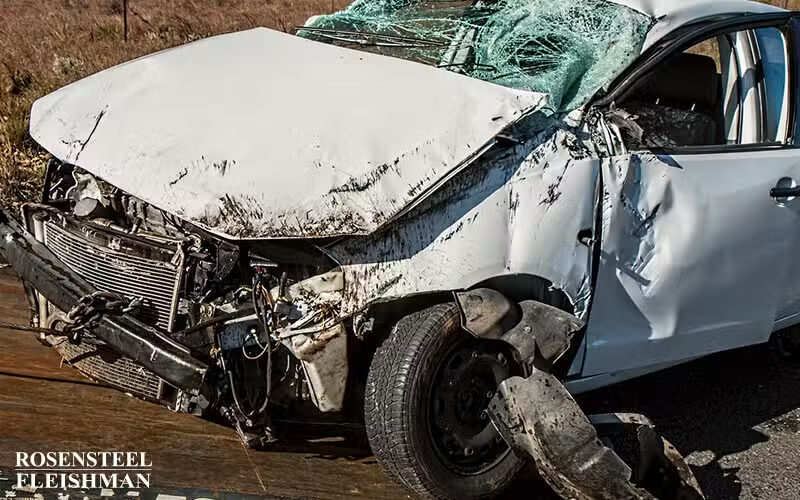

One of the defenses used by insurance companies to not pay NC car accident claims is sudden emergency. The argument, many times misused, is that their insured was reacting to an emergency situation which resulted in the accident. As such, it was not their negligence which caused the accident and they should not be held liable. Too many personal injury lawyers fall for this claim and fail to fight for their clients.
The typical example of a sudden emergency is when a child runs out into the road chasing a ball directly in front of a car causing the driver to swerve to avoid hitting the child resulting in an accident. However, there are limitations with the exclusion. Lets start with the basics. The courts have held that the definition of an Emergency Situation is a situation that “compels the party to act instantly to avoid a collision or injury”
If a defendant in a car accident case requests an instruction on sudden emergency they are required to meet two requirements:
- An emergency situation must exist requiring immediate action to avoid injury.
- The emergency must not have been created by the negligence of the party seeking the protection of the doctrine.
A sudden emergency jury instruction is properly rendered if SUBSTANTIAL evidence on each of the two essential elements of the doctrine has been presented. Lets look at both elements in greater detail.
- An emergency situation must exist requiring immediate action to avoid injury.
Pinckney v. Baker 130 NC App 670(1998) - In Pinckey (a passenger) vehicle merged his vehicle to the left in front of the Baker vehicle resulting in the Backer Vehicle colliding into the rear of the Pinckney vehicle. The court found it was an error to instruct the jury on sudden emergency.
It logically follows that in order for perception of an emergency to have affected the reasonableness of the actor's conduct, the latter must have perceived the emergency circumstance and reacted to it. We note our Supreme Court has upheld a trial court's refusal to instruct on sudden emergency in an instance when, inter alia, the “evidence demonstrate[d] that to the very end [defendant] did not himself perceive any ‘emergency.’ ” Hairston v. Alexander Tank and Equipment Co., 310 N.C. 227, 241, 311 S.E.2d 559, 569 (1984). Commentators on North Carolina tort law agree. See Charles E. Daye and Mark W. Morris, North Carolina Law of Torts, § 16.40.4, at 141-42 (1991) (“[t]he sudden emergency rule relates only to conduct after the emergency has been observed”
According to Baker, the alleged emergency circumstance in the case sub judice was the action of Pinckney in pulling suddenly and unexpectedly in front of Baker's van. However, Baker repeatedly testified he did not see Pinckney' vehicle prior to the collision, and that his attention was directed to it only upon impact. This testimony was insufficient to sustain submission of an instruction on sudden emergency in that Baker was never “confronted an emergency situation compell[ing] him to act instantly to avoid a collision or injury.” Colvin, 120 N.C.App. at 812, 463 S.E.2d at 780. In other words, the sole indication in the record is that Baker was unaware of the alleged emergency until the actual collision. Accordingly, his conduct could in nowise have been in response to his “confrontation,” see id., with that emergency.
2. The emergency must not have been created by the negligence of the party seeking the protection of the doctrine.
Moore v. Shaikh 155 NC App 220 (2002) and Keith v. Polier 109 NC App 94 (1993)
In both cases the drivers where in stop and go traffic. In both cases the defendants hit the back of the the car in front of them when they came to a quick stop. The courts held that,
As a general rule, every motorist driving upon the highways of this state is bound to a minimal duty of care to keep a reasonable and proper lookout in the direction of travel and see what he ought to see. (citation omitted). Within this duty is a requirement that the motorist drive and anticipate dangers in a manner consistent with the circumstances and exigencies of traffic ... Drivers are therefore required in the exercise of ordinary care to expect sudden stops when driving in heavy traffic. In accord, such stops do not constitute an unexpected or emergency situation.
As you can see just because the insurance company or defense lawyer makes the argument of sudden emergency it doesn't mean the argument will be successful. It is incumbent on your personal injury lawyer to fight each and every argument of the defendant. Failure to do so can result in a negative outcome on your case. To discuss your case and the best possible outcome please contact our personal injury lawyers. We will discuss your case in detail as well as what we can do to help you out.
Additional Personal Injury Articles
The Witness Role in Motorcycle Accidents When Accounts Conflict in Charlotte
Motorcycle crashes can leave families trying to understand how two people saw the same event so differently. A driver may say a rider entered the lane unexpectedly, while the rider may remember having the right of way. Witnesses can help clarify what happened, but their statements must be considered alongside physical evidence, policy terms, and […]
Understanding Rental Reimbursement Limits After a Car Accident
After a collision, arranging transportation can feel urgent, especially when work, medical visits, school schedules, and family responsibilities still need attention. Rental coverage may help with that gap, but payment is usually controlled by a daily amount, a maximum total amount, and the circumstances of the crash. In Charlotte, understanding those limits early can make […]
When Fear Triggers Dog Bite Injuries in Charlotte and Coverage Questions Follow
A dog does not need to appear aggressive for an ordinary encounter to become unsafe. Fear may cause a dog to retreat, lunge, snap, or bite with little warning, particularly when the animal feels cornered or startled. The resulting injuries can involve puncture wounds, torn skin, infection, nerve damage, scarring, or a fall caused by […]


