After a serious truck crash, checking for joint injuries early can reduce the risk of untreated damage becoming harder to manage. The force of a collision may injure cartilage, ligaments, tendons, bones, or the joint capsule even when swelling and pain seem manageable at first. In Charlotte, anyone experiencing stiffness, weakness, instability, or reduced movement […]
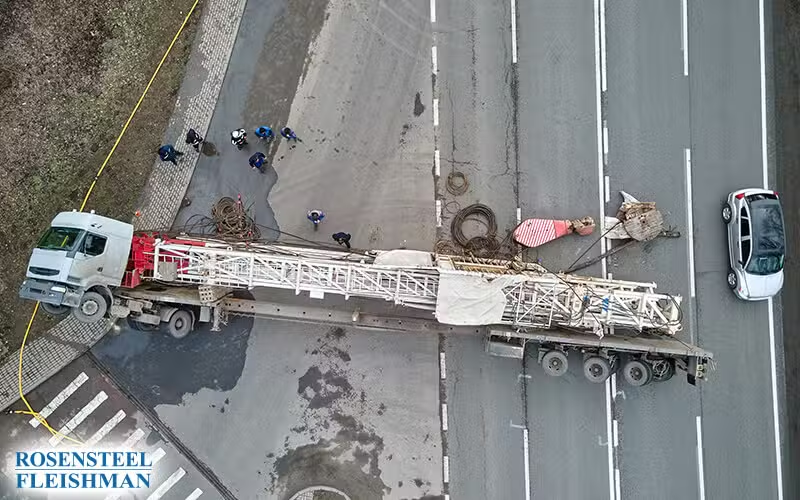

Excess weight can affect braking, tires, suspension, steering, stability, rollover threshold, and roadway interaction. The effect depends on how much weight was carried, how it was distributed, the vehicle configuration, speed, road, maneuver, equipment, and collision sequence.
Proof that a truck exceeded a weight limit does not by itself prove that excess weight caused the collision or a particular injury. A complete claim must connect the applicable limit, actual load, responsible conduct, vehicle response, crash, and damages.
North Carolina regulates axle and vehicle weight
G.S. 20-118 defines terms including gross weight, axle group, single-axle weight, and tandem-axle weight and provides weight limits, exceptions, tolerances, and penalties. The calculation can depend on axle spacing, road classification, vehicle type, commodity, permits, and other provisions.
The number printed on a scale ticket should therefore be matched to the correct axle configuration, statutory provision, declared weight, route, bridge or road posting, tolerance, exception, and date.
Weighing and enforcement records can preserve direct evidence
G.S. 20-118.1 authorizes law enforcement to stop and weigh a vehicle, direct it to a nearby scale, and detain an overweight vehicle until the overload is removed. It also addresses entry into weigh stations or inspection sites for specified vehicles.
- Certified scale tickets and axle-by-axle measurements
- Weigh-station, inspection, transponder, bypass, citation, and overload-removal records
- Bills of lading, shipping papers, manifests, purchase records, and declared weights
- Loading diagrams, loader data, container records, seal information, and photographs
- Empty or tare weight, fuel, tractor, trailer, axle, tire, suspension, and equipment configuration
- Route, bridge, road-posting, origin, destination, and permitted-movement information
A special permit may change the allowable movement
G.S. 20-119 authorizes specified permits for vehicles or loads exceeding ordinary size or weight limits and allows conditions concerning routes, days, times, banners, escort vehicles, and other safety measures.
A permit should be examined for the exact vehicle, load, route, time, conditions, and compliance. Having a permit does not resolve unrelated negligence, and lacking a required permit does not establish every element of civil causation.
Vehicle dynamics connect weight to the crash
- Stopping distance, brake demand, brake temperature, adjustment, condition, and application
- Axle and tire loading, inflation, heat, failure, suspension response, and steering
- Center of gravity, load distribution, shift, roll stability, speed, curve, grade, and evasive movement
- Electronic engine, braking, stability-control, event, telematics, and trailer data
- Physical marks, component examination, cargo position, vehicle damage, and reconstruction
- Alternative causes including driver response, maintenance, roadway, weather, another vehicle, or securement failure
Several entities may have different responsibilities
The driver may inspect or operate the vehicle; the carrier may dispatch and control the operation; an owner may supply the tractor or trailer; a shipper or third-party loader may select, weigh, distribute, or seal the cargo; and a broker or customer may communicate schedules or specifications. Contracts and federal or state roles should be compared with what each entity actually knew and controlled.
The driver may have limited ability to inspect a sealed or inaccessible load, while weight tickets, suspension indicators, onboard scales, permits, or vehicle behavior may provide other notice. Responsibility should not be assigned solely from a company name on the vehicle.
Cargo weight and securement should be analyzed separately
Excess weight concerns how much load the vehicle or axle carried. Securement concerns whether cargo was contained, immobilized, and prevented from falling or shifting in a way that affected stability or maneuverability. Both can exist, one can exist without the other, or neither may have caused the crash.
The related guide to cargo-crash response and evidence preservation identifies securement devices, shipping records, cargo sensors, emergency reporting, and scene documentation.
Preservation should occur before unloading or repair
Safety and government directions control at an active scene, but evidence may change when cargo is transferred, removed, weighed, disposed of, or returned; when the vehicle is repaired or placed back in service; or when electronic systems continue recording. Photographs, measurements, native data, samples when appropriate, chain of custody, and records should be preserved lawfully.
Rosensteel Fleishman Car Accident & Injury Lawyers provides information about truck-accident claims in Charlotte. An overloaded-truck review should identify the governing weight rule, permit and route, actual axle and gross weight, loading actors, vehicle dynamics, alternative causes, injury proof, insurance, and deadlines.
Sources
Additional Trucking Accidents Articles
Documenting Family Impact Truck Accident Injuries in Charlotte Households
When a serious truck collision disrupts a Charlotte family’s daily life, medical records often become the clearest evidence of what changed and why. Insurance adjusters review those records to determine whether injuries are connected to the crash, how treatment progressed, and whether ongoing limitations are medically supported. That review can affect compensation for medical expenses, […]
How Imaging Confirms Compound Fractures Truck Crash Injuries Can Cause
Compound fractures are medical emergencies that require fast treatment, careful imaging, and thorough documentation. When these injuries result from a collision involving a commercial truck, the medical issues may be clear long before the insurance claim is ready for resolution. Questions about responsibility, insurance coverage, vehicle maintenance, and employment relationships can add months of investigation. […]
Assessing Fear of Driving After Truck Collision Through Symptoms and Treatment Records
Charlotte drivers share major routes such as I-77, I-85, and I-485 with commercial trucks every day. Improvements such as brighter lane markings, longer merge areas, better lighting, and clearer warning signs can reduce collision risks, but infrastructure cannot prevent every crash. After a serious truck collision, a driver may remain physically capable of operating a […]