When several people are injured in the same commercial truck crash, the evidence can affect more than one claim at the same time. In Charlotte, dashcam footage may help clarify where vehicles were positioned, how traffic was moving, when braking began, and what happened in the seconds before impact. Those details can become especially important […]
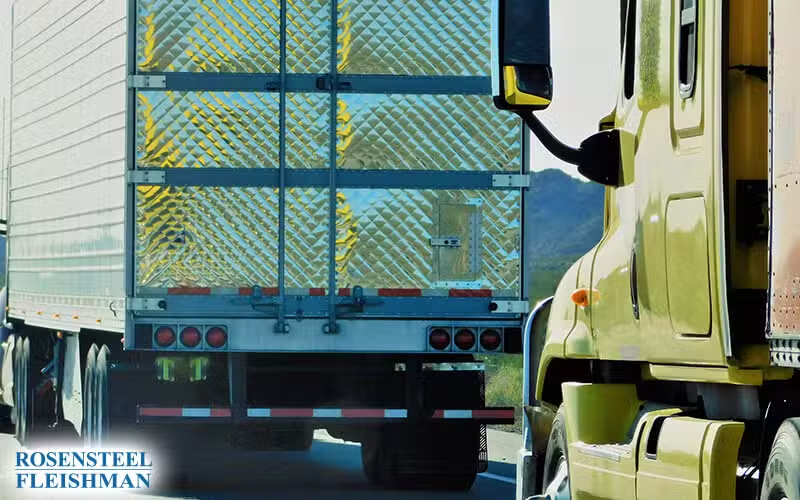

Blind spot evidence is evaluated by comparing what the truck driver could have seen with where each vehicle was before contact. For Charlotte, NC families dealing with truck blind spot accident injuries, that distinction helps separate a driver's explanation from evidence supporting it. The practical question is whether photographs, recordings, and accounts of the collision fit the same sequence of events.
Keeping original photographs, messages, and claim correspondence together gives the review a clearer starting point. Those records can support strengthening a truck injury claim by making disputed details easier to identify and compare. A family's account should distinguish what someone personally saw from what they learned afterward.
A blind spot describes a visibility limitation, not a complete explanation of responsibility. The review must also address how the vehicles moved, when their positions changed, and what evidence supports each account. Families do not need to reconstruct the collision themselves, but they can avoid turning an uncertain detail into a definite statement.
A family's reason to find a truck accident attorney may be a disagreement over what the truck driver could see. In a discussion with Rosensteel Fleishman, the useful starting point is the disputed moment and the records available to explain it. That keeps attention on the family's actual questions rather than treating the words “blind spot” as an answer.
Overview
- Compare visibility with the vehicles' movements before contact.
- Check statements against independent records.
- Keep collision evidence separate from documentation of losses.
- Identify missing information without guessing.
Reconstructing What Was Visible Before Contact
The central difficulty is that the vehicles' positions after a collision do not necessarily show their positions just before it. A useful review works backward from documented points, such as the moment of contact, a visible lane marking, or a vehicle passing through a camera's view. It then identifies which parts of the sequence are supported and which depend on estimates.
In a hypothetical lane change collision, the truck driver says the passenger vehicle was beside the trailer and out of view. A witness says the passenger vehicle had been traveling ahead of the truck moments earlier. Those accounts are not necessarily incompatible because they may describe different moments. Comparing timing is more useful than choosing one statement before checking the surrounding evidence.
The materials worth examining depend on what exists and can be obtained. A focused evidence inventory can include:
- Original photographs showing lanes, vehicle positions, and contact damage.
- Available dashcam or nearby camera footage.
- Details of the truck's mirrors, cameras, and configuration.
- Witness accounts identifying their location and viewing angle.
- Available vehicle records relevant to timing or movement.
Visibility analysis needs to address the actual truck rather than rely only on a general blind spot diagram. Relevant questions include the driver's viewing position, mirror placement, the trailer's angle, and any obstruction shown in the evidence. A photograph taken later may help explain the layout, but it cannot establish the earlier view unless the differences in position and configuration are accounted for.
A camera view also needs context. A recording may show a vehicle beside the truck without showing what was visible in a mirror, and a short clip may omit the approach that explains how the vehicles reached those positions. Keeping the original file and noting any gaps makes it easier to distinguish what the recording shows from what someone infers. If timestamps differ between recordings, that uncertainty should remain visible in the timeline.
Witness statements deserve the same careful comparison. An account is easier to assess when it explains where the witness was, which direction they were looking, and whether anything blocked their view. “I did not see a turn signal” is different from a continuous observation showing that no signal was visible. Likewise, contact damage may help assess an account without establishing every movement that preceded the impact.
The claims question goes beyond whether a visibility limit existed. It asks how the available evidence bears on the conduct of the people involved and the responsibility alleged in the claim. In the hypothetical lane change, useful questions include which vehicle changed position, when that happened, and whether the visibility explanation fits the documented sequence. Neither a driver's statement nor a general blind spot diagram settles those questions alone.
Preservation and access are separate issues. A family can retain records already in its possession, while footage or vehicle information held by another party may require a request through the claim or legal process. A request does not establish that the material exists or that access will be granted. Recording what was requested, from whom, and what response arrived helps keep missing evidence from being mistaken for evidence that supports either side.
Finally, collision reconstruction and injury documentation answer different questions. Vehicle evidence addresses how contact occurred; existing medical records, bills, employer records, and household expense records address the injuries described and their practical consequences. A blind spot diagram cannot establish a diagnosis, and vehicle damage alone should not be treated as proof of a particular injury. Keeping these categories distinct makes the claim's reasoning clearer.
Building a Record of Unanswered Questions
The next practical task is to make the uncertainties manageable without asking your family to resolve them. A short evidence log can show what you have, where it came from, and what still needs clarification. That gives later discussions a concrete focus while leaving room to correct an incomplete account.
- Keep original files separate from annotated copies.
- Record when and from whom each item was received.
- Mark estimates and secondhand details clearly.
- List unanswered questions beside the relevant record.
- Keep dated expense and work records in a separate folder.
If an account changes as more information becomes available, retain the earlier version and explain the correction rather than silently replacing it. For practical losses, record the specific expense, missed work period, or household task and keep the supporting document when available. Specific entries are easier to assess than broad statements about everything the collision disrupted.
It is understandable to want a definite explanation while family routines are unsettled. You can contribute useful information without deciding fault or filling gaps in the evidence. A clear record of what is known and what remains uncertain gives the next review something solid to work with.
Additional Trucking Accidents Articles
Tests That Confirm Fine Motor Issues Truck Accident Injuries May Cause
Fine motor problems can be easy to miss after a truck crash because they often involve small changes rather than an obvious loss of movement. A person may still be able to move an arm or hand but struggle to button a shirt, type accurately, hold a key, or pick up a coin. Early photographs […]
Connecting Mechanical Failure Truck Accident Injuries to Inspection Evidence
A serious truck crash can change a person’s energy level as much as it changes mobility or comfort. Pain, interrupted sleep, medication side effects, medical appointments, and the effort required to complete ordinary tasks may leave an injured person exhausted. In Charlotte, someone who previously worked a full schedule might suddenly need breaks while preparing […]
How Investigators Reconstruct Multi Impact Truck Crash Injuries in Charlotte, NC
Investigators reconstruct a truck collision by comparing physical evidence, vehicle movement, medical findings, and witness accounts. In a crash involving several impacts, this process can help explain when an injury likely occurred, how additional contact changed the forces on an occupant, and why symptoms may become more noticeable as activity levels increase. A person may […]