
A lasting disability affects more than a claim file. Learn how to connect the collision timeline with documented changes in work, household responsibilities, and expenses without treating assumptions as evidence.
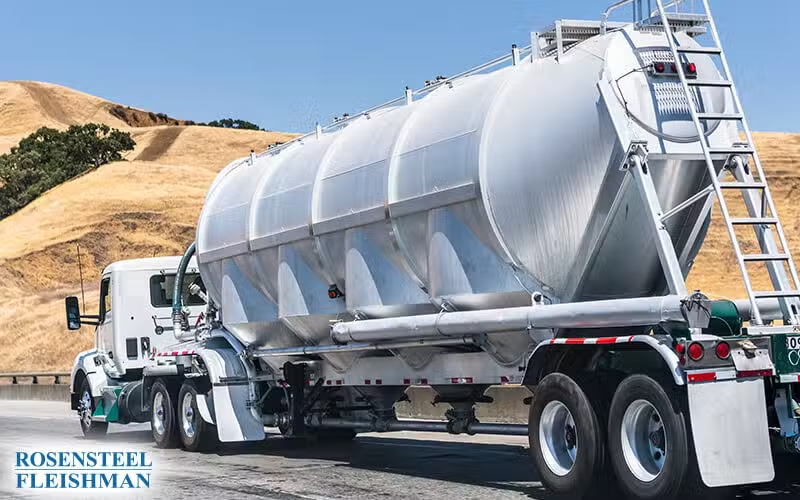

A motor carrier may control records created by dispatch, safety, payroll, maintenance, telematics, electronic logging, onboard systems, insurance, post-crash review, and outside vendors. A rear-end contact does not reveal which records exist or which company, contractor, device, or platform holds them.
The purpose of a carrier-source map is to identify who controls each record, how the system creates it, the relevant time window, and what must be preserved before a reconstruction opinion is attempted.
Start with documents and messages you already lawfully hold. A source map identifies possible records; it does not authorize access to a carrier’s accounts, equipment, personnel files or vendor systems. Share the list of possible sources with the person handling the claim so authorized requests and any necessary legal process can be considered.
Identify the carrier and operating structure
- Driver, employer, motor carrier, USDOT number, operating authority, vehicle owner, lessee, broker, shipper, consignee, maintenance provider, telematics vendor, and insurer
- Tractor, trailer, unit numbers, registration, VINs, plates, lease, dispatch identifier, load, route, terminal, trip, bill of lading, and delivery record
- Employee or contractor status asserted, hiring and qualification records, supervision, pay method, dispatch control, policies, and actual operating relationship
- Exact source for each identity or role; do not infer the responsible entity from a logo, shipping document, or insurance card alone
Preserve the carrier crash register and investigation
49 C.F.R. § 390.15 addresses a motor carrier accident register and specified supporting documents for reportable accidents under the rule. Record whether the event fits the rule’s definition, the register entry, date, location, driver, injuries or fatalities, hazardous-material information, copies of government reports, retention period, custodian, and any company investigation kept separately from the required record.
Map hours-of-service and electronic logging sources
49 C.F.R. § 395.8 addresses records of duty status, and FMCSA explains electronic logging devices and their role. Identify the ELD provider, device, driver account, vehicle assignment, duty-status records, edits, annotations, certifications, unidentified driving, diagnostic or malfunction events, output file, supporting documents, time zone, and export method.
Map dispatch, route, and communication records
- Dispatch assignment, route, stop, appointment, delivery window, navigation, geofence, location history, arrival and departure, delay, message, call, email, and driver application
- Who sent or received each communication, device, account, platform, native export, time zone, retention, deletion setting, and custodian
- Traffic, construction, weather, queue, work-zone, roadside event, change in plan, service-hour concern, equipment report, and escalation record
- No assumption that schedule pressure, fatigue, distraction, or a missed message occurred without source evidence
Map vehicle and braking records
- Inspection, repair, preventive maintenance, driver vehicle inspection, roadside inspection, brake or tire work, defect report, out-of-service event, and return-to-service decision
- Engine-control, event-data, collision-warning, automatic emergency braking, camera, radar, telematics, speed, throttle, brake application, cruise-control, and fault-code sources when present
- System make, model, software, configuration, clock, units, calibration, extraction tool, raw export, report, analyst, and known limitations
- Post-crash tow, storage, repair, download, testing, disposal, transfer, and every person with access to the tractor or trailer
Map cargo and loading records
Preserve load description, weight, seal, bill of lading, shipper instructions, loading and securement records, axle information, inspection, temperature or hazardous-material documentation when relevant, unloading, photographs, and communications. Cargo evidence may affect vehicle dynamics or identify additional custodians, but it does not establish causation without analysis.
Create a preservation and receipt ledger
For each source, record the custodian, system, date range, format, retention or overwrite risk, preservation request, delivery proof, response, objection, legal-process need, export received, checksum when available, missing fields, and follow-up. Keep native data and vendor documentation with any human-readable report.
For example, a dispatch message may be stored in a fleet application while a camera clip is held by a different vendor. Record each custodian and time range separately. Receipt of the dispatch export does not confirm that the camera footage was preserved or that the two systems use the same clock.
Hand the source map to qualified analysis
The source map identifies what exists and how it was collected. It does not calculate speed, following distance, perception time, stopping distance, brake performance, or legal responsibility. Those conclusions require a defined method, complete facts, and an appropriately qualified reviewer.
The related electronic-logging-device records guide explains ELD event fields, manual entries, edits, annotations, certifications, unidentified driving, and supporting documents in greater detail.
Rosensteel Fleishman Car Accident & Injury Lawyers provides information about Charlotte truck-accident claims involving carrier-controlled records. The available evidence and legal issues depend on the carrier structure, systems, and complete collision record.
Sources
Additional Trucking Accidents Articles
Reducing Reinjury Risk With Physical Therapy After a Truck Crash in Charlotte
Concerns about reinjury involve medical questions that claim records cannot answer. Learn how to organize physical therapy documentation, practical expenses, and scene evidence without drawing unsupported conclusions.
When Mobility Loss After a Charlotte, NC Truck Crash Has No Clear Diagnosis
An unclear diagnosis does not prevent a family from recording practical changes after a truck crash. Keep observations, added expenses, and unanswered claim questions separate.
How Insurers Review Worsening Pain After a Truck Crash
An early insurance review may start with an incomplete account. Dated records can help explain later changes in pain, work limitations, and expenses without treating symptoms as proof of an injury.


