A lasting disability affects more than a claim file. Learn how to connect the collision timeline with documented changes in work, household responsibilities, and expenses without treating assumptions as evidence.
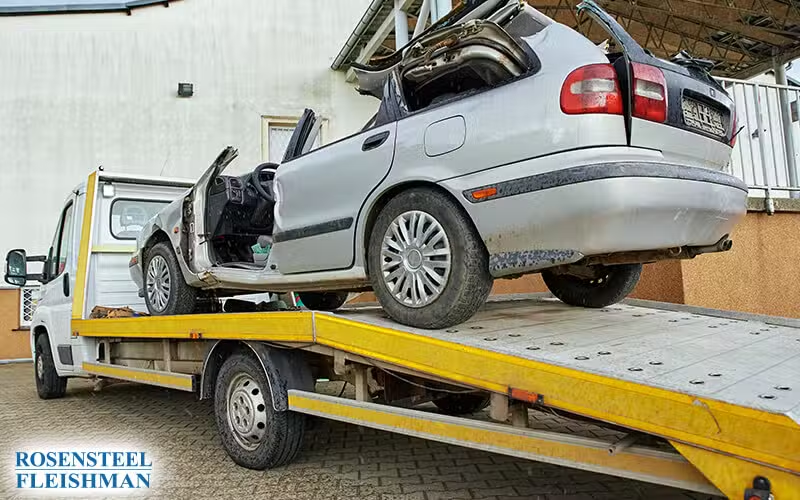

A company vehicle may be titled to an employer, leased from an equipment owner, rented for a job, supplied to a contractor, or used by a worker for a mixed-purpose trip. Identifying the business on the door does not resolve who controlled the driver or vehicle at the collision time.
A company logo, registration, paycheck, or lease is one relationship fact; responsibility requires the complete ownership, permission, control, work, conduct, and causation record.
Map the people, companies, and equipment
- Driver, employer, contractor, staffing company, carrier, vehicle owner, lessee, renter, and insurer
- Title, registration, lease, rental, possession, keys, garaging, maintenance, dispatch, and trip records
- Origin, destination, cargo, route, schedule, compensation, customer, and business benefit
- Who selected, trained, supervised, dispatched, inspected, repaired, and could stop the work
- Which participant controlled each relevant document or electronic system
Use ownership evidence precisely
G.S. 20-71.1 describes prima facie effects of ownership and registration evidence in covered motor-vehicle injury, property-damage, and death actions. Apply the statute with the full record rather than treating the registered owner as the end of every responsibility question.
Review the actual lease and operation
49 C.F.R. § 376.12 addresses required provisions in covered leases. Determine whether it applies, obtain the executed agreement and receipts, and compare its terms with dispatch, payment, system access, possession, and actual conduct.
Preserve driver and company records
49 C.F.R. § 391.51 addresses listed driver-qualification-file materials for covered drivers. Applicability, timing, completeness, later additions, and information held outside the formal file all matter.
- Application, licensing, qualification, medical, testing, training, evaluation, and review records
- Prior incidents, complaints, coaching, discipline, dispatch, safety communication, and work history
- Vehicle inspections, defects, repairs, maintenance, fault codes, and return-to-service decisions
- Electronic logs, telematics, cameras, mobile devices, route, fuel, toll, scale, and cargo records
The related carrier-conduct guide explains how a claimed company failure must be connected to dated knowledge, a reasonable alternative, and the collision sequence.
Separate driver and company theories
Reconstruct the driver’s operation first. Then evaluate employment or agency, owner responsibility, entrustment facts, hiring or supervision, maintenance, dispatch, cargo, and other company conduct. Each theory requires its own duty, evidence, and causal connection.
Keep insurance distinct
A policy may cover a person or company without proving fault; a participant can be responsible even when an insurer disputes coverage. Obtain complete policies, endorsements, reservations, tenders, and written positions. Chart direct claims, insured relationships, defense, limits, exclusions, and priority separately.
Test the company-vehicle conclusion
- What exact relationship is asserted and on which date
- What record and actual conduct support control or benefit
- What driver or company act is alleged
- How that act changed the collision outcome
- What contrary evidence or alternative explanation remains
Rosensteel Fleishman Car Accident & Injury Lawyers provides information about company-vehicle collision claims in Charlotte.
Sources
Additional Trucking Accidents Articles
Reducing Reinjury Risk With Physical Therapy After a Truck Crash in Charlotte
Concerns about reinjury involve medical questions that claim records cannot answer. Learn how to organize physical therapy documentation, practical expenses, and scene evidence without drawing unsupported conclusions.
When Mobility Loss After a Charlotte, NC Truck Crash Has No Clear Diagnosis
An unclear diagnosis does not prevent a family from recording practical changes after a truck crash. Keep observations, added expenses, and unanswered claim questions separate.
How Insurers Review Worsening Pain After a Truck Crash
An early insurance review may start with an incomplete account. Dated records can help explain later changes in pain, work limitations, and expenses without treating symptoms as proof of an injury.