
Leaving a hospital, rehabilitation facility, or other care setting after a fall does not necessarily mean recovery is complete. Discharge usually marks a transition from one stage of care to another, with decisions shaped by documented function, safety concerns, available support, and the follow-up plan established by the treating providers. For someone injured in a […]
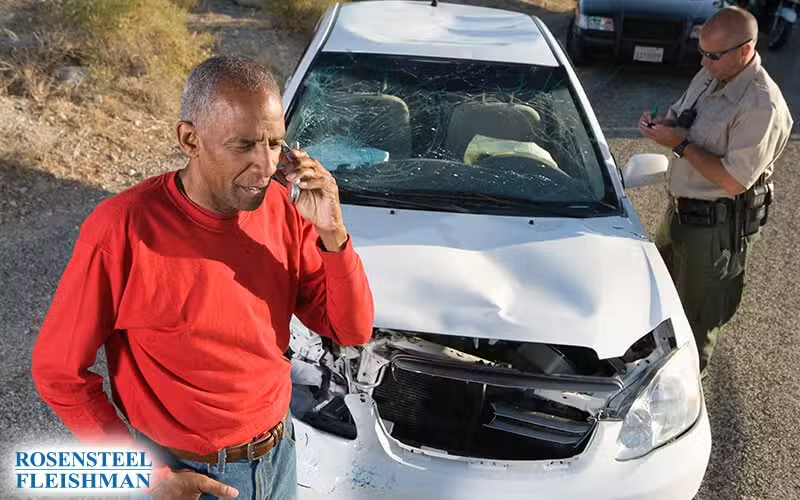

A driver leaving a Charlotte crash scene creates immediate safety, identification, evidence, and insurance questions. The remaining driver or pedestrian should focus first on health and reporting rather than pursuing the fleeing vehicle.
A hit-and-run claim has two parallel investigations: identifying what happened and mapping coverage if the driver remains unknown or turns out to be uninsured.
Protect people and report the event
- Call emergency services when anyone needs help or the scene presents danger
- Move out of active traffic when it can be done safely and follow responder instructions
- Report the collision promptly and provide the most accurate location, time, direction, and vehicle description available
- Do not chase or confront a fleeing driver
- Record the agency, report number, responding personnel, tow location, and vehicle status
G.S. 20-166 addresses stopping, remaining, information, assistance, vehicle movement, and other duties after identified crashes. G.S. 20-166.1 addresses notice and investigation of reportable accidents. Apply the current text to the actual circumstances.
Capture a vehicle description without guessing
- Color, body type, approximate size, make or model features, and partial plate characters
- Travel direction, lane, turn, exit, street, or destination
- Visible damage, missing parts, lighting, markings, decals, cargo, or accessories
- Driver or occupant features actually observed
- Sounds, fluid, debris, tire marks, or objects left at the scene
Preserve location-specific evidence quickly
Identify traffic cameras, businesses, residences, parking facilities, transit vehicles, dash cameras, doorbell systems, and nearby witnesses. Record exact camera positions and likely time windows. Send a focused preservation request before routine overwrite occurs.
The related digital-evidence and attention guide explains timing, native files, device records, privacy, and why activity alone does not establish distraction.
Document the remaining vehicle and scene
- Wide views of the roadway, traffic controls, lanes, sight lines, weather, lighting, and obstructions
- Damage before repair, transfer marks, embedded material, broken parts, lamps, glass, and debris
- Tire marks, scrape marks, fluid, resting positions, and measured reference points
- Full-resolution original photographs and video with metadata preserved
- Tow, storage, estimate, repair, salvage, and inspection records
Separate identification from collision proof
A plate or owner record may identify a vehicle but not necessarily the driver or event sequence. Conversely, video may establish the collision without revealing a plate. Build separate findings for vehicle identity, driver identity, permission, route, collision sequence, responsibility, and injury cause.
Map uninsured-motorist coverage
G.S. 20-279.21 addresses motor-vehicle liability policies and uninsured-motorist protection, including identified provisions concerning hit-and-run vehicles. Coverage depends on the policy, insured status, facts, notice, proof, and procedural requirements.
- Policies covering the occupied vehicle and potentially applicable household vehicles
- The injured person’s status under each policy
- Bodily injury and property coverage, limits, deductibles, exclusions, and conditions
- Prompt notice, cooperation, preservation, statement, consent, and lawsuit requirements
- Other coverage, payments, claims, or people affected by the event
Build the medical and loss chronology
Record symptom onset, emergency care, providers, diagnoses, tests, treatment, restrictions, baseline conditions, later events, work effects, bills, payments, and daily limitations. The unidentified driver does not remove the need to establish responsibility, causation, and documented loss.
Update the investigation without contaminating it
Provide supplemental facts, files, witness information, and possible vehicle identifiers to the investigating agency and relevant insurer. Preserve original material and label later inferences. Do not circulate uncertain accusations or edit evidence to make an identifier appear clearer.
Rosensteel Fleishman Car Accident & Injury Lawyers provides information about hit-and-run car accident claims in Charlotte.
Sources
Additional Personal Injury Articles
Return to Hobbies Dog Bite Injuries and How Activity Goals May Change During Recovery
Can returning to a favorite activity affect how the impact of a dog bite is understood? It can. Hobbies often reveal limitations that may not be apparent from medical expenses or time away from work alone. Someone may complete routine job duties but still have difficulty gardening, playing tennis, riding a bicycle, working with tools, […]
When to Contact a Bicycle Accident Attorney After Conflicting Statements About a Crash
After a bicycle crash, the process of figuring out what happened can become more complicated when the people involved remember the event differently. A driver may say the cyclist entered an intersection unexpectedly, while the cyclist may remember having the right of way. In Charlotte, NC, those conflicting accounts can affect how an insurance company […]
Counteroffers in Accident Claims Based on Changes in Medical Prognosis
How should an accident claim change when a doctor gives a different outlook than expected? That question can become important when an injury initially appears temporary but later requires additional treatment, testing, therapy, or time away from work. A settlement discussion is based on the information available at that moment, so meaningful changes in the […]



