
Highway crashes do not always happen during predictable rush hour congestion or in the middle of heavy commuter traffic. In North Carolina, a collision may occur late at night, during an off-peak afternoon, or on a relatively open stretch of interstate where traffic conditions initially appear straightforward. Claims arising from these crashes can still become […]
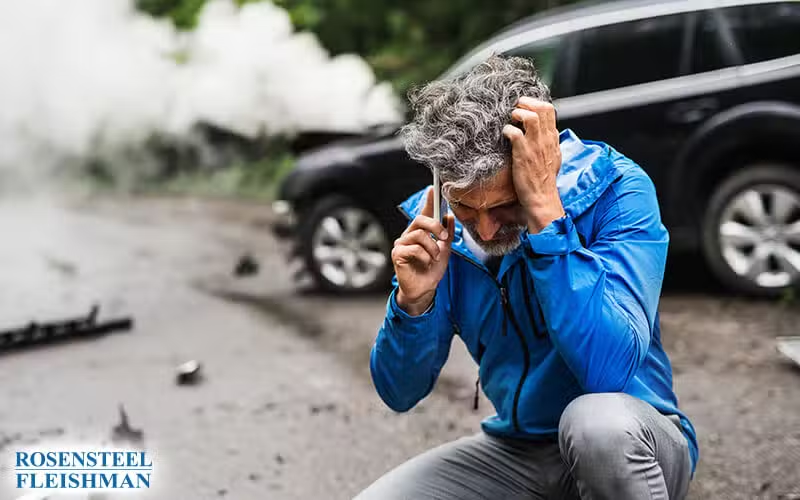

Charlotte continues to see serious car accidents on a relatively small number of roadways, according to recent city data. Local reports show that just 13 percent of Charlotte streets account for roughly 80 percent of fatal and serious injury crashes. These corridors, identified through the city’s High Injury Network, are concentrated primarily in north and west Charlotte.
The numbers are difficult to ignore. During the fiscal year running from July 2024 through June 2025, 81 people lost their lives on Charlotte streets and 111 suffered serious injuries. While overall crash totals have trended downward, life altering collisions have increased. Speeding and improper vehicle operation accounted for 64 percent of fatal and serious crashes during that period, with distracted driving contributing to another 11 percent.
Seven roads currently rank highest on the city’s High Injury Network map, based on crash severity and frequency between 2019 and 2023:
- Wilkinson Boulevard between Billy Graham Parkway and Morris Field Drive
- Old Statesville Road between Statesville Road and Gibbon Road
- West Boulevard between Walton Road and Remount Road
- North Tryon Street near Lambeth Drive and Dorton Street
- East Mallard Creek Church Road near UNC Charlotte
- Beatties Ford Road near West Charlotte High School
- North Tryon Street in the University City area
Pedestrian and bicycle crashes account for fewer than 1.5 percent of total collisions but make up 29 percent of fatal and serious injuries. That imbalance underscores how vulnerable certain road users are, especially on high speed arterial corridors.
Charlotte adopted Vision Zero in 2019 with the goal of eliminating traffic deaths and severe injuries. Despite infrastructure investments, new sidewalks, speed limit reductions, and upgraded crossings, serious collisions remain a major public safety concern. City leaders have acknowledged that more focused action may be needed, particularly along corridors already identified as high risk. For those affected by crashes in these areas, it may be helpful to learn how a Charlotte car accident lawyer can help when navigating next steps.
Why High Risk Roads Increase Legal Complexity After A Crash
When a car accident occurs on one of Charlotte’s high injury network roads, the legal and insurance issues can quickly become complicated. High speed traffic, multiple lanes, commercial vehicle activity, and pedestrian crossings often create overlapping factors that must be carefully reviewed.
In serious crashes, investigators typically analyze:
- Vehicle speeds and whether speed limits were exceeded
- Road design, visibility, and traffic control devices
- Driver behavior such as distraction or impairment
- Surveillance footage or nearby camera data
- Witness statements and electronic vehicle data
Because many of these corridors carry heavy daily traffic, evidence can disappear quickly. Skid marks fade, debris is cleared, and witnesses move on. For injury victims, early legal representation helps preserve critical documentation and coordinate independent investigation when necessary.
Insurance companies often begin evaluating exposure within days of a crash. Adjusters may attempt to assign partial fault or minimize the severity of injuries. On complex urban corridors like North Tryon Street or Wilkinson Boulevard, fault may not always be obvious at first glance. Legal counsel can help ensure that all contributing factors are thoroughly examined before conclusions are drawn.
Understanding How Different Types Of Car Accidents Are Handled
Not all car accidents are evaluated the same way. The type of crash, the vehicles involved, and the injuries sustained can significantly shape how a claim progresses.
The handling of an incident is often influenced by:
- Whether the collision involved pedestrians or cyclists
- Whether commercial vehicles were present
- The severity and permanence of injuries
- Disputed liability between multiple drivers
- Availability of video or electronic crash data
For example, rear end collisions often center on following distance and reaction time, while intersection crashes may require detailed analysis of signal timing, right of way, and driver visibility. Pedestrian crashes on high injury network roads frequently involve questions about lighting, marked crosswalks, and driver awareness.
Serious injury cases typically involve coordination with medical providers to document long term prognosis. Insurance carriers review medical records closely and may request independent examinations. Clear documentation and organized presentation of evidence can influence whether a claim resolves through settlement discussions or proceeds toward litigation.
How Accident Structure Influences Negotiation And Resolution
The dynamics of a crash often affect negotiation leverage. Cases involving clear traffic violations, strong documentation, and consistent medical records may move more efficiently through settlement discussions. By contrast, accidents involving disputed liability or multiple contributing drivers can take longer to resolve.
Dispute resolution methods can vary depending on the structure of the case. Some claims are addressed through direct negotiation with insurers, while others may involve mediation or formal court proceedings. Preparation for both possibilities is essential. Attorneys often build each case as though it could proceed to trial, even while pursuing settlement opportunities.
This dual approach encourages thorough evidence gathering, careful damage calculation, and realistic evaluation of long term impact. When injuries affect a person’s ability to work or require ongoing medical treatment, those future costs must be factored into any resolution discussion.
Measured Guidance After A Charlotte Car Accident
When a serious car accident disrupts daily life, clear and steady guidance can make a meaningful difference. Medical appointments, insurance paperwork, and financial uncertainty can quickly become overwhelming. Having experienced counsel involved early helps bring structure to the process and ensures important deadlines and documentation requirements are met.
At Rosensteel Fleishman Car Accident & Injury Lawyers, we focus on representing individuals and families affected by car accidents across Charlotte. Our firm prepares each case with attention to both settlement strategy and potential litigation. That means gathering detailed evidence, consulting with appropriate experts when needed, and clearly explaining available options at every stage. We understand that families need practical answers, not pressure. Our goal is to provide thoughtful representation that protects your interests while you concentrate on recovery and rebuilding after a crash.
Additional Car Accidents Articles
Left Turn Gap Judgment Errors When Visibility or Road Design Plays a Role
What happens when a driver begins a left turn and another vehicle suddenly changes lanes? The available opening can disappear almost instantly. In Charlotte traffic, this type of conflict may occur near multilane intersections where drivers must monitor oncoming vehicles, traffic signals, pedestrians, and vehicles moving between lanes at the same time. These crashes can […]
Multi Policy Insurance Considerations When One Policy Does Not Cover Every Loss
Insurance coverage after a serious car accident is not always limited to one policy. A collision may involve liability coverage, underinsured motorist coverage, medical payments coverage, an employer’s commercial policy, or another source of compensation. Identifying each applicable policy can affect how losses are documented, how negotiations develop, and whether a proposed resolution fairly reflects […]
What Happens When Vehicle Damage Appears Later Despite an Initial Inspection
Damage found days or weeks after a collision can complicate an insurance claim, especially when the cause of the crash or responsibility for the repairs remains disputed. A vehicle may look drivable during an initial roadside review in Charlotte, yet later show suspension problems, electrical faults, alignment issues, or damage hidden beneath exterior panels. When […]




