
Can an injury claim still move forward when recovery takes longer than expected? For many people in Charlotte, the answer depends on how carefully the situation is documented, how treatment progresses, and whether the available resolution options match what is actually happening in real life. After a car accident, early assumptions about healing can change. […]
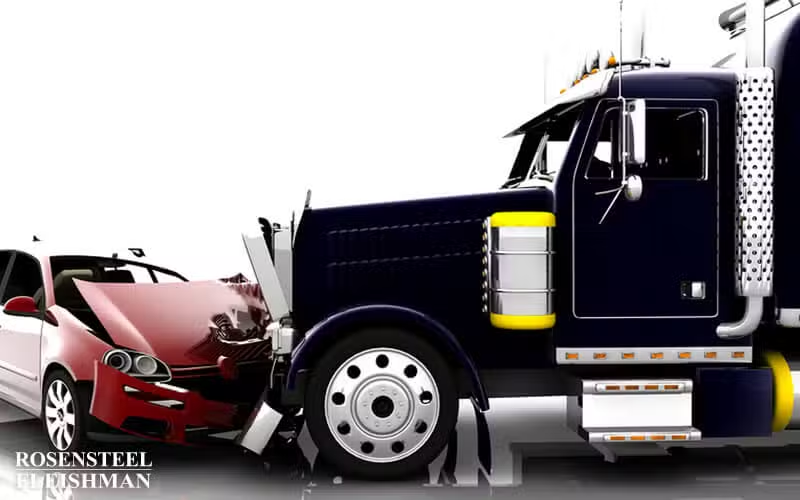

An accident yesterday left two drivers injured after a car struck a feed truck in Union County. The driver of the car hit the feed truck after going through a stop sign. Both drivers were injured in the accident, although the driver of the feed truck suffered only minor injuries. Unfortunately, the driver of the car suffered serious injuries and was flown to Carolinas Medical Center-Main. He was not wearing his seatbelt.
In North Carolina, motorists and their passengers are required to wear seatbelts. The requirement that occupants of a motor vehicle wear a seatbelt comes from North Carolina statute. G.S. 20-135.2A(a) states that “each occupant of a motor vehicle manufactured with seat belts shall have a seatbelt properly fastened about his or her body at all times when the vehicle is in forward motion on a street or highway in this State.” However, law enforcement cannot stop a vehicle solely because a rear-seat occupant fails to wear a seatbelt. Subsection (d1) of the statute states that “[f]ailure of a rear seat occupant of a vehicle to wear a seat belt shall not be justification for the stop of a vehicle.”
Subsection (c) contains exceptions for the requirement of wearing a seatbelt. The requirement does not apply to
(1) A driver or occupant of a noncommercial motor vehicle with a medical or physical condition that prevents appropriate restraint by a safety belt or with a professionally certified mental phobia against the wearing of vehicle restraints.
(2) A motor vehicle operated by a rural letter carrier of the United States Postal Service while performing duties as a rural letter carrier and a motor vehicle operated by a newspaper delivery person while actually engaged in delivery of newspapers along the person's specified route.
(3) A driver or passenger frequently stopping and leaving the vehicle or delivering property from the vehicle if the speed of the vehicle between stops does not exceed 20 miles per hour.
(4) Any vehicle registered and licensed as a property-carrying vehicle in accordance with G.S. 20-88, while being used for agricultural purposes in intrastate commerce.
(5) A motor vehicle not required to be equipped with seat safety belts under federal law.
(6) Any occupant of a motor home, as defined in G.S. 20-4.01(27)d2, other than the driver and front seat passengers.
(7) Any occupant, while in the custody of a law enforcement officer, being transported in the backseat of a law enforcement vehicle.
(8) A passenger of a residential garbage or recycling truck while the truck is operating during collection rounds.
Failure to wear a seatbelt in an accident might increase a driver’s or passenger’s risk of injury, but it will not increase a driver’s or passenger’s liability for injuries sustained in a car accident. Subsection (d) of the seatbelt statute states that “[e]vidence of failure to wear a seat belt shall not be admissible in any criminal or civil trial, action, or proceeding except in an action based on a violation of this section or as justification for the stop of a vehicle or detention of a vehicle operator and passengers.” A negligent defendant might argue that the plaintiff was contributorily negligent, which can bar a plaintiff’s recovery of damages in North Carolina. However, if a plaintiff’s failure to wear a seatbelt cannot be introduced as evidence, it cannot be used to show the plaintiff’s contributory negligence.
Although the seatbelt statute became effective in the 1980’s, even prior to the statute, it was difficult to base a plaintiff’s contributory negligence on failure to wear a seatbelt. Well before the enactment of the statute requiring the use of seatbelts, the North Carolina Supreme Court looked at the issue of contributory negligence from failure to wear a seatbelt in Miller v. Miller (1968). The Court reasoned that
It would be a harsh and unsound rule which would deny all recovery to the plaintiff, whose mere failure to buckle his belt in no way contributed to the accident, and exonerate the active tort-feasor but for whose negligence the plaintiff's omission would have been harmless.
As a policy issue, the Court doubted that “such a rule would increase the use of seat belts.”
The Court went on to theorize about a future law requiring the use of seatbelts and stated that “[s]hould the duty to use a seat belt be imposed--either by the legislature or by the court--, the issue of proximate cause would then loom.” The Court imagined various safety experts testifying about the relationship between failure to wear a seatbelt and the injuries sustained and “the complicated task of damage apportionment would 'invite verdicts on prejudice and sympathy contrary to the law,' create 'unnecessary conflicts in result,' and 'degrade the law by reducing it to a game of chance.’” The Court in Miller also voiced additional concerns regarding the harshness of such a rule. The North Carolina legislature perhaps considered these concerns when it did pass a law requiring seatbelt use, which not only created the duty to use a seatbelt but also specifically exempted the failure to wear a seatbelt from being an act of contributory negligence. The statute instead provides nominal fines for failure to wear a seatbelt.
Caselaw that has looked at the issue of seatbelts and contributory negligence since the passage of the law has held that misuse of a seatbelt is equivalent to nonuse of a seatbelt, and similarly cannot be used as evidence of contributory negligence. The North Carolina Court of Appeals came to this holding in the 1996 case, Chaney v. Young. In that case, a mother was sitting in the front passenger seat, holding her infant son on her lap, and the seatbelt was strapped around them both. When their car was involved in an accident, the infant son suffered injuries and died. The court held that “improper use of a seat belt under the circumstances of this case is tantamount to nonuse” and “the statutory provisions are applicable.”
If you have been injured in a car accident, contact Rosensteel Fleishman Car Accident & Injury Lawyers (704) 714-1450, to speak with an attorney about your options.
Additional Car Accidents Articles
How Soft Tissue Injuries Are Evaluated After a Crash Over Time
The way an injury feels right after a crash is not always the way it will feel several days later. Soft tissue injuries can be frustrating because soreness, stiffness, swelling, headaches, or limited movement may develop slowly, especially after a person has gone home, returned to work, or tried to resume a normal routine around […]
High Impact Crash Overview for Claims With Serious Damage
A serious crash can leave a family trying to make decisions before all the facts are clear. Vehicle damage, medical concerns, missed work, school pickup plans, and insurance calls can all arrive at the same time, which makes it easy for important details to get overlooked. A practical high impact crash overview can help explain […]
How Liability Is Determined in a Car Accident When Reports Are Delayed
Fault decisions often become harder when crash reports, medical records, repair estimates, or insurance updates are delayed. In a Charlotte car accident, even a few missing details can leave drivers unsure about what the insurance company is reviewing, why the claim is taking longer, and what happens when each side tells a different story. A […]


