Can an injury claim still move forward when recovery takes longer than expected? For many people in Charlotte, the answer depends on how carefully the situation is documented, how treatment progresses, and whether the available resolution options match what is actually happening in real life. After a car accident, early assumptions about healing can change. […]
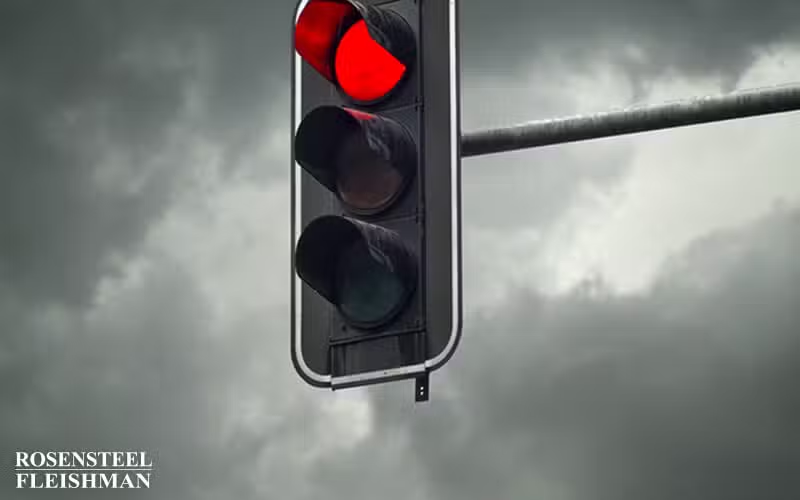

The North Carolina Supreme Court recently affirmed an appeal from the court of appeals in a case which involves a common traffic scenario. Car #1 approaches wants to turn left at an intersection with a traffic signal but no left turn signal. It enters the intersection and comes to a complete stop waiting for a break in traffic coming from the other direction. That break does not come until the light turns red, so Car #1 does not complete his left turn until after the light turns red. Most of the time, this common traffic scenario occurs with no problems. In Ward v. Carmona (N.C. 2015), however, Car #2 was coming from the opposite direction, entered the intersection after the light had turned red, and collided with Car #1 while it was completing its left turn. The Court held that the drivers of both cars were negligent and the owner of Car #1 was correctly denied damages from the driver of Car #2 because of the contributory negligence of the driver of Car #1.
In its analysis, the court noted that a plaintiff who wishes to prove negligence must show
First that there has been a failure to exercise proper care in the performance of some legal duty which the defendant owed the plaintiff . . . and, second that such negligent breach of duty was the proximate cause of the injury—a cause that produced the result in continuous sequence and without which it would not have occurred, and one from which any man of ordinary prudence could have foreseen that such a result was probable under all the facts as they existed.
The court of appeals reasoned in its analysis of Ward that
Drivers approaching an intersection have a duty to maintain a lookout and to exercise reasonable care under the circumstances. Hyder v. Asheville Storage Battery Co., 242 N.C. 553, 557, 89 S.E.2d 124, 128 (1955). Failure to do so “is likely to endanger the safety of persons and property.” N.C. Gen. Stat. § 20-4.23(a)(2) (2011). When drivers approach a green traffic signal at an intersection they must keep “a reasonable lookout for vehicles in or approaching the intersection at excessive speed.” Hyder, 242 N.C. at 557, 89 S.E.2d at 128. They have a duty to “anticipate and expect the presence of others.” Id. Drivers “cannot go forward blindly even in reliance on traffic signals.” Id. Furthermore, “[a]ny person who undertakes to drive a motor vehicle upon a highway must exercise reasonable care to ascertain that such movement can be made in safety before he turns to the right or left from a direct line.” Wiggins v. Ponder, 259 N.C. 277, 279, 130 S.E.2d 402, 404 (1963) (emphasis added); see also N.C. Gen. Stat. § 20-154(a) (2011).
The North Carolina Supreme Court cautioned that the reasoning from the court of appeals should not be read to contradict North Carolina G.S. 20-158(b)(2)(a), which states that “[w]hen a traffic signal is emitting a steady red circular light controlling traffic approaching an intersection, an approaching vehicle facing the red light shall come to a stop and shall not enter the intersection.”
Looking at the situation of the driver who seeks to make a left turn at an intersection with a traffic signal, the Court stated that
If [the driver] entered the intersection while the circular light was green and the light turned red, he was permitted to complete his turn to exit the intersection and avoid blocking traffic as long as he maintained a lookout and exercised reasonable care under the circumstances. If [the driver] had not yet entered the intersection when the light turned red, he had a duty to stop.
The Court then looked at previous North Carolina Supreme Court case which involved the situation of a plaintiff who was hit while proceeding through a green light by a defendant who ran a red light. In Cicogna v. Holder (1997), the Court stated that the plaintiff was only contributorily negligent if he was put “on notice that the defendant would not obey the traffic light.” Absent such notice, “[t]he plaintiff was not required to anticipate that the defendant would be negligent.”
The North Carolina Supreme Court distinguished Cicogna from Ward as follows:
The undisputed evidence presented in Cicogna showed that the plaintiff had a green traffic light and proceeded straight into the intersection as allowed under North Carolina law. The defendant approached from the plaintiff’s left. These important distinctions show Cicogna is not controlling.
Although the Court does not explain further, we can further describe the difference in the two situation. In Cicogna, because the driver of Car #1 was proceeding straight through the intersection and had a green light, he was most likely looking in front of him and not looking left and right for cars approaching from these directions. In Ward, however, the driver of Car #1 was fully stopped at the intersection waiting to turn left. He was waiting for a break in oncoming traffic to do so, but this break did not come until the light turned red. Because he was watching oncoming traffic, he should have been on notice of any oncoming cars which might have entered the intersection through a red light. Therefore, consistent with Cicogna, the driver of Car #1 should have been “on notice that the defendant would not obey the traffic light” and therefore could be held contributorily negligent.
If you have been injured in a car accident, contact an attorney at Rosensteel Fleishman Car Accident & Injury Lawyers (704) 714-1450, to discuss your options.
Additional Car Accidents Articles
How Soft Tissue Injuries Are Evaluated After a Crash Over Time
The way an injury feels right after a crash is not always the way it will feel several days later. Soft tissue injuries can be frustrating because soreness, stiffness, swelling, headaches, or limited movement may develop slowly, especially after a person has gone home, returned to work, or tried to resume a normal routine around […]
High Impact Crash Overview for Claims With Serious Damage
A serious crash can leave a family trying to make decisions before all the facts are clear. Vehicle damage, medical concerns, missed work, school pickup plans, and insurance calls can all arrive at the same time, which makes it easy for important details to get overlooked. A practical high impact crash overview can help explain […]
How Liability Is Determined in a Car Accident When Reports Are Delayed
Fault decisions often become harder when crash reports, medical records, repair estimates, or insurance updates are delayed. In a Charlotte car accident, even a few missing details can leave drivers unsure about what the insurance company is reviewing, why the claim is taking longer, and what happens when each side tells a different story. A […]