What happens when a driver begins a left turn and another vehicle suddenly changes lanes? The available opening can disappear almost instantly. In Charlotte traffic, this type of conflict may occur near multilane intersections where drivers must monitor oncoming vehicles, traffic signals, pedestrians, and vehicles moving between lanes at the same time. These crashes can […]
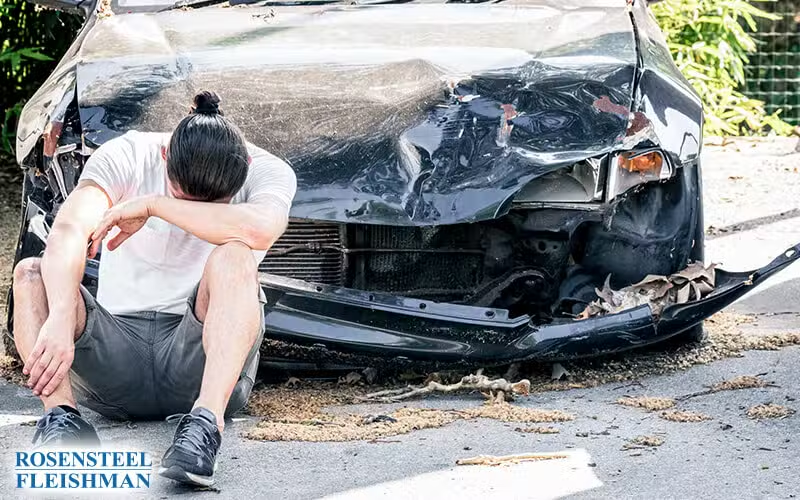

Highway crashes do not always happen during predictable rush hour congestion or in the middle of heavy commuter traffic. In North Carolina, a collision may occur late at night, during an off-peak afternoon, or on a relatively open stretch of interstate where traffic conditions initially appear straightforward. Claims arising from these crashes can still become complicated when several vehicles, insurance companies, commercial policies, or disputed versions of events are involved. A useful highway accident overview therefore looks beyond when the collision occurred and considers how responsibility, available coverage, medical documentation, and communication among insurers can affect the pace of a claim.
Article Brief
An accident outside ordinary traffic patterns may seem easier to evaluate because fewer vehicles or witnesses were present, but insurance claims can actually take longer when responsibility or coverage is uncertain. Multiple insurers may conduct separate investigations, request overlapping information, and wait for other companies to determine their positions before discussing payment.
- Several insurance companies can investigate the same collision at different speeds.
- Disagreements about fault may delay decisions about which policy should pay.
- Medical treatment and vehicle damage documentation can affect claim timing.
- Commercial vehicles or multiple injured people may introduce additional insurance issues.
- Organized records can make it easier to respond when insurers request information.
Why Multiple Insurance Companies Can Slow a Highway Accident Claim
The number of insurance companies involved often has more influence on the pace of a claim than the amount of traffic present when the crash occurred. A two-vehicle collision may involve only two liability carriers, while a highway accident involving several vehicles can bring multiple personal auto policies, commercial coverage, uninsured or underinsured motorist coverage, and sometimes additional policies into the same investigation.
People trying to understand their options after a complicated collision may review information from an auto crash injury law firm while still communicating directly with insurers. Understanding why delays happen can make those conversations easier to evaluate because an unanswered claim does not necessarily mean nothing is happening. In many cases, insurers are still collecting records, comparing statements, reviewing physical evidence, and deciding how responsibility should be divided.
Each insurance company generally conducts its own investigation rather than automatically accepting another carrier's conclusions. An adjuster may review photographs, driver statements, police records, vehicle damage, witness accounts, available video, and other evidence before deciding whether its insured bears responsibility. When several carriers are involved, those investigations may reach different conclusions.
Consider a collision on I-85 outside Charlotte during a relatively quiet period. One driver changes lanes, another brakes suddenly, and a third vehicle strikes the back of the slowing traffic. Even if the roadway was not crowded, the resulting claim may involve three insurers trying to determine which action started the sequence and whether more than one driver contributed to the crash. One carrier might argue that the lane change created the danger, while another could focus on following distance or driver reaction time.
That disagreement matters because an insurer may be reluctant to pay a substantial claim while believing another company should bear some or all of the responsibility. Instead of one straightforward evaluation, the injured person can find themselves dealing with separate adjusters who are examining the same event from different financial and legal perspectives.
Insurance limits can also complicate the process. If several people are injured and one driver's policy has limited liability coverage, the insurer may need to determine how available funds relate to multiple claims. That can make an otherwise ordinary investigation more complicated because the carrier must consider not only whether its insured is responsible but also the total amount of potential claims against the policy.
Common sources of delay can include:
- Waiting for statements from every driver involved in the collision
- Reviewing police reports and supplemental investigative records
- Determining whether personal or commercial insurance applies
- Resolving disagreements among insurers about responsibility
- Evaluating several injury claims against the same available coverage
A delayed response does not automatically indicate that a claim will be denied. It does, however, make careful recordkeeping particularly important. Keeping copies of correspondence, claim numbers, medical bills, repair estimates, photographs, and notes from insurer conversations can help someone understand what information has already been provided and what remains outstanding.
How Evidence and Coverage Questions Affect the Claim Timeline
Evidence becomes especially important when a highway collision occurs outside normal traffic patterns because there may be fewer independent witnesses available to explain what happened. A crash at 2 p.m. on an open interstate or shortly after midnight may involve only the drivers themselves, leaving insurers to rely heavily on physical evidence and electronic records.
Vehicle damage can sometimes help investigators evaluate how the collision developed. The location and severity of impact damage may support or challenge driver statements about lane position, direction of travel, or the sequence of contact. Photographs taken shortly after the crash can also preserve conditions that disappear once vehicles are moved and the roadway is cleared.
Other evidence may include traffic cameras, nearby business surveillance systems, dashboard cameras, electronic vehicle information, dispatch records, or commercial vehicle records. Not every crash will have these sources available, and some records may not be kept indefinitely. That is one reason the early stages of a claim can matter even when an insurer has not yet made a decision.
Police documentation can provide another important reference point, but an accident report does not necessarily resolve every insurance question. Reports may identify the drivers and vehicles, record statements, describe visible roadway conditions, or note citations. Insurers can still conduct their own evaluations and may interpret the available evidence differently.
Medical documentation creates another timeline within the claim. An insurer evaluating an injury claim generally needs enough information to understand what treatment was required, how the injury affected the person's daily activities, and whether future care may be needed. Attempting to evaluate a claim before the medical picture is reasonably clear can make it difficult to understand the full financial effect of the accident.
For example, a driver injured in a late evening crash on I-77 might initially believe that soreness will disappear within a few days. If symptoms continue and additional medical evaluation becomes necessary, the amount of treatment and related expenses may look very different several weeks later. An early settlement discussion that considers only the first medical visit may not reflect later treatment that was reasonably connected to the collision.
Coverage questions can create additional delays when the vehicle involved is not simply a privately owned passenger car. A delivery vehicle, rideshare vehicle, leased automobile, company truck, or vehicle being driven for work purposes can require closer examination of which insurance policy applies. Insurers may request employment information, trip details, vehicle ownership records, or policy documents before determining their coverage position.
The same issue can arise when an at-fault driver has inadequate insurance. An injured person's own policy may contain coverage that becomes relevant, but that does not necessarily mean the process immediately becomes simple. The carrier may still require documentation concerning the other driver's coverage and the value of the underlying claim before addressing additional benefits.
These overlapping investigations explain why a highway accident overview should consider more than the mechanics of the crash itself. Claim timing is often shaped by a combination of liability evidence, insurance contracts, medical information, and communication between several parties. A collision that happened in seconds can require weeks or longer to evaluate because each piece of that larger picture must be documented.
Making Careful Decisions While a Claim Is Still Developing
People dealing with a delayed accident claim can benefit from separating ordinary investigation time from unexplained inactivity. Some delays have understandable causes, such as waiting for medical records or reviewing several drivers' statements. Other situations may justify closer attention, particularly when requests repeatedly go unanswered or an insurer keeps seeking information that has already been provided.
It can help to maintain a simple timeline of the claim. Recording the date of the collision, medical appointments, conversations with adjusters, document submissions, repair inspections, and insurer responses creates a clearer picture of what has happened. That information can also make it easier to identify whether progress is being made or whether important issues remain unresolved.
Settlement decisions deserve the same careful approach. A payment offer can seem attractive when medical bills, transportation expenses, missed work, and vehicle repairs are placing pressure on a household budget. At the same time, accepting an injury settlement may involve resolving claims that cannot simply be reopened because additional expenses appear later. Understanding what an offer covers is therefore just as important as knowing the amount being offered.
A person should also pay attention to which insurer is making the request or offer. In a multi-vehicle accident, different carriers may be addressing different parts of the loss. One may be investigating property damage, another may be considering bodily injury liability, and a person's own insurer may be reviewing separate coverage. Keeping those roles clear can reduce confusion when several adjusters are communicating at once.
When a Legal Review May Help Clarify the Options
A legal review can be useful when fault remains disputed, several insurance companies are involved, injuries are significant, or it is difficult to determine whether an offer reasonably accounts for the losses connected to the crash. The purpose of getting information is not simply to make a claim move faster. It can also help someone understand what evidence matters, which coverage may apply, and what questions should be answered before making a final decision.
Rosensteel Fleishman Law Firm works with people dealing with car accident and injury claims in Charlotte and throughout North Carolina. Someone who wants to discuss the circumstances of a highway collision can contact the firm at 1-704-714-1450 for information about their situation and the options that may be available.
An unusual time of day or an open stretch of highway does not necessarily make an accident claim simple. Multiple insurers, conflicting accounts, medical developments, and coverage questions can all influence how long the process takes. Keeping organized records, understanding why information is being requested, and carefully evaluating decisions before resolving a claim can provide a steadier path forward.
Additional Car Accidents Articles
Multi Policy Insurance Considerations When One Policy Does Not Cover Every Loss
Insurance coverage after a serious car accident is not always limited to one policy. A collision may involve liability coverage, underinsured motorist coverage, medical payments coverage, an employer’s commercial policy, or another source of compensation. Identifying each applicable policy can affect how losses are documented, how negotiations develop, and whether a proposed resolution fairly reflects […]
What Happens When Vehicle Damage Appears Later Despite an Initial Inspection
Damage found days or weeks after a collision can complicate an insurance claim, especially when the cause of the crash or responsibility for the repairs remains disputed. A vehicle may look drivable during an initial roadside review in Charlotte, yet later show suspension problems, electrical faults, alignment issues, or damage hidden beneath exterior panels. When […]
How Claim Documentation Supports a Car Accident Case Without Perfect Records
After a car accident in Charlotte, recovery often develops one day at a time, and the records connected to that process may be less complete than expected. A person might visit an emergency room, schedule follow-up care with a family doctor, miss a physical therapy appointment because of pain, or forget to save a receipt […]