
After a crash, another driver’s pressure should not determine your account. Keep specific records of the encounter, later concerns, and practical disruptions while separating observations from conclusions.
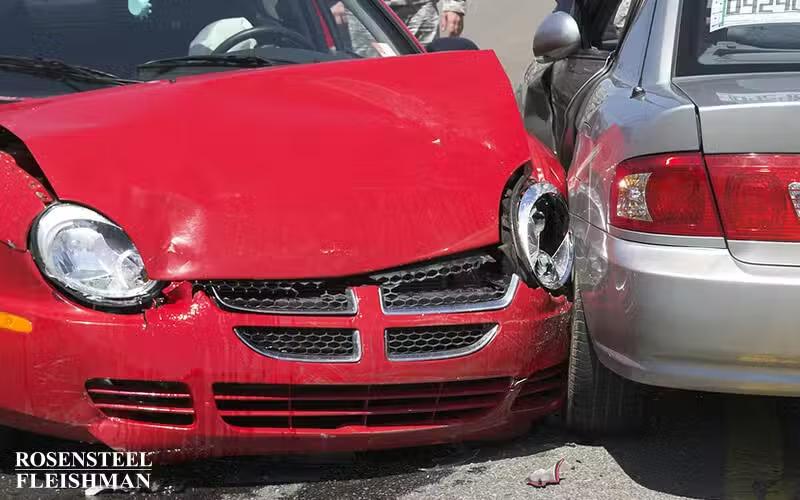

A collision involving more than one state can create separate legal questions. The law used to interpret an automobile insurance policy may differ from the law applied to the drivers’ conduct, damages, court procedure, or filing deadline. A North Carolina resident and a North Carolina crash location do not by themselves answer every part of that analysis.
Begin with the actual policy transaction and the insured interests before drawing a conclusion from the accident location.
North Carolina generally starts with where the insurance contract was made
In Fortune Insurance Company v. Owens, the North Carolina Supreme Court explained the rule known as lex loci contractus: an automobile policy is generally interpreted under the law of the state where the contract was entered, usually the state where the last act making the contract binding occurred. The Court also recognized a limited exception when North Carolina has a close connection to the interests insured by the policy.
G.S. 58-3-1 states that insurance contracts on property, lives, or interests in North Carolina, and contracts for which the applications are taken in North Carolina, are deemed made in this State and are subject to its law. Applying that language requires the policy, application, insured property or interests, and transaction history rather than residence alone.
Build a policy-formation record
- Complete policy form, declarations, application, endorsements, renewals, cancellation or reinstatement notices, and every version in effect near the loss
- State where the application was taken, who took it, method of application, signatures, delivery address, producer and insurer offices, and premium-payment history
- Named insureds, household members, listed drivers, vehicle identification numbers, title and registration states, garaging locations, and changes reported to the insurer
- Coverage at issue, including liability, medical payments, uninsured or underinsured motorist, collision, rental, umbrella, employer, or rideshare coverage
- Written coverage position identifying the policy language, governing-law position, factual assumptions, exclusions, limits, and reservations relied upon
Test the close-connection issue against insured interests
Fortune explains that the exception is tied to North Carolina’s connection with the interests insured, not merely the presence of an insured interest in this State at the time of an accident. It relied on Collins & Aikman Corp. v. Hartford Accident & Indemnity Co., which involved an insurance program covering substantial property concentrated in North Carolina. The comparison requires the actual policy and insured interests, not a residence or crash-location shortcut.
- Which policy is being interpreted and which person, vehicle, property, or risk that policy insured
- Where each insured vehicle was titled, registered, principally garaged, and used during the policy period
- Whether the insurer received and accepted a North Carolina address or a later change in risk
- Whether more than one policy must be interpreted and whether each policy was formed in the same state
- Which fact supports the proposed governing law and which source document establishes that fact
Keep policy law separate from the collision rules
The policy-law analysis should not be used as shorthand for where suit may be filed, which state’s traffic or negligence rules govern, how damages are measured, or when a claim must be filed. Those questions can use different choice-of-law and procedural rules. Record each issue, each proposed state law, and the reason for that choice in separate rows.
The related guide to North Carolina auto insurance after an out-of-state crash explains the practical notice, reporting, coverage, and evidence steps.
Rosensteel Fleishman Car Accident & Injury Lawyers provides information about consulting a Charlotte car accident lawyer when a claim involves policies or events in more than one state. Governing law, coverage, jurisdiction, liability, deadlines, and damages depend on the complete record.
Sources
Additional Car Accidents Articles
Options for Recovering Losses After a Crash Caused by Sun Glare
Sun glare may explain reduced visibility without settling responsibility for a crash. Clear records can help connect driving decisions, documented losses, and available insurance options.
Why Charlotte Crash Settlements May Require a Health Insurance Repayment Review
Health insurance payments can raise repayment questions when a crash claim settles. Clear records help distinguish what was billed, what was paid, and what a health plan is asking to recover.
How Speed and Visibility Shape Claim Outcomes After a Crash in Fog
Fog alone does not explain who caused a collision or what a claim may be worth. Speed, visibility evidence, responsibility, and documented losses each matter.



