
Health insurance payments can raise repayment questions when a crash claim settles. Clear records help distinguish what was billed, what was paid, and what a health plan is asking to recover.
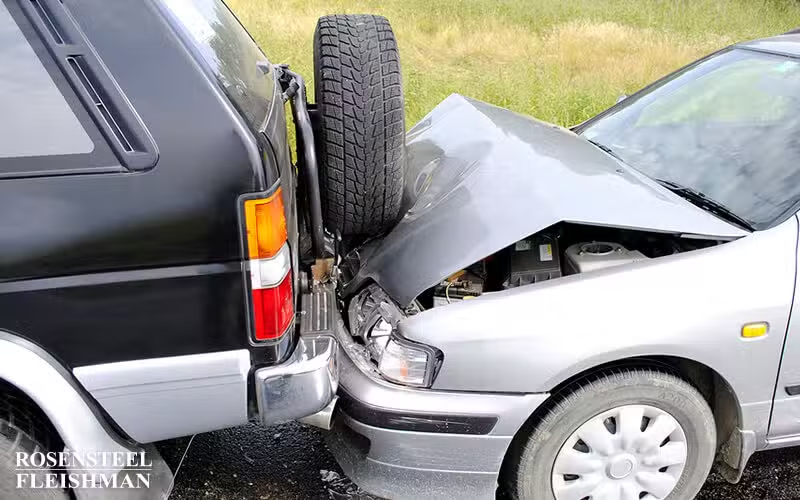

A driver may have very little time to react when another vehicle enters the lane, cargo falls into the road, an animal appears, a mechanical condition suddenly presents itself, or another danger develops. Calling an event an emergency does not automatically excuse the response. North Carolina law asks whether the evidence supports a sudden-emergency instruction and then evaluates the actor’s conduct in the circumstances that actually existed.
Sudden emergency does not erase ordinary care; it changes the circumstances in which the actor’s response is evaluated.
The doctrine has two threshold requirements
Holbrook v. Henley, reported in volume 118 of the North Carolina Court of Appeals Reports, describes two essential predicates: a sudden emergency requiring immediate action, and an emergency not created by the actor’s own negligence. If the evidence does not support both propositions, an emergency instruction should not replace the ordinary negligence analysis.
- Unexpected danger: identify the precise event and when it became reasonably perceptible
- Immediate response: measure the time and distance available after perception rather than labeling the interval short or long
- No contribution: examine whether speed, following distance, distraction, maintenance, lane position, or another earlier act helped create the danger
- Reasonable response: evaluate what an ordinarily prudent person could do in the same emergency, not what hindsight reveals later
- Causation: determine whether the alleged response or an earlier act caused or contributed to the collision and claimed harm
An unusual condition is not necessarily a sudden emergency
A condition can be serious without being unexpected. Weather, traffic congestion, a visible stopped vehicle, a known mechanical problem, or a developing hazard may leave time to slow, increase following distance, inspect, warn, or choose another course. The timeline must show what changed suddenly and why immediate action was required.
In the published decision Chahdi v. Mack, reported in volume 288 of the North Carolina Court of Appeals Reports, the court examined a requested sudden-emergency instruction in a case involving an asserted brake problem. The decision illustrates that a claimed mechanical condition does not end the inquiry. The evidence must support the legal predicates and the requested instruction in the context of the entire event.
Separate conduct before and after the danger appears
- Before: vehicle condition, inspections, prior warnings, speed, spacing, visibility, route knowledge, distraction, impairment, and compliance with ordinary traffic duties
- Onset: first objective indication of danger, first reasonable opportunity to perceive it, location, speed, distance, and alternative paths
- Response: braking, steering, warning, acceleration, lane movement, reaction interval, vehicle capability, and nearby traffic
- Impact: collision sequence, force, final positions, subsequent impacts, and whether another cause intervened
- Afterward: statements, diagnostic findings, repairs, photographs, video, vehicle data, and any later change to the scene or vehicle
The doctrine is not a lower duty of care
The emergency becomes part of the circumstances used to assess reasonable care. The question is not whether the actor selected the ideal maneuver. It is whether the response was reasonable for an ordinarily prudent person facing the same unexpected danger, while also accounting for any earlier conduct that may have produced or worsened the emergency.
An instruction is a procedural and evidentiary question, not a finding that a party wins. The judge must determine whether the record supports submitting the doctrine, and the factfinder must evaluate the evidence under the applicable instructions. Case-specific facts and current controlling authority matter.
Do not confuse an external emergency with medical incapacity
A conscious driver reacting to an unexpected external danger presents a different issue from a driver who claims a sudden medical inability to control the vehicle. The related guide to sudden incapacitation in a North Carolina car accident addresses warning symptoms, foreseeability, loss of control, and medical causation. A diagnosis should not be used as shorthand for an external emergency.
Evidence that can test an emergency claim
- Original dash-camera, surveillance, phone, infotainment, event-data, telematics, dispatch, and 911 files with timestamps and metadata
- Scene measurements, sight lines, grade, curves, lighting, weather, traffic, road surface, skid or tire evidence, debris, and final positions
- Vehicle inspection and maintenance evidence, diagnostic codes, component preservation, prior complaints, repair history, and post-event testing
- Witness statements preserved in their original form, with vantage point, timing, later corrections, and conflicts identified
- Alternative timelines that disclose assumptions about speed, perception, response, distance, vehicle capability, and uncertainty
Rosensteel Fleishman Car Accident & Injury Lawyers provides information about consulting a Charlotte car-accident lawyer when a sudden emergency is disputed. The availability of an instruction, reasonable care, causation, defenses, and damages depend on the complete evidence and current law.
Sources
Additional Car Accidents Articles
How Speed and Visibility Shape Claim Outcomes After a Crash in Fog
Fog alone does not explain who caused a collision or what a claim may be worth. Speed, visibility evidence, responsibility, and documented losses each matter.
Reducing Injury Risks When Giving First Aid After a Crash in Charlotte
Responsible recordkeeping after a crash means separating observations from assumptions. Learn what to document about assistance, follow-up appointments, and practical disruptions.
How Scene Safety Affects Charlotte Crash Documentation and Claims
Safety can limit what you document after a crash. Clear notes about timing, vehicle spacing, and scene changes help explain those limits without guessing about fault.



