
A lasting disability affects more than a claim file. Learn how to connect the collision timeline with documented changes in work, household responsibilities, and expenses without treating assumptions as evidence.
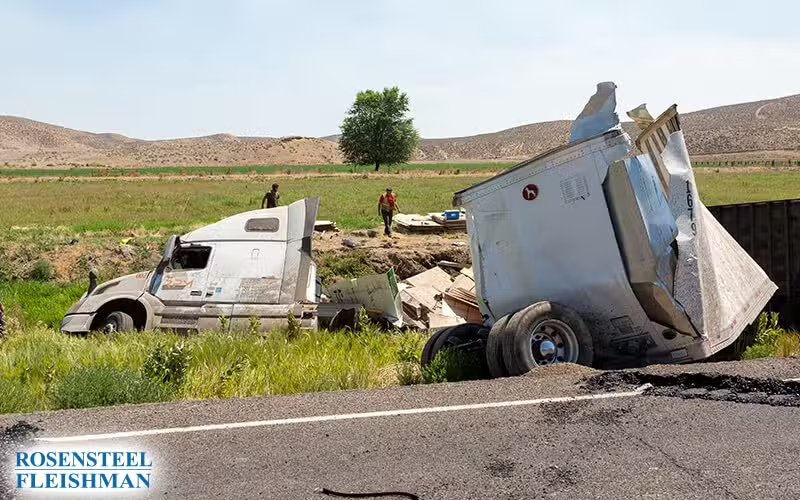

Processing a truck accident claim often involves more than just filing paperwork and waiting for a response. When dashcam footage becomes part of the review, it can introduce both clarity and complexity, especially in cases where fault or timing is disputed. In a growing city like Charlotte, NC, where commercial traffic regularly moves through major corridors like I-77 and I-85, these cases are becoming more common and more detailed.
Dashcams are increasingly used by trucking companies and individual drivers, which means more claims now include video evidence. While this can provide valuable insight, it can also extend the time it takes to evaluate a claim. As Attorney Corey Rosensteel explains, “Video evidence can answer key questions, but it often raises new ones that require closer review before decisions are made.”
Understanding how dashcam footage fits into the broader claims process can help reduce confusion and set more realistic expectations. For those exploring how a truck collision attorney may approach these situations, it helps to first see how video evidence is handled behind the scenes.
In many cases, delays tied to video review are not a sign of inaction but rather a reflection of how carefully claims are evaluated when multiple factors are involved. This article takes a closer look at how dashcam footage affects timelines, decision-making, and ongoing case reviews.
TLDR
Dashcam footage can influence truck accident claims by providing visual evidence, but it often leads to longer review times due to deeper analysis and verification.
- Video evidence may clarify fault but still require expert interpretation
- Claims can slow down when footage conflicts with reports or witness statements
- Insurance companies may use footage strategically during negotiations
- Missing or incomplete footage can raise new questions
- Understanding the review process helps set realistic expectations
How Dashcam Footage Affects Claim Timelines And Review Complexity
When a truck accident claim includes video evidence, the process often becomes more detailed than expected. While many assume that footage speeds up decisions, the reality is that it can introduce new layers of analysis. Adjusters and legal teams may need to review the footage frame by frame, compare it with police reports, and consult reconstruction professionals to interpret what actually happened.
This additional scrutiny can extend timelines, especially when the video does not clearly show every angle of the incident. For example, a dashcam may capture the moment of impact but miss the events leading up to it. In those situations, the footage becomes just one piece of a larger puzzle, rather than a complete answer.
In Charlotte, construction and work zones frequently impact traffic flow, particularly around expanding areas near Uptown or along I-485. These environments can make video interpretation more complicated, as lane shifts, signage, and temporary barriers may not be fully visible or easy to understand in the footage.
Common Reasons Video Evidence Slows Down Claims
Several factors contribute to delays when dashcam footage is involved, many of which are not immediately obvious to those filing a claim. While video can be helpful, it often requires careful validation before it can be used effectively.
- Footage must be authenticated to ensure it has not been altered
- Multiple camera angles may need to be reviewed for accuracy
- Conflicts between video and witness statements require reconciliation
- Experts may be needed to interpret speed, distance, and timing
- Insurance companies may request additional documentation tied to the footage
In the middle of this process, those navigating a claim may feel uncertain about why things are taking longer than expected. Understanding that these steps are part of a thorough review can help reduce frustration and provide context for the delay.
It is also worth noting that insurance companies may use dashcam footage strategically. In some cases, they may focus on specific moments that support their position while minimizing other details. This makes it important for all evidence to be reviewed carefully and in full context.
What To Expect When Dashcam Evidence Is Part Of An Ongoing Case
As a claim moves forward, dashcam footage often continues to play a role beyond the initial review. It can influence negotiations, settlement discussions, and even how liability is shared between parties. However, its impact depends heavily on how clearly the footage supports a specific version of events.
Consider a situation where a driver in Charlotte is involved in a collision with a commercial truck near a work zone on I-77. The truck’s dashcam shows the moment of impact but does not clearly capture the lane markings due to construction changes. While the footage confirms the collision, it leaves room for interpretation about who was at fault. This type of ambiguity can lead to extended discussions and additional investigation.
Another overlooked issue is missing or incomplete footage. Sometimes, dashcams fail to record continuously or overwrite older data. When expected footage is unavailable, it can raise questions that slow down the claim even further.
Why Careful Review Matters In Real World Outcomes
Taking the time to fully evaluate dashcam footage can ultimately lead to more accurate claim outcomes, even if it requires patience. Rushing through the process may result in decisions that do not reflect the full scope of what happened.
Working with a firm like Rosensteel Fleishman can help bring clarity to these situations. Their experience with truck accident cases in Charlotte allows them to approach video evidence with a balanced and practical perspective. Instead of relying on assumptions, they focus on how each piece of evidence fits into the overall case.
For those dealing with the aftermath of a truck accident, understanding the role of dashcam footage can make the process feel more manageable. While delays can be frustrating, they are often a sign that the claim is being reviewed with the level of detail it deserves.
Taking a steady and informed approach helps ensure that important details are not overlooked, especially when video evidence plays a central role in the case.
Additional Trucking Accidents Articles
Reducing Reinjury Risk With Physical Therapy After a Truck Crash in Charlotte
Concerns about reinjury involve medical questions that claim records cannot answer. Learn how to organize physical therapy documentation, practical expenses, and scene evidence without drawing unsupported conclusions.
When Mobility Loss After a Charlotte, NC Truck Crash Has No Clear Diagnosis
An unclear diagnosis does not prevent a family from recording practical changes after a truck crash. Keep observations, added expenses, and unanswered claim questions separate.
How Insurers Review Worsening Pain After a Truck Crash
An early insurance review may start with an incomplete account. Dated records can help explain later changes in pain, work limitations, and expenses without treating symptoms as proof of an injury.


