
Lane markings, turning movements, and crosswalk locations can help explain a truck collision, but they cannot establish an injury. Clear records help separate crash circumstances from documented losses.
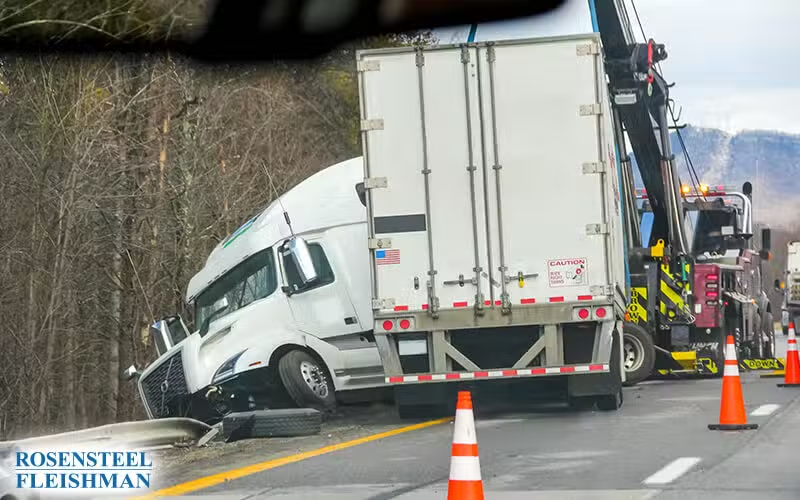

A highway tractor-trailer crash may be recorded not only by drivers, witnesses, vehicles, and law enforcement, but also by transportation and public-safety systems used to detect an incident, warn travelers, manage lanes, dispatch responders, arrange traffic control, and clear the roadway. These systems are operational tools. Their records, clocks, fields, and retention practices can differ.
A highway-operations record should identify the exact incident, roadway segment, system, agency, event type, opening and closing times, lane effect, source file, clock basis, custodian, request history, and limitation without assuming that every system retained the same data.
Define the incident before naming a system
- Collision date, local and UTC time when available, route, direction, county, municipality, mile or reference marker, interchange, ramp, lane, shoulder, and known event number
- First reported hazard, first vehicle contact, later impact, disabled vehicle, spill, fire, rollover, cargo issue, medical response, lane closure, detour, recovery, and reopening kept as separate events
- Investigating agency, fire, EMS, towing or recovery company, transportation management center, roadway owner, contractor, and utility identified by source
- Uncertain route name, direction, jurisdiction, time zone, reference point, or event match left open until reconciled
Inventory the operational systems that may have participated
NCDOT’s May 2026 traveler-information release describes road and lane-closure entries, route alerts, highway-sign messages and live camera views. It also says the system provides an archive of events affecting state-maintained roads. That archive should be distinguished from a complete investigation file or retained camera recording; ask the custodian which event fields and files exist for the particular collision.
- DriveNC or Traveler Information Management System incident entry, event identifier, status history, narrative, map location, lane effect, detour, opening and closing time, and revision history when retained
- Transportation management center operator log, notification, radio or telephone entry, message sign action, lane-control action, camera observation, detector alert, service patrol activity, and roadway-contractor communication
- Law-enforcement, fire, EMS, towing, hazardous-material, utility, and transportation computer-aided dispatch or incident numbers mapped without assuming that numbering systems match
- Public web page, screenshot, email, alert, feed, export, native system record, database report, photograph, video, or audio labeled by format and source
Understand why incident-management records exist
The Federal Highway Administration describes traffic incident management as a coordinated process to detect, respond to, and clear incidents so traffic flow can be restored safely and efficiently. A record created for detection, traveler warning, response coordination, lane management, responder safety, or clearance may omit collision details that were not needed for that operational purpose.
- Incident detection source and time kept separate from the collision time
- Operator observation kept separate from information relayed by another agency or caller
- Lane closed, blocked, restricted, reopened, or reported clear tied to the exact direction and segment
- Camera selected, preset moved, recording capability, export method, and retention response documented rather than inferred from a visible camera housing
Request the record from the actual custodian
N.C. Gen. Stat. § 132-1 defines public records and includes records made or received in connection with public business, subject to other law. Whether a specific operations record exists, is held by a particular agency, is disclosable, or includes exempt or confidential material requires a current custodian response.
- Agency, office, unit, system owner, vendor or contractor role, records contact, request date, incident identifiers, date range, requested format, and delivery method
- Acknowledgment, clarification, search performed, estimated fee, partial production, redaction, withheld category, no-record response, referral, and appeal or follow-up path
- Original production preserved with cover message, metadata, file names, folder structure, data dictionary, export settings, and any statement about missing fields or retention
- Recurring check only when justified by a pending search or preservation question; no repeated request that overwrites the earlier response history
Normalize clocks without erasing the source time
- Displayed timestamp, stored timestamp, time zone, daylight-saving status, device or server clock, known offset, and conversion method
- Detection, entry creation, dispatch, acknowledgment, unit assignment, arrival, lane closure, message activation, tow request, clearance, and reopening retained as different timestamps
- Estimated or rounded time labeled as such, with the source language preserved
- Later correction, export-generation time, or database-update time kept separate from the event time
Authenticate the file before using its summary
North Carolina Rule of Evidence 901 addresses authentication or identification. Preserve who produced the file, which system and incident it represents, how it was exported, the field definitions, clock information, completeness statement, and any conversion or annotation. A screenshot or spreadsheet assembled later should not be described as the native operations record.
Compare operations data with roadway-location evidence
The related guide to identifying the exact roadway location after a highway truck crash explains route names, direction, mile or reference markers, interchanges, ramps, lanes, collision areas, and final positions. Use that location model to test whether an operations record concerns the same incident rather than matching only a date or highway number.
- Record conflict, missing interval, duplicate incident, merged event, incorrect map pin, changed narrative, or unexplained closure status retained for review
- Operational record compared with the crash report, dispatch, responder, tow, vehicle, witness, photographic, and roadway evidence
- No assumption that an incident entry, closure duration, warning message, camera view, or clearance action establishes how the crash occurred
- No assumption that absence from a public traveler page means the agency created no underlying record
Rosensteel Fleishman Car Accident & Injury Lawyers provides general information about Charlotte tractor-trailer crash matters involving highway operations records. Record availability, access, interpretation, preservation, responsibility, and legal significance depend on the actual agency systems and collision facts.
Sources
Additional Trucking Accidents Articles
Living With Permanent Disabilities After a Truck Crash Involving Multiple Vehicles
A lasting disability affects more than a claim file. Learn how to connect the collision timeline with documented changes in work, household responsibilities, and expenses without treating assumptions as evidence.
Reducing Reinjury Risk With Physical Therapy After a Truck Crash in Charlotte
Concerns about reinjury involve medical questions that claim records cannot answer. Learn how to organize physical therapy documentation, practical expenses, and scene evidence without drawing unsupported conclusions.
When Mobility Loss After a Charlotte, NC Truck Crash Has No Clear Diagnosis
An unclear diagnosis does not prevent a family from recording practical changes after a truck crash. Keep observations, added expenses, and unanswered claim questions separate.



