
Truck crash injuries can affect far more than a person’s ability to work or attend medical appointments. They may also change how someone cooks, cleans, shops, handles yardwork, cares for children, or completes basic home maintenance. Insurers handling claims with several involved parties often examine who caused the collision, which insurance policies apply, and whether […]
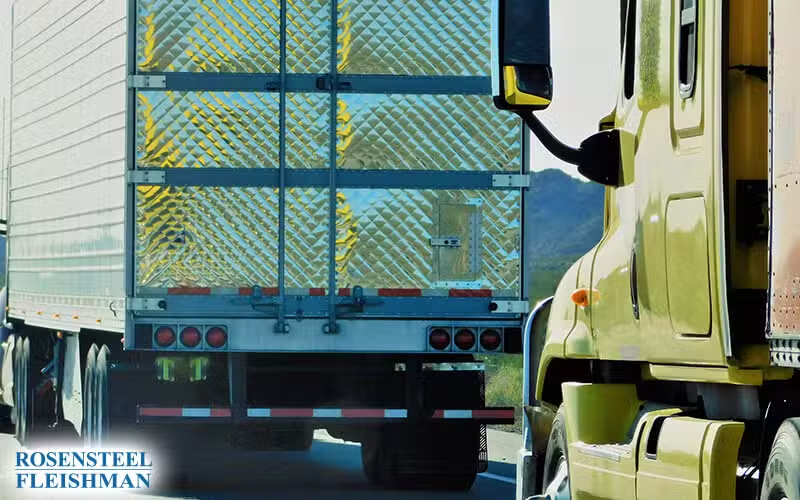

A jackknife event occurs when a tractor and trailer lose their normal alignment and form an acute angle. The trailer can sweep across lanes, the tractor can rotate, and other vehicles may be struck during the developing sequence or afterward.
Jackknife describes a tractor-trailer configuration after loss of alignment; it does not identify the initiating cause.
Build the event sequence before assigning fault
- Traffic, speed, following distance, grade, curve, weather, pavement, and visibility before the instability
- Hazard perception, throttle, service braking, trailer braking, steering, lane movement, and driver response
- Initial loss of traction or alignment, tractor and trailer rotation, coupling forces, and cargo movement
- First impact, later impacts, barrier contact, rollover, separation, and final positions
- Actions by other vehicles that created, worsened, avoided, or responded to the event
Inspect the complete braking system
49 C.F.R. § 393.48 generally requires brakes on specified wheels, subject to stated exceptions. A jackknife analysis can require tractor and trailer brake condition, adjustment, air system, antilock function, warning information, compatibility, and actual braking inputs.
Document components before repair or destructive testing. Preserve fault codes, electronic records, inspection measurements, photographs, removed parts, air-system condition, and a chain of custody.
Review maintenance and defect history
49 C.F.R. § 396.3 addresses systematic inspection, repair, and maintenance and specified vehicle records for covered carriers.
- Driver inspection reports, roadside inspections, work orders, invoices, parts, and return-to-service decisions
- Brake, tire, suspension, steering, coupling, stability-control, and warning-system history
- Tractor and trailer ownership, leases, dates of control, mileage, and responsible maintenance provider
- Prior reported symptoms, follow-up, unresolved defects, and post-crash changes
Evaluate tire-road traction and conditions
Measure pavement, grade, curve, contamination, water, ice, snow, debris, and tire condition. Photograph temporary evidence and obtain weather, treatment, road-work, and incident records. A low-friction surface can interact with speed, braking, steering, tires, and vehicle configuration.
Examine cargo distribution and movement
49 C.F.R. § 393.100 addresses preventing cargo from leaking, spilling, blowing, or falling and immobilizing or securing cargo so shifting does not adversely affect stability or maneuverability.
Preserve the bill of lading, loading diagram, seal, weight and axle records, securement equipment, photographs, inspection records, and cargo condition. A load can be within total weight limits yet poorly distributed or inadequately secured.
Keep electronic sources separate
- Event data recorder and engine control information
- Antilock-brake, stability-control, collision-warning, and automatic-braking modules
- Forward, rear, side, and driver-facing cameras
- Telematics, GPS, dispatch, phone, electronic logs, and weather or road alerts
- Native files, metadata, clock settings, software, calibration, and download method
Test driver-response hypotheses
Possible questions include excessive speed for conditions, short following distance, delayed perception, abrupt or uneven braking, steering input, fatigue, distraction, training, and response to another vehicle. Each hypothesis should be aligned with the physical and electronic timeline.
Do not confuse post-impact damage with a pre-impact defect
Collision forces can damage brakes, tires, suspension, coupling, cargo, wiring, modules, and sensors. Compare fracture surfaces, deformation, maintenance history, fault timing, witness information, and technical analysis to determine when a condition arose.
Use competing causal models
Construct and test more than one sequence: driver response to a traffic hazard, mechanical imbalance, traction loss, cargo shift, another vehicle’s movement, or combined causes. State which evidence supports or weakens each model and which unknown would change the result.
The related truck-collision cause map shows how driver, vehicle, cargo, carrier, roadway, and other-road-user evidence can be evaluated without assuming the category proves the event.
Rosensteel Fleishman Car Accident & Injury Lawyers provides information about jackknife truck collisions in Charlotte. Early controlled inspection and native-data preservation are central to distinguishing the initiating event from the final configuration.
Sources
Additional Trucking Accidents Articles
Joint Trauma Truck Collisions Can Cause and How Doctors Confirm It
After a serious truck crash, checking for joint injuries early can reduce the risk of untreated damage becoming harder to manage. The force of a collision may injure cartilage, ligaments, tendons, bones, or the joint capsule even when swelling and pain seem manageable at first. In Charlotte, anyone experiencing stiffness, weakness, instability, or reduced movement […]
Documenting Family Impact Truck Accident Injuries in Charlotte Households
When a serious truck collision disrupts a Charlotte family’s daily life, medical records often become the clearest evidence of what changed and why. Insurance adjusters review those records to determine whether injuries are connected to the crash, how treatment progressed, and whether ongoing limitations are medically supported. That review can affect compensation for medical expenses, […]
How Imaging Confirms Compound Fractures Truck Crash Injuries Can Cause
Compound fractures are medical emergencies that require fast treatment, careful imaging, and thorough documentation. When these injuries result from a collision involving a commercial truck, the medical issues may be clear long before the insurance claim is ready for resolution. Questions about responsibility, insurance coverage, vehicle maintenance, and employment relationships can add months of investigation. […]



