
Accident recovery rarely follows a perfectly straight path, especially when early symptoms change or new limitations appear after a person returns to normal routines. In Charlotte, someone injured in a collision may begin with goals such as reducing pain, restoring movement, returning to work, or safely resuming everyday activities, then adjust those goals as doctors […]
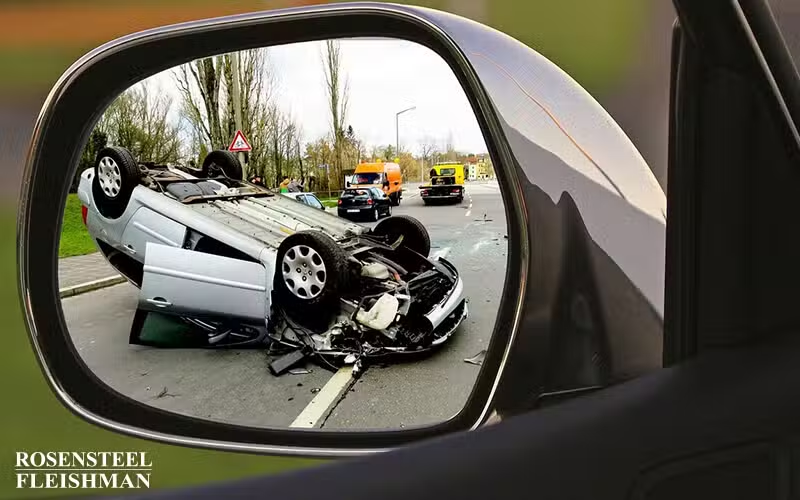

Terms such as rear-end, angle, head-on, sideswipe, rollover, and fixed-object describe parts of a crash configuration. They do not by themselves identify the cause, assign legal responsibility, establish an injury, or determine insurance coverage.
A useful crash-type review starts with the label in its original record, then tests it against vehicle paths, traffic controls, timing, physical evidence, and reliable accounts.
Start with the source of the label
The N.C. Department of Transportation explains that its crash data comes from reports completed by law-enforcement officers and records the location, date, crash type, and involved parties. Its database is an inventory of reported crashes; unreported events are outside that dataset.
Record whether a term came from the crash report, a data table, a witness, an insurer, a repair document, or a later reviewer. A category copied from one source should not be converted into an eyewitness account or a technical reconstruction.
Read common configurations narrowly
- Rear-end: the reporting manual focuses on vehicles traveling in the same direction, one behind the other, without a turn. The location of visible damage alone does not determine the classification.
- Angle: vehicles approach on crossing paths. An angle label does not establish which signal applied, whether a driver had a clear view, or who failed to yield.
- Head-on: vehicles traveling in opposite directions on generally parallel paths come into conflict. The label does not identify why either vehicle entered the conflict area.
- Sideswipe: side contact may occur between vehicles traveling in the same or opposite directions. Lane position, steering, road width, and the sequence before contact still require evidence.
- Fixed object, parked vehicle, pedestrian, pedalcyclist, overturn, or other non-collision event: the category identifies an object, road user, or event type, but it may not describe every event in a longer sequence.
Separate configuration from cause
A rear-end crash can involve following distance, a stopped vehicle, a turn, visibility, road conditions, mechanical questions, or several contacts. An angle crash can involve signal timing, sight lines, turning paths, or a driveway. A head-on label can involve a centerline, passing movement, curve, obstruction, avoidance maneuver, or wrong-way travel. List plausible questions without treating any one explanation as established.
Build the event record
- Each vehicle or road user, travel direction, lane, intended movement, and position before and after contact
- Traffic signals, signs, markings, road geometry, lighting, weather, surface, construction, and sight obstructions
- Every contact or avoidance event in sequence when more than one impact or participant is involved
- Original photographs, video, report versions, witness accounts, vehicle records, and the source and time for each item
The related guide to reading a North Carolina crash report explains how to review coded fields, narrative, diagram, versions, and information gaps without treating the report as a final civil-liability decision.
Keep injury and legal conclusions separate
A collision label does not diagnose an injury or establish medical causation. Record symptoms and function accurately and leave diagnosis and treatment to qualified clinicians. Legal responsibility depends on the applicable duties, facts, causal sequence, and defenses rather than the crash-type name alone.
Rosensteel Fleishman Car Accident & Injury Lawyers provides information about collision records in Charlotte car-accident claims.
Sources
Additional Car Accidents Articles
Occupant Safety Considerations in Crashes Involving Unusual Seating Positions
Families often think about crash safety in terms of seat belts, airbags, and where children are seated, but unusual seating positions can change how those protections work. A passenger who is reclined far back, leaning toward the center console, resting their feet on the dashboard, or sitting at an angle may not interact with a […]
Keeping Records After Claim Closure in Case New Issues Develop
After an insurance claim closes, the paperwork connected to the accident can still matter months or even years later. A driver may feel relieved when repairs are completed, medical bills appear resolved, and the insurer marks the file closed, but later developments can make old records important again. Symptoms may return, a medical provider may […]
Insurance Coverage Gaps for Injury Care After Benefits Run Out
A car accident can create medical needs that continue long after the first emergency room visit, particularly when rehabilitation, physical therapy, diagnostic testing, or follow-up treatment stretches across several months. For people recovering in Charlotte, the financial side of that care can become almost as complicated as the treatment itself. Different insurance policies may pay […]



