
Fog alone does not explain who caused a collision or what a claim may be worth. Speed, visibility evidence, responsibility, and documented losses each matter.
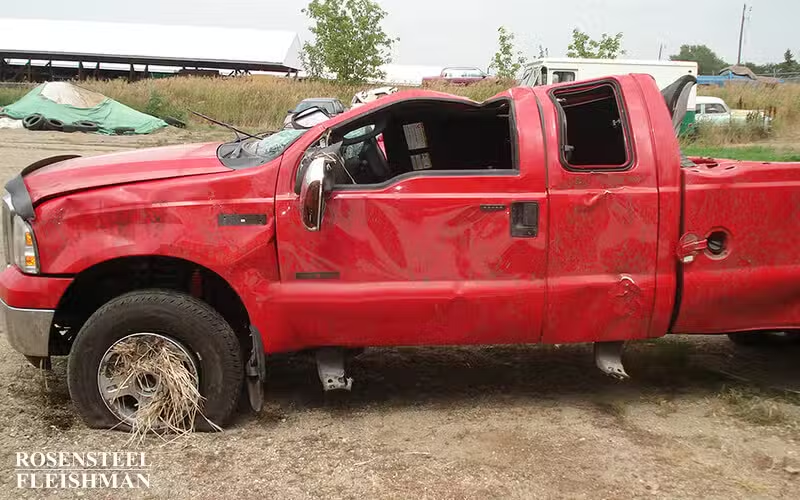

If a vehicle stalls, hangs up, or is trapped on railroad tracks, the immediate task is to get every occupant out and away from the tracks rather than remain with the vehicle or try to protect property.
A train can arrive before a person sees or hears it and cannot stop like a road vehicle. Emergency action comes before photographs, vehicle retrieval, or a legal assessment.
Get everyone out and move away from the tracks
The current North Carolina Driver Handbook, available from the NCDMV Driving Handbooks page, instructs occupants of a vehicle stalled on or near railroad tracks to get out immediately and move away from the vehicle and tracks. Do not spend time collecting property or trying repeated restarts while people remain exposed.
If a train is approaching, official rail-safety guidance directs people away from the tracks and toward the direction from which the train is approaching at an angle, reducing exposure to debris carried forward by an impact. The safest available route still depends on the scene, traffic, terrain, mobility, and immediate hazards. Call 911 when safely able.
Use the blue Emergency Notification System sign
The Federal Railroad Administration explains that the blue-and-white Emergency Notification System sign provides the railroad’s emergency telephone number and the U.S. Department of Transportation crossing identification number. That identifier tells the railroad the exact crossing.
- Call the railroad emergency number shown on the sign after reaching a safer location
- Give the crossing identification number, state, road or street, and direction of travel
- State that a vehicle or other obstruction is on the tracks and describe any approaching train, injuries, fire, fuel, or other immediate danger
- Call 911 and follow emergency instructions; do not assume one call automatically reached every responder
- Remain away from the tracks and vehicle until railroad and emergency personnel state that the area is safe
The crossing itself can explain why a vehicle became trapped
After the emergency has been addressed, identify whether the vehicle stalled mechanically, bottomed out on a high-profile crossing, entered without clearance beyond the tracks, was directed by traffic, encountered a surface defect, was struck, or became disabled for another reason. Avoid assigning the cause from a photograph of the final position alone.
- Crossing name, road, DOT crossing number, railroad, track count, approach direction, lanes, signs, signals, gates, pavement markings, grade, surface, flangeways, and clearance
- Vehicle identity, wheelbase, ground clearance, trailer or equipment dimensions, load, mechanical condition, damage, prior changes, and post-event movement
- Traffic queue, signal cycle, gate and light sequence, horn or bell, train direction and speed evidence, sight distance, lighting, weather, and obstructions
- 911, ENS, dispatch, railroad, event-recorder, signal, camera, witness, tow, inspection, maintenance, complaint, and crossing-inventory records
- Time source for every call, video, event, observation, and later correction
North Carolina law identifies stop circumstances
G.S. 20-142.1 requires a driver to stop between 15 and 50 feet from the nearest rail under specified warning, gate, flagger, audible-signal, visibility, and hazardous-proximity circumstances. It also prohibits driving through, around, or under a closed or moving crossing gate and states that a violation does not constitute negligence per se.
A stalled vehicle can present additional statutory, negligence, crossing-condition, railroad-operation, causation, and defense questions. The emergency instruction to leave the vehicle should not be converted into a complete civil-liability conclusion.
Use the related guide for the broader crossing analysis
The related guide to North Carolina railroad-crossing duties and evidence covers stopping, available space beyond the tracks, train movement, active warnings, crossing condition, government and railroad records, and possible responsible roles.
Rosensteel Fleishman Car Accident & Injury Lawyers provides general information about discussing a North Carolina vehicle collision at a railroad crossing. Applicable duties, possible parties, preservation, causation, defenses, damages, and deadlines depend on the individual crossing and record.
Sources
Additional Car Accidents Articles
Reducing Injury Risks When Giving First Aid After a Crash in Charlotte
Responsible recordkeeping after a crash means separating observations from assumptions. Learn what to document about assistance, follow-up appointments, and practical disruptions.
How Scene Safety Affects Charlotte Crash Documentation and Claims
Safety can limit what you document after a crash. Clear notes about timing, vehicle spacing, and scene changes help explain those limits without guessing about fault.
When an Older Driver’s Medical Condition Affects Crash Liability and Costs
A medical condition alone does not explain a crash. Connecting records to the collision and tracking bills that have not arrived helps keep fault questions separate from unresolved costs.



