
Truck crash injuries can affect far more than a person’s ability to work or attend medical appointments. They may also change how someone cooks, cleans, shops, handles yardwork, cares for children, or completes basic home maintenance. Insurers handling claims with several involved parties often examine who caused the collision, which insurance policies apply, and whether […]
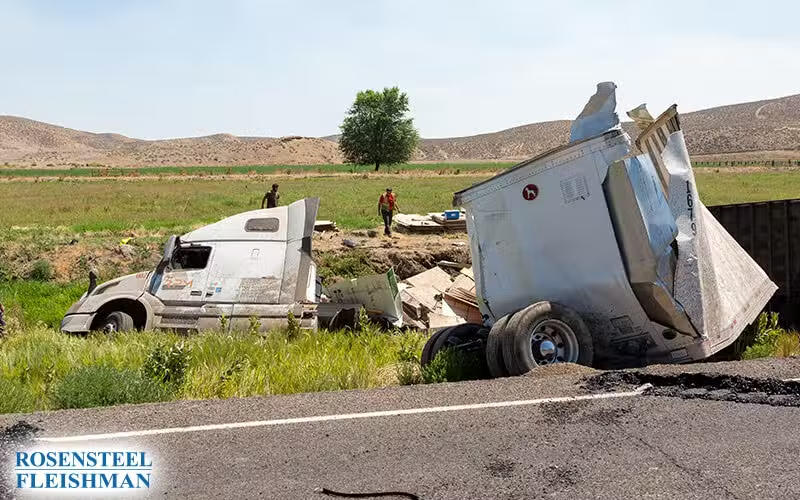

Interstate truck collisions can unfold across several lanes and involve long approach distances, changing traffic queues, ramps, work zones, weather, and secondary impacts. A reliable reconstruction uses measurements and synchronized sources rather than adjectives about speed or severity.
Highway speed is a measured input to a collision sequence, not a conclusion about fault or injury.
Define the complete event window
- Traffic and truck movement before a hazard became detectable
- Perception opportunity, driver response, braking, steering, and available alternatives
- Initial impact, vehicle interaction, rotation, rollover, barrier or object contacts, and final positions
- Secondary collisions and post-impact actions
- Time range required from each camera, electronic system, witness, and record custodian
Measure speed in context
North Carolina G.S. 20-141 addresses speed limits and reasonable and prudent operation under conditions and hazards.
Compare posted and advisory speeds with traffic flow, sight distance, grade, curve, lane width, weather, lighting, work activity, vehicle weight, following distance, stopping distance, and the time a hazard became visible. A numerical limit does not answer every reasonable-speed question.
Preserve independent scene sources
- Traffic-management, toll, business, dash, fleet, emergency, and other vehicle video
- Road survey, geometry, pavement, marks, debris, gouges, barrier contacts, and final positions
- 911 timing, dispatch, responder photographs, lane closures, and incident records
- Weather observations, lighting, construction, traffic-control, and prior condition reports
- Witness locations, viewing conditions, estimates, contemporaneous statements, and uncertainty
Keep electronic systems distinct
The National Highway Traffic Safety Administration describes an event data recorder as recording technical vehicle and occupant information for a brief period before, during, and after a crash, with capability varying by system.
An engine module, brake or stability system, collision-warning system, camera, telematics platform, electronic logging device, phone, or dispatch application may cover another interval. Preserve native files, metadata, time settings, vehicle and driver assignments, hardware, software, calibration, and download method.
Evaluate perception and response
Identify when a traffic queue, stopped vehicle, lane intrusion, warning, work zone, debris, animal, weather condition, or other hazard first could have been perceived. Test visibility, attention, reaction time assumptions, braking onset, steering, escape space, and whether another road user changed the available response.
Fatigue analysis is more than a log total
The FMCSA hours-of-service summary describes driving, duty-window, break, weekly, sleeper-berth, and adverse-condition provisions for covered drivers. The applicable rules and exceptions depend on the operation.
Compare logs with dispatch, fuel, toll, location, receipts, communications, vehicle motion, prior work, sleep opportunity, medical factors, and observed behavior. Compliance does not establish alertness, and a violation requires a causal connection to the event.
Inspect mechanical response
Document brakes, tires, steering, suspension, coupling, load, warning systems, stability control, and collision-mitigation equipment. Determine whether a condition existed before impact and how it changed stopping, steering, stability, or avoidance.
Separate collision mechanics from medical causation
Vehicle mass, speed change, direction, intrusion, restraint, occupant position, contact, and post-impact motion can inform mechanism. Medical diagnosis and causal relationship require person-specific clinical evidence and, where needed, qualified opinion.
State assumptions and ranges
Use a source and calculation ledger for measurements, coefficients, timing, data definitions, vehicle configuration, weights, and alternative inputs. Explain which conclusions remain stable and which change materially under another reasonable assumption.
The related truck-collision evidence guide integrates reconstruction with participants, preservation, medical causation, damages, insurance, defenses, and version control.
Rosensteel Fleishman Car Accident & Injury Lawyers provides information about interstate truck collisions near Charlotte. Reconstruction should expose uncertainty while preserving every source needed to test it.
Sources
Additional Trucking Accidents Articles
Joint Trauma Truck Collisions Can Cause and How Doctors Confirm It
After a serious truck crash, checking for joint injuries early can reduce the risk of untreated damage becoming harder to manage. The force of a collision may injure cartilage, ligaments, tendons, bones, or the joint capsule even when swelling and pain seem manageable at first. In Charlotte, anyone experiencing stiffness, weakness, instability, or reduced movement […]
Documenting Family Impact Truck Accident Injuries in Charlotte Households
When a serious truck collision disrupts a Charlotte family’s daily life, medical records often become the clearest evidence of what changed and why. Insurance adjusters review those records to determine whether injuries are connected to the crash, how treatment progressed, and whether ongoing limitations are medically supported. That review can affect compensation for medical expenses, […]
How Imaging Confirms Compound Fractures Truck Crash Injuries Can Cause
Compound fractures are medical emergencies that require fast treatment, careful imaging, and thorough documentation. When these injuries result from a collision involving a commercial truck, the medical issues may be clear long before the insurance claim is ready for resolution. Questions about responsibility, insurance coverage, vehicle maintenance, and employment relationships can add months of investigation. […]



