What happens when a driver says they never saw a cyclist, but the cyclist believes they were clearly visible? Questions like this often arise after bicycle crashes because visibility depends on more than whether a person was physically present on the road. Lighting, traffic, parked vehicles, weather, road design, vehicle blind spots, and the movements […]
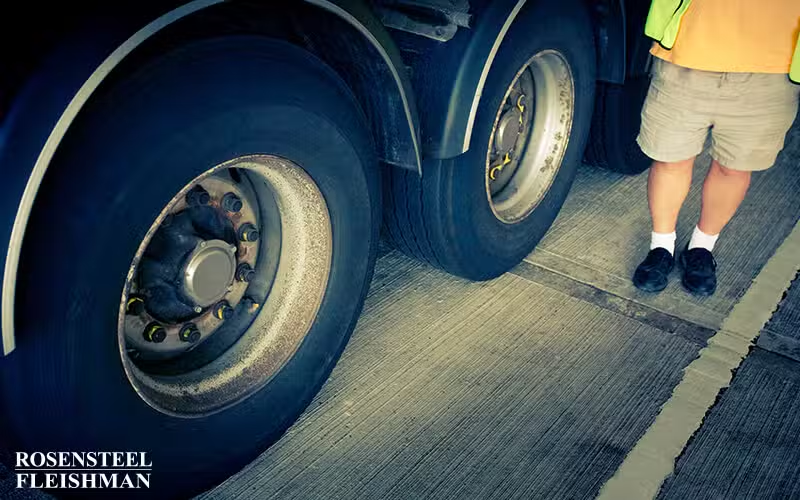

A pickup, box truck, work truck, or other vehicle may be titled to one family member, insured through a household or business, maintained by another person, and driven for a mixed personal and business trip. The family connection alone does not answer who is legally responsible or which coverage applies.
Family relationship, vehicle ownership, permission, business use, agency, and insurance are separate questions that require separate evidence.
Start with vehicle and trip identity
- Title, registration, purchase, financing, lease, possession, keys, principal garage, and maintenance
- Driver, permission, restrictions, household, employment, business, and family relationships
- Origin, destination, purpose, route, cargo, passengers, payment, errands, and benefit from the trip
- Who could direct the driver, restrict use, repair the vehicle, or remove access
- Personal-auto, commercial-auto, umbrella, excess, household, and business policies
Understand what ownership evidence does
G.S. 20-71.1 describes prima facie effects of vehicle ownership and registration evidence in covered motor-vehicle injury, property-damage, or death actions. The statute should be read with the evidence and applicable law; it does not make the family label a substitute for proof.
Determine actual permission and use
Preserve messages, calendars, receipts, location data, work orders, cargo records, compensation, prior use, key access, household practices, and statements made near the event. Distinguish express permission, implied permission, disputed restrictions, and a use outside any granted permission.
Separate agency or business benefit
Ask whether the driver was performing work, a family errand, a personal trip, a mixed-purpose trip, or an independent task. Identify the person or company that requested the trip, selected the route or schedule, supplied the vehicle, paid expenses, controlled the work, and received the benefit.
Read every policy, not just the insurance card
G.S. 20-279.21 contains requirements for North Carolina motor-vehicle liability policies, including described insured-use and uninsured-motorist provisions. Current statutory language, policy forms, vehicle status, named insureds, permission, exclusions, endorsements, and other-insurance clauses all matter.
The North Carolina Department of Insurance provides post-accident consumer information about reporting and handling vehicle insurance claims. Obtain the full policy and written coverage position rather than relying on a card or telephone summary.
The related truck insurance guide shows how policy and insured relationships can be mapped without treating coverage as fault.
Keep negligent operation and other theories distinct
First reconstruct how the collision occurred. Then evaluate the driver’s conduct, vehicle condition, owner conduct, entrustment facts, employment or agency evidence, and any company decision. Each theory needs its own facts and causal link.
Test common assumptions
- The registered owner may not have been the person who selected or controlled the trip
- A household policy may not be the only potentially relevant policy
- A business logo may not establish business use at the time
- Permission to use a vehicle does not establish negligent operation
- A family relationship does not establish the amount or availability of coverage
Build a responsibility and coverage chart
Use separate rows for each person, business, vehicle, policy, role, alleged conduct, source, and unresolved issue. That structure prevents the family story from obscuring ownership, control, causation, and contract questions.
Rosensteel Fleishman Car Accident & Injury Lawyers provides information about family- and business-owned truck claims in Charlotte.
Sources
Additional Personal Injury Trucking Accidents Articles
How Prescription Records Affect an Injury Claim and Document Ongoing Treatment
Prescription records can help show whether an injured person followed a consistent course of medical care after an accident. They may identify when medication was prescribed, what symptoms a provider was trying to manage, whether prescriptions changed as recovery progressed, and how long treatment continued. For families in Charlotte, North Carolina, these details can become […]
Low Speed Collision Basics When Injuries Are More Serious Than Expected
A low speed crash can look minor at first, yet the physical and financial consequences are not always obvious in the first hours or days. In Charlotte, North Carolina, someone may leave a parking lot collision, intersection bump, or stop and go traffic crash believing the matter will be simple, only to notice increasing neck […]
Lane Splitting Accident Considerations for Riders in Charlotte North Carolina
In Charlotte, North Carolina, a motorcycle crash involving movement between lanes can quickly raise questions about visibility, road position, and each driver’s actions. Those questions become even more complicated when an injured rider waits to seek medical care, since an insurance company may examine both the circumstances of the collision and the timing of the […]