
Reconsidering motorcycle travel after a crash means separating road concerns from assumptions about fault. Clear records can help connect everyday transportation decisions with unresolved claim questions.
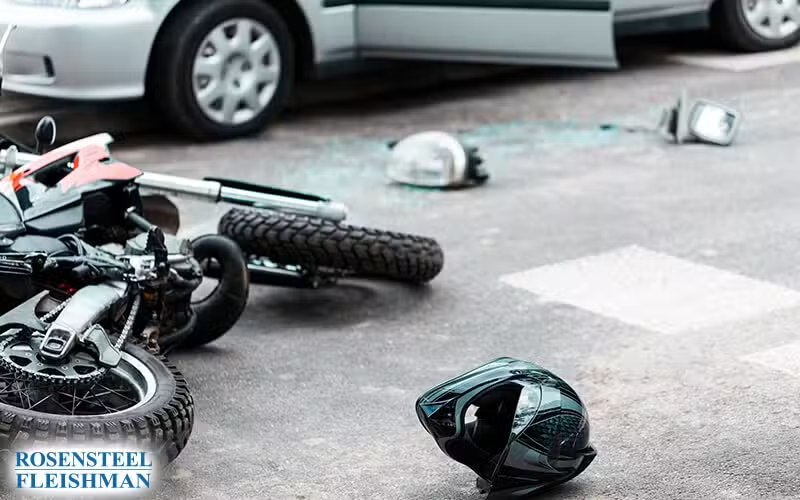

A motorcycle crash involving a passenger can raise questions about the motorcycle’s designed capacity, seating configuration, helmets, passenger supports, loading, instructions, operator control, and each person’s injuries. Those facts should be documented independently rather than reduced to whether the motorcycle was carrying two people.
A passenger-rule or helmet issue is one fact to document; North Carolina law does not make a violation negligence per se or contributory negligence per se.
Identify the motorcycle’s designed capacity
- Make, model, year, VIN, manufacturer label, owner manual, seating configuration, seat changes, passenger pegs or supports, handholds, luggage, and other modifications
- Operator and passenger identity, age, seating position, relationship, trip purpose, permission, experience, and protective equipment kept separate
- Pre-crash photographs, purchase and modification records, inspection, repair, post-crash condition, removed parts, and storage location preserved
- Manufacturer specification kept separate from a person’s belief that the motorcycle could carry another rider
Read the North Carolina statute exactly
G.S. 20-140.4 prohibits operating a motorcycle or moped with more people than it was designed to carry and addresses helmet requirements for operators and passengers. The statute also states that a violation is not negligence per se or contributory negligence per se in a civil action.
- Number of people, vehicle design, operator, passenger, helmet type, retention strap, and actual use recorded without adding a legal conclusion
- Citation, warning, dismissal, conviction, or no charge kept separate from the crash investigation
- Helmet compliance kept separate from whether a helmet reduced, prevented, or contributed to a particular injury
- Statutory compliance kept separate from reasonable operation, negligence, contributory conduct, causation, defenses, and damages
Check the operator’s passenger restrictions
G.S. 20-7(a1) and (a2) separately prohibit carrying a passenger for motorcycle learner-permit holders and for riders under 18 who have a motorcycle endorsement. A motorcycle designed for two people does not remove those restrictions. Match the operator’s age and actual credential to the law in effect on the riding date.
The motorcycle license and learner-permit records guide explains how to check the credential and its dates. A licensing issue still needs to be distinguished from the evidence of how a collision occurred.
Distinguish handbook guidance from the statute
The NCDMV Motorcyclist Handbook discusses carrying passengers, including a suitable seat, passenger footpegs, protective equipment, suspension and tire adjustments, mirror and headlamp angle, passenger instructions, and changed braking or handling. These are safety and licensing-study materials; each point should not be described automatically as a statutory requirement or a civil-fault rule.
- Owner-manual specifications and manufacturer instructions checked for the exact motorcycle and load
- Tire pressure, suspension settings, headlamp or mirror adjustment, passenger supports, luggage, and weight distribution documented when relevant
- What instructions were given and what the operator and passenger each remember recorded independently
- Speed, spacing, braking, turning, acceleration, road condition, visibility, other vehicles, and avoidance opportunity reconstructed from event evidence
Preserve passenger-specific injury evidence
- Seating position, point of contact, separation from the motorcycle, ejection, landing location, helmet and gear damage, and emergency observations
- Operator and passenger medical, work, expense, functional, and communication records maintained in separate files
- Motorcycle damage, debris, scrape marks, photographs, video, witness accounts, and crash-report fields compared with each person’s account
- A passenger injury not attributed to a capacity, helmet, instruction, or equipment issue without a supported event-specific causal analysis
The related guide to separating motorcycle operator and passenger claim records explains how to maintain one common event file and individual evidence, insurance, communication, conflict, and settlement records for each person.
Rosensteel Fleishman Car Accident & Injury Lawyers provides general legal information for people who may later ask about a Charlotte motorcycle-accident claim involving a passenger. The applicable rules, evidence, insurance, negligence, causation, defenses, and damages depend on current law and the complete facts.
Sources
Additional Motorcycle Accidents Articles
Investigating Unexplained Loss of Control in Charlotte, NC Motorcycle Crashes
An unexplained loss of motorcycle control leaves questions about what happened before the fall. Clear records can help families distinguish evidence from assumptions and respond to claim disputes.
Medical Guidance for Resuming Outdoor Walks After a Motorcycle Crash in Charlotte
An outdoor walk does not tell the whole story of an injury. Accurate records can distinguish daily activity, treatment history, practical limitations, and unresolved claim questions.
When Anxiety After a Motorcycle Crash Disrupts Sleep and Relationships in Charlotte
When anxiety affects family routines after a motorcycle crash, specific records can describe what changed. Learn how to separate everyday observations from medical conclusions and questions about a claim.



