Lasting tightness does not establish whether scar massage would help. Keep personal observations, existing care records, expenses, and unresolved claim questions separate.
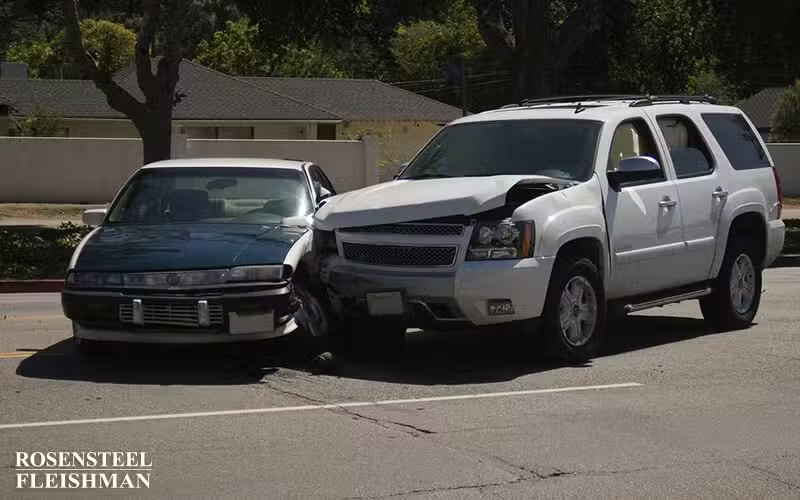

Vehicles now offer adaptive cruise control, lane support, automatic emergency braking, driver monitoring, parking assistance, and other automated functions. The feature’s name does not establish what it could safely do or whether the human driver remained responsible for monitoring and intervention.
Driver assistance is not the same as a fully autonomous vehicle under North Carolina law. A crash investigation should identify the exact vehicle, software version, feature, operating conditions, engagement state, warnings, and human role.
North Carolina defines a fully autonomous vehicle narrowly
Article 18 of Chapter 20 defines an automated driving system as hardware and software capable of performing the entire dynamic driving task on a sustained basis. It defines a fully autonomous vehicle as one that will not require an occupant to perform any part of that task while the system is engaged.
The same Article distinguishes a vehicle that expects a human operator to respond to a request to intervene. That distinction is important because many consumer vehicles automate some functions while still requiring an attentive licensed driver to perform or supervise the driving task.
Operational limits matter
North Carolina defines an operational design domain as the conditions within which an automated driving system is limited to operate, such as geographic area, road type, speed range, or environment. Weather, lane markings, construction, lighting, sensor obstruction, mapped areas, and road geometry may affect whether the feature was used within those limits.
The National Highway Traffic Safety Administration’s automated-vehicle resource explains levels and safety issues surrounding vehicle automation. Consumer instructions, safety communications, recalls, and the feature’s actual capabilities should be checked for the vehicle and crash date.
Responsibility can involve several actors
- The human driver or user who activated, supervised, ignored, overrode, or misunderstood the system
- The registered owner and any company that placed the vehicle into service
- The vehicle, sensor, component, or software manufacturer
- A dealer, repairer, calibrator, fleet operator, or maintenance provider
- A map, communications, remote-assistance, or mobility-service provider
- Another road user or a roadway condition independent of the automated feature
A feature malfunction is not the only possible theory, and system involvement does not establish a defect. Negligence, product-liability, warranty, contract, federal-safety, ownership, agency, and insurance questions may overlap while requiring different proof.
Electronic evidence is central and time-sensitive
- Event-data recorder, automated-driving, driver-monitoring, braking, steering, speed, and warning logs
- Software, firmware, calibration, sensor, maintenance, repair, recall, and over-the-air update history
- Driver settings, activation, disengagement, takeover requests, attention alerts, and user acknowledgments
- Cameras, radar, lidar, ultrasonic sensors, maps, telematics, and remote-service communications when applicable
- Phone, application, ride-service, fleet, dispatch, and account records
- Scene, vehicle, roadway, weather, witness, and medical evidence independent of the automation data
The vehicle should not be repaired, sold, salvaged, powered, updated, or downloaded without a preservation plan suited to the evidence and safety needs. Access to proprietary data may require consent, litigation process, qualified inspection, and protection of unrelated private information.
Insurance remains part of the analysis
Article 18 requires a fully autonomous vehicle to be covered by a motor-vehicle liability policy meeting applicable requirements. G.S. 20-279.21 addresses motor-vehicle liability policies and related coverage provisions, but the applicable policy, named insureds, users, exclusions, endorsements, commercial use, and additional coverage must be reviewed.
Start with capability, control, and causal sequence
A useful chronology identifies who or what controlled acceleration, braking, steering, object detection, and response at each point. It then compares that sequence to the system’s documented limits, warnings, maintenance, and the conduct of other road users.
Rosensteel Fleishman Car Accident & Injury Lawyers provides information about Charlotte car-accident claims. An automated-vehicle collision requires prompt preservation, technically qualified review, identification of all human and corporate actors, insurance analysis, medical proof, and deadline evaluation.
Sources
Additional Car Accidents Personal Injury Rideshare Accidents Articles
How Evidence Is Reviewed During a Wrongful Death Case
Evidence review means checking where records came from, comparing accounts, and separating documented facts from assumptions about responsibility and losses.
Living With Permanent Disabilities After a Truck Crash Involving Multiple Vehicles
A lasting disability affects more than a claim file. Learn how to connect the collision timeline with documented changes in work, household responsibilities, and expenses without treating assumptions as evidence.
Investigating Unexplained Loss of Control in Charlotte, NC Motorcycle Crashes
An unexplained loss of motorcycle control leaves questions about what happened before the fall. Clear records can help families distinguish evidence from assumptions and respond to claim disputes.