
A motorcycle crash can disrupt more than a rider’s health. It can affect work, family responsibilities, transportation, and household finances for weeks or months. Medical records created during that period help show how the injuries developed, how consistently the rider followed treatment recommendations, and when daily life began returning to normal. Why the Timeline Matters […]
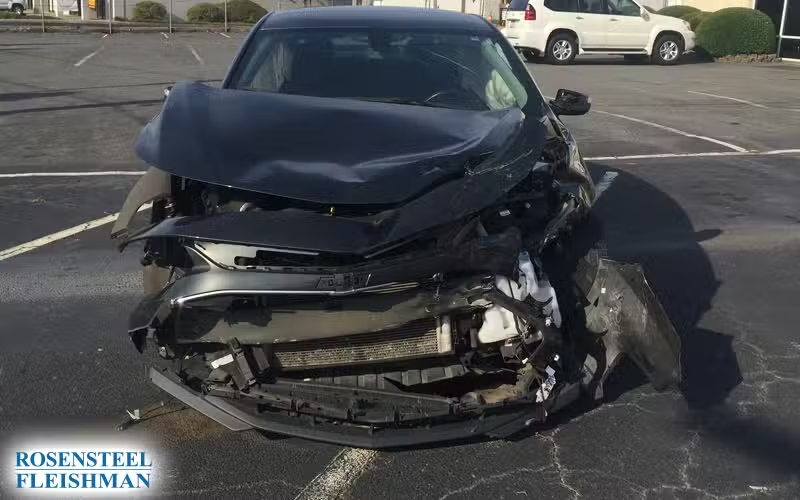

North Carolina’s stopped-vehicle rules, truck-warning-device rule, and crash-movement provision address different situations and do not by themselves decide what happened in a particular collision. This guide is a general orientation to the statutes; it is not an instruction for a live roadside emergency or a conclusion about fault, insurance, or a claim.
Start with the roadway and the vehicle’s actual condition
N.C. Gen. Stat. § 20-161 addresses stopping, parking, or leaving a vehicle on a highway. Its main-traveled-portion provisions distinguish highways by posted speed and contain an exception when a vehicle is disabled to the extent that stopping and temporarily leaving it on the paved or main-traveled portion cannot be avoided. Whether that language applies depends on the exact road, posted speed, location, vehicle condition, and facts at the time.
The statute separately addresses a vehicle left on the shoulder of a public highway. It states that the vehicle must be clearly visible to approaching drivers from 200 feet in both directions and must not obstruct normal traffic movement. That is a statutory description, not a substitute for emergency personnel, road conditions, visibility, injury, traffic, weather, or other real-time safety considerations.
The warning-device provision is not a blanket passenger-car flare rule
Section 20-161(c) applies to an operator of a disabled truck, truck tractor, trailer, or semitrailer. It requires warning devices of the type and in the manner required under United States Department of Transportation rules adopted by the Division of Motor Vehicles. The subsection does not create the same warning-device requirement for every ordinary passenger vehicle. A reader should not turn a truck-specific provision into an automatic conclusion about a passenger car.
A crash-movement rule has its own conditions
N.C. Gen. Stat. § 20-166 governs duties after a crash and has different provisions depending on injury, death, property damage, reportability, and risk. Subsection (c2) addresses a crash on a main lane, ramp, shoulder, median, or adjacent area of a highway. It calls for each vehicle to be moved as soon as possible out of the travel lane and onto the shoulder or to a designated accident-investigation site only when the listed conditions are met.
- The crash did not result in injury or death, or the drivers did not know and had no reason to know of an injury or death.
- Each vehicle can be normally and safely driven. The statute defines that term as a vehicle that does not require towing and can operate under its own power and in its usual manner without additional damage or hazard to the vehicle, other traffic, or the roadway.
That provision should not be read as a direction to move every vehicle after every crash. The surrounding statutory provisions, the vehicle’s condition, injury information, significant risk, and directions from law enforcement or emergency personnel matter. This general guide cannot determine those questions for an individual event.
Removal authority is separate from responsibility
Section 20-161 also authorizes specified law-enforcement and Department of Transportation removal action when a wrecked, disabled, unattended, burned, partially dismantled vehicle, cargo, or other property interferes with traffic or otherwise constitutes a hazard. For a crash involving serious personal injury or death, the statute states that removal does not occur until the investigating officer determines adequate information has been obtained for a crash report. Removal or clearance authority describes an operational response; it does not establish who caused a collision or whether a person acted negligently.
Keep the relevant facts separate
- Roadway name, direction, posted speed, lane, shoulder, median, ramp, bridge, and available space.
- Whether the vehicle could move, what condition affected it, and whether a tow was required.
- Visibility, lighting, traffic, weather, road surface, warnings, vehicle position, and the timing of each observed condition.
- Injury information, emergency response, law-enforcement investigation, directions given, vehicle movement, and removal or towing records.
- The original crash report, photographs, video, witness accounts, towing documentation, and any later correction or supplemental record, each identified by source and time.
Do not turn a statute into a collision conclusion
A vehicle may be disabled, partially obstructing a roadway, moved after a crash, or removed by authorities for many factual reasons. The statutory language does not alone answer what was visible, what could safely be done, whether a vehicle was operable, whether anyone created a hazard, or what caused a later impact. Those questions require the complete evidence and applicable law.
Questions about a Charlotte car-accident matter involving a disabled passenger vehicle are fact-specific. The service page provides general information about representation; it does not replace emergency directions, a current reading of the statute, or collision-specific review.
Sources
Additional Car Accidents Personal Injury Articles
How Recovery Setbacks Can Affect an Injury Claim in Charlotte, NC
Charlotte injury claims often develop over weeks or months rather than following a perfectly predictable path. A person may begin treatment after an accident, improve for a while, and then experience renewed pain, limited movement, or another problem that slows recovery. When that happens, insurers may look closely at the medical records and other available […]
Insurance Coverage Gaps for Injury Care After Benefits Run Out
A car accident can create medical needs that continue long after the first emergency room visit, particularly when rehabilitation, physical therapy, diagnostic testing, or follow-up treatment stretches across several months. For people recovering in Charlotte, the financial side of that care can become almost as complicated as the treatment itself. Different insurance policies may pay […]
Second Opinion Timing After Fall When Recovery Progress Remains Unclear
How can someone protect their interests when recovery after a fall remains difficult to understand? In Charlotte, the answer often begins with maintaining clear records, following established provider instructions, and asking appropriate questions when the existing information leaves important concerns unresolved. The decision to seek another evaluation is personal and should be discussed with a […]



