
A lasting disability affects more than a claim file. Learn how to connect the collision timeline with documented changes in work, household responsibilities, and expenses without treating assumptions as evidence.
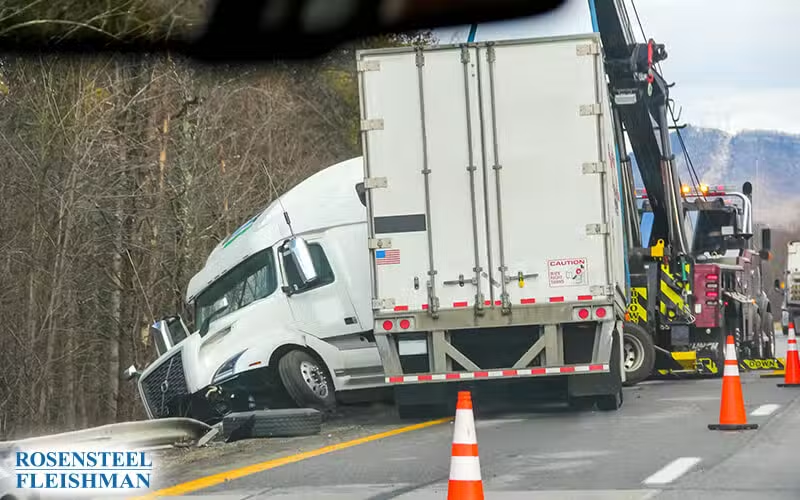

A truck collision in North Carolina may involve federal motor-carrier safety rules, North Carolina traffic statutes, common-law negligence, evidence rules, insurance contracts, and civil procedure. Those sources answer different questions.
Federal motor-carrier rules can identify duties and records. The law governing a civil claim depends on the claim, parties and circumstances; filing in a North Carolina court does not, by itself, answer every choice-of-law question.
First decide which federal rules apply
49 C.F.R. § 390.3T addresses general applicability of the federal motor-carrier safety regulations and includes exceptions and other provisions. Coverage can depend on vehicle weight or rating, passengers, hazardous material, commerce, operation, and another stated exception.
Do not assume every delivery truck, rented vehicle, utility vehicle, bus, farm vehicle, or local trip is governed by every federal provision. Confirm the vehicle, cargo, trip, driver, carrier, and date before using a rule.
Federal regulations organize operational questions
- Driver qualification and medical documentation
- Hours of service and records of duty status
- Commercial driving conduct and equipment readiness
- Parts, accessories, cargo, inspection, repair, and maintenance
- Carrier records, reporting, testing, and operating authority
A regulation may identify a record to request or a safety question to investigate. Whether a violation occurred, who was responsible, and whether it caused the collision remain separate issues.
North Carolina traffic duties apply to the roadway event
G.S. 20-141 addresses speed restrictions and requires operation at a reasonable and prudent speed under existing conditions, with attention to actual and potential hazards. The posted limit is not the only speed question when traffic, visibility, grade, curves, weather, or stopping conditions change.
G.S. 20-140 addresses reckless and careless driving. Other statutes may govern lane use, passing, following, turns, signals, lights, stopping, and duties after a crash.
A civil negligence claim needs a causal proof chain
- Duty owed by the identified defendant
- Specific act or omission that failed to meet the duty
- Actual and proximate causal connection to the collision or injury
- Documented injury and damages
- Evaluation of contributory negligence and other defenses
A safety violation may support part of that analysis, but it does not automatically establish every element or the amount of loss. Conversely, reasonable-care evidence may matter even when no specific citation was issued.
Administrative records and civil discovery are not the same process
Crash reports, roadside inspections, carrier authority records, enforcement materials, or safety data may provide leads. Civil litigation can involve pleadings, document requests, electronically stored information, interrogatories, depositions, inspections, admissions, qualified opinions, motions, mediation, and trial evidence.
Public databases can have scope, reporting, timing, and attribution limits. Preserve native company and vehicle records rather than relying only on a public summary or score.
Insurance is a separate contract analysis
Identify the driver, tractor, trailer, carrier, policy period, named insured, limits, exclusions, reservations, excess layers, other claimants, and any household or other applicable coverage. A safety obligation and an insurance obligation can involve different parties and standards.
Deadlines depend on claim and party
G.S. 1-52 includes a three-year period for many injury actions, but it does not control every possible claim. A death claim, government entity, estate, minor, contract, federal claim, or other procedure can require different analysis. Evidence may disappear long before any filing deadline.
Build one integrated issue map
- Issue and governing source
- Participant with the relevant duty or control
- Supporting record, physical evidence, or testimony
- Contrary facts, exception, or defense
- Causal importance and remaining uncertainty
- Preservation action, owner, and date
The related truck-collision cause guide demonstrates how federal records and roadway evidence can be combined without treating a recurring risk as the cause of an individual event.
Rosensteel Fleishman Car Accident & Injury Lawyers provides information about North Carolina truck-accident claims. A careful analysis states which rule applies, what evidence establishes the facts, and what still must be resolved.
Sources
Additional Trucking Accidents Articles
Reducing Reinjury Risk With Physical Therapy After a Truck Crash in Charlotte
Concerns about reinjury involve medical questions that claim records cannot answer. Learn how to organize physical therapy documentation, practical expenses, and scene evidence without drawing unsupported conclusions.
When Mobility Loss After a Charlotte, NC Truck Crash Has No Clear Diagnosis
An unclear diagnosis does not prevent a family from recording practical changes after a truck crash. Keep observations, added expenses, and unanswered claim questions separate.
How Insurers Review Worsening Pain After a Truck Crash
An early insurance review may start with an incomplete account. Dated records can help explain later changes in pain, work limitations, and expenses without treating symptoms as proof of an injury.


