
How should an accident claim change when a doctor gives a different outlook than expected? That question can become important when an injury initially appears temporary but later requires additional treatment, testing, therapy, or time away from work. A settlement discussion is based on the information available at that moment, so meaningful changes in the […]
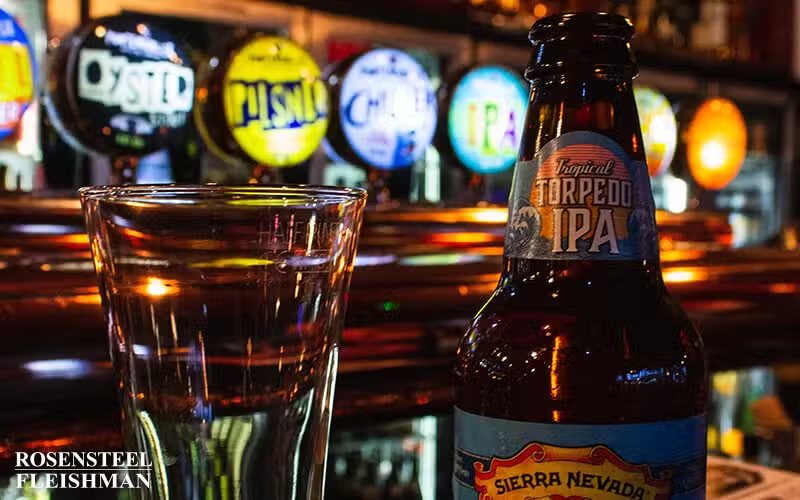

“Dram shop” is a convenient label, but North Carolina alcohol-related injury claims do not all arise under one rule or require the same proof.
Begin with the person who furnished the alcohol, the person who consumed it, the consumer’s age and condition at that time, the claimant’s relationship to the event, the later conduct, and the injury. A commercial permittee, social host, underage driver, adult patron, passenger, pedestrian, and another driver may place the same event on different legal paths.
Route one: service to an intoxicated adult by a permittee
G.S. 18B-305(a) makes it unlawful for a permittee or its employee, or an ABC store employee, to knowingly sell or give alcoholic beverages to a person who is intoxicated. A third-party civil claim still requires a careful connection among the seller or server, service-time condition and knowledge, alcohol furnished, later conduct, causation, injury, and defenses.
- Permit and business identity, employee role, shift, training, policies, point-of-sale access, receipt, tab, item, quantity, time, payment, void, and surveillance
- Patron arrival, food, prior alcohol, each order and drink, observations at each service, refusal or intervention, companions, transportation plan, departure, and later alcohol
- Witness vantage point and timing, speech, balance, coordination, behavior, interaction, handling money, movement, and any contemporaneous communication
- Driving, collision, testing, medical findings, alternative causes, and the purpose for which each record or opinion is offered
Route two: sale or furnishing to an underage driver
Chapter 18B Article 1A creates a defined claim for an aggrieved party injured as a consequence of a permittee’s negligent sale or furnishing to an underage person when the statutory impairment and vehicle-causation requirements are met. It also defines who is excluded from the term “aggrieved party,” identifies proof relevant to negligence, and contains its own damages and filing provisions.
Do not transfer an adult visible-intoxication analysis into an underage-driver claim or assume that proof of age alone establishes every statutory element. Preserve identification checks, warnings, purchase and furnishing records, who received and consumed the alcohol, driving, impairment evidence, causation, injury, and claimant status.
Route three: alcohol furnished by a social host
In Hart v. Ivey, the North Carolina Supreme Court addressed a common-law negligence claim against social hosts alleged to have served an intoxicated person who later drove and injured third parties. The opinion did not turn every gathering into automatic host liability. The source of alcohol, host control, service or furnishing, what the hosts knew or should have known, later driving, foreseeability, causation, and the claimant’s injury remained central.
- Who bought, brought, stored, controlled, opened, poured, handed out, or made alcohol available
- Whether the gathering involved a private host, permittee, caterer, venue, employee, club, organization, or several sources
- The consumer’s condition and what each alleged host actually observed at the time of furnishing
- Keys, vehicle access, stated plans, transportation offered or refused, departure, later stops, and subsequent alcohol
- Separate conduct and evidence for each person or entity rather than one collective “host” label
Route four: the injured drinker’s own claim
Sorrells v. M.Y.B. Hospitality Ventures of Asheville involved an adult patron who died from alcohol poisoning after drinking at a hotel lounge. The North Carolina Supreme Court concluded on that record that contributory negligence barred the estate’s negligence claim. The opinion should not be shortened into a rule that an intoxicated person can never have a claim or that every third-party claim is barred.
Identify who was injured, whose conduct is attributed to that claimant, the legal theory, capacity of an estate or representative, claimed duty, causation, and each asserted defense. A passenger, pedestrian, another driver, consumer, family member, or estate may present a different record.
Keep civil, criminal, regulatory, and insurance files separate
- ABC investigation, permit action, employee discipline, police report, DWI charge, chemical analysis, criminal disposition, and restitution
- Civil preservation, insurance notice, coverage position, claimant identity, liability theory, damages records, pleadings, discovery, and resolution
- The same document may be relevant in more than one file, but one agency’s action does not automatically decide another proceeding
- Record original source, date, custodian, version, correction, and admissibility foundation instead of relying on a summary
Use the service-time evidence guide for an adult permittee claim
The related guide to proving visible intoxication in a North Carolina dram shop claim focuses on the evidence that a permittee knew or should have known an adult patron was intoxicated when alcohol was served. This page owns the broader routing question.
Rosensteel Fleishman Car Accident & Injury Lawyers provides general information about discussing a North Carolina car-accident claim involving alcohol service or furnishing. The applicable route, parties, proof, defenses, insurance, damages, and deadlines depend on the complete facts and current law.
Sources
Additional Car Accidents Articles
How Car Accident Claims Are Reviewed When Accounts of the Crash Differ
What happens when two drivers remember the same collision differently? After a crash in Charlotte, North Carolina, conflicting descriptions are common because each person may have seen only part of what happened, reacted within seconds, or remembered certain details more clearly than others. Insurance companies generally do not rely on a single statement alone. They […]
Vehicle Inspection Reports After Crash Events with Suspected Hidden Damage
Crash-related vehicle damage is not always obvious from the outside. A car may still start, steer normally, and show only limited cosmetic damage while problems involving the frame, suspension, steering components, sensors, or alignment remain out of sight. A careful inspection can help turn those uncertainties into documented findings that drivers, repair shops, and insurers […]
Options After Claim Resolution When Additional Losses Are Discovered
A claim can feel finished once the insurer issues payment and closes its file, but later information sometimes changes the picture. A vehicle owner may discover hidden collision damage after repairs begin, an injured person may receive a new medical bill, or a work absence may last longer than originally expected. When that happens, understanding […]



