
Records created after an injury often serve different purposes. A crash report records an officer’s investigation, an emergency intake captures information available during treatment, an insurer log tracks a claim, and an employer record documents work. A difference among them does not automatically establish dishonesty, but a material error should be addressed through the channel […]
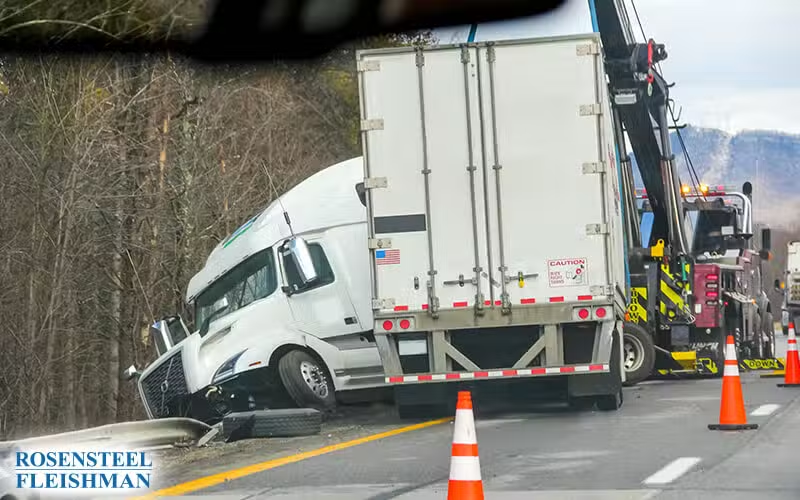

Electronic evidence from a commercial truck can help reconstruct speed, braking, engine operation, duty status, location, warnings, and other events. The available information depends on the vehicle, component, carrier systems, configuration, triggering event, and retention practices.
“Black box” is an informal label, not one standardized truck data source. An event data recorder, engine control module, electronic logging device, camera, telematics platform, and fleet application serve different purposes and should not be treated as interchangeable.
An event data recorder focuses on a crash event
The National Highway Traffic Safety Administration describes an event data recorder, or EDR, as a device that records technical vehicle and occupant information for a brief period before, during, and after a crash. Depending on the system, the information may include vehicle dynamics, driver inputs, restraint status, and crash-related system activity.
NHTSA also cautions that EDR capabilities and limitations vary and that the information should be evaluated with other evidence. A data field does not explain every mechanical, environmental, or human factor by itself.
An ELD primarily records duty status
The Federal Motor Carrier Safety Administration’s ELD resource explains that an electronic logging device synchronizes with the commercial vehicle’s engine to record information including engine power, vehicle motion, miles driven, engine hours, driver and carrier identity, and duty status.
An ELD is designed principally for hours-of-service records. It should not be described as if it necessarily contains the same short-duration crash dynamics as an EDR or the same diagnostic information as an engine control module.
Other systems may preserve different parts of the sequence
- Engine and transmission control modules, including fault codes and manufacturer-specific event records
- Antilock-brake, stability-control, collision-warning, and automatic-braking modules
- Forward, rear, side, driver-facing, and cargo cameras
- GPS, dispatch, route, geofence, telematics, fuel, and fleet-management records
- Phone, messaging, application, navigation, and hands-free system activity
- Trailer, refrigeration, tire-pressure, cargo-temperature, weight, and door sensors when equipped
Retention requirements are not a preservation plan
FMCSA states that a carrier must retain required ELD records of duty status and supporting documents for six months and maintain a backup copy separately during that period. The agency’s ELD retention guidance addresses regulatory records; it does not guarantee that every crash-related record from every system will remain available for that long.
Some information may be overwritten through normal operation, altered by repair or software activity, stored by a third-party vendor, or retrievable only with manufacturer-specific equipment. A preservation request should identify the vehicle, trailer, driver, account, date range, systems, raw files, associated metadata, and responsible custodians.
A reliable download protects the context
- Document the vehicle identification number, module, hardware, software, calibration, and download tool
- Record whether the vehicle was powered, moved, repaired, updated, or operated after the crash
- Preserve the native file and a readable report without replacing the original data
- Identify time-zone settings, clock drift, units, driver assignments, and unassigned activity
- Retain photographs and notes showing module condition, connectors, warning lights, and vehicle damage
- Use a qualified person who can explain both the retrieval process and the system’s limitations
Electronic data must be compared with physical evidence
A recorded speed may require interpretation of wheel slip, tire size, system sampling, vehicle configuration, and the data definition. A brake input may not show full brake performance. Duty status may address fatigue-related timing without proving why the driver reacted as the driver did.
Scene measurements, vehicle damage, skid or tire marks, video, witness accounts, road and weather conditions, cargo position, maintenance records, and medical evidence provide independent checks. Conflicts should be investigated rather than resolved by assuming the electronic source is complete.
Access and admissibility are separate questions
Ownership, privacy, consent, subpoenas, discovery, protective orders, trade-secret concerns, authentication, expert foundation, and evidentiary rules can affect how information is obtained and used. A demand for “the black box” is less useful than a system-specific preservation and inspection plan.
Rosensteel Fleishman Car Accident & Injury Lawyers provides information about truck-accident claims in Charlotte. A serious truck collision should prompt early identification of every vehicle, module, carrier, vendor, account, retention period, physical artifact, responsible party, insurance policy, injury record, and filing deadline.
Sources
Additional Law Articles Articles
Why Micronutrient Focus After Fall Recovery Matters During Early Healing
A fall in a busy Charlotte grocery store, apartment stairwell, or rain-slick parking area can produce injuries that change during the first weeks of recovery. Medical records may initially focus on pain, swelling, mobility, and imaging results, but later updates can add information about nutrition, fatigue, bone health, wound healing, or delayed progress. When those […]
How Different Accident Scenarios Affect Claims After a Multi Vehicle Crash
A claim’s value is usually built in stages, starting with what happened in the crash and continuing through the injured person’s recovery. In a multi vehicle accident, that process can take extra care because insurers are not only looking at repair bills and medical costs. They are also trying to understand whether the injury will […]
Car Accident Claim Strategy Basics When the Process Moves Slowly
Car accident claims can move slowly because the facts often develop in stages, especially when injuries, insurance reviews, and fault questions are still being evaluated. In Charlotte, a crash on a busy road like I-77, South Boulevard, or Independence Boulevard may seem straightforward at first, but new medical records, repair findings, witness details, or insurance […]


