A clearer picture of wage benefits starts with separating income replacement from other claim payments and documenting what has been paid, disputed, or left unanswered.
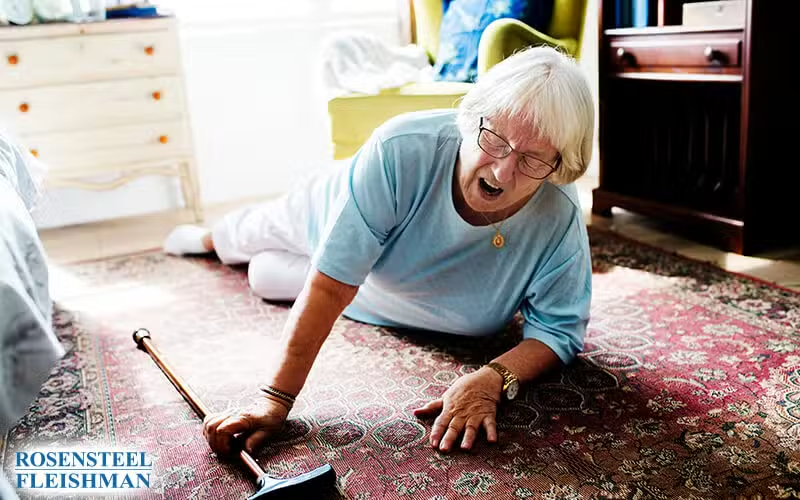

A family may receive an incident report that describes what a resident did but leaves unanswered questions about staff assistance. In a hypothetical Charlotte nursing home fall, the report might say the resident stood without help. Comparing that account with the care plan before the fall helps frame the family’s question: what assistance was planned, and what actually happened?
A resident’s involvement in an event does not, by itself, establish legal fault. The evaluation must distinguish the resident’s conduct from the facility’s responsibilities, consider the circumstances surrounding that conduct, and examine whether it contributed to the harm. That requires more than accepting a phrase such as “failed to follow instructions” at face value.
Overview. When a family presents a resident fault allegation to elder abuse lawyers, a useful starting point is the specific action being alleged and the records supporting or contradicting it. The review should address these separate issues:
- What the resident allegedly did and who observed it.
- What assistance the facility had planned or undertaken.
- How the disputed conduct relates to the harm.
- Which fault rules apply to the claim.
- Whether unresolved disagreements leave room for compromise.
Separate Resident Conduct From Legal Fault
Comparative fault in nursing home claims is not simply a question of assigning percentages of blame. Comparative negligence generally involves reducing damages in proportion to an injured person’s share of fault. North Carolina generally follows contributory negligence instead: legally qualifying negligence by an injured person that contributes to the harm can bar recovery in a negligence claim, subject to applicable exceptions. The distinction matters because a family should not assume an allegation would merely reduce a payment.
Before considering that legal consequence, the underlying allegation needs careful definition. “Resident refused assistance” could describe a particular conversation, or it could be a broad conclusion with little supporting detail. A meaningful review asks what help was offered, what the resident communicated, who was present, and when the exchange occurred.
The resident’s circumstances also matter. The review should consider documented abilities, limitations, and ability to understand the relevant instructions rather than assume every resident could respond in the same way. A note about refusal or noncompliance does not automatically establish that the resident acted negligently under the applicable legal standard.
The facility’s responsibilities must be examined alongside the resident’s actions, not set aside because the resident participated in the event. For example, in a hypothetical case involving movement without assistance, the question includes whether that behavior was already anticipated in the care plan and what staff were expected to do. The same resident action may have a different significance depending on those surrounding facts.
Finally, conduct and causation are separate issues. Evidence that a resident disregarded an instruction does not, on its own, explain how that action contributed to the particular harm. The claim review must examine that connection while also considering any alleged failure by the facility.
Use the Evidence to Clarify Disputes and Resolution Choices
Records are most useful when compared as a timeline rather than read in isolation. The care plan describes intended assistance, while incident reports, staff notes, and witness accounts may describe what occurred. A family’s dated messages can help establish when concerns were communicated, but each record should be assessed for what it actually shows.
Distinguish direct observations from conclusions and secondhand accounts. A note stating that someone saw the resident decline an offered hand is different from a later summary stating that the resident “caused the fall.” Neither statement should be expanded beyond its contents, and disagreement between accounts should be identified rather than silently resolved in favor of one version.
Families can organize the documents they already have, preserve original messages, and keep their own recollections separate from statements made by others. A simple chronology can identify unanswered questions, such as whether assistance was requested before the event. Missing documentation leaves uncertainty; its absence alone does not prove either that assistance was provided or that it was withheld.
The strength and consistency of the evidence can affect how a claim proceeds. A detailed contemporaneous account may support a position more clearly than a vague later recollection, but no single document necessarily resolves every issue. Disputes may remain about what happened, what responsibility each party had, or whether a particular action contributed to the harm.
Some claims reach closure through compromise rather than full agreement on every point. Settlement discussions can account for conflicting evidence and uncertainty about how fault rules would apply. A family and facility may agree to resolve a claim without adopting the same explanation of the event; the meaning of that agreement depends on its actual terms.
Clarify Unanswered Questions Before Considering Closure
Before evaluating a proposed resolution, identify which facts remain disputed and which questions the available records can answer. Keep documented expenses and practical consequences, such as missed work or changes in family caregiving arrangements, separate from the disagreement about fault. This helps distinguish the impact of the event from the evidence needed to establish responsibility.
Attorney Matthew Fleishman: "A resident’s action needs context, not just a label. A compromise can resolve a claim without resolving every disagreement about what happened."
If you would like to discuss the available claim options, you can make an inquiry at 1-704-714-1450. Questions about unresolved evidence, the applicable fault rule, and the proposed settlement terms can keep that conversation focused.
For a family seeking stability after a disruptive event, clarity can be more useful than a simple statement of blame. Understanding what is supported, what remains uncertain, and what an agreement would resolve provides a practical basis for deciding what comes next.
Additional Personal Injury Articles
Public Space Rules to Consider in Charlotte When Planning Remembrance Rituals
Creating remembrance rituals in a shared space starts with clear permissions and responsibilities. Learn what to ask before inviting guests and how to keep memorial planning separate from accident documentation.
How Scene Safety Affects Charlotte Crash Documentation and Claims
Safety can limit what you document after a crash. Clear notes about timing, vehicle spacing, and scene changes help explain those limits without guessing about fault.
When Anxiety After a Motorcycle Crash Disrupts Sleep and Relationships in Charlotte
When anxiety affects family routines after a motorcycle crash, specific records can describe what changed. Learn how to separate everyday observations from medical conclusions and questions about a claim.