
A motorcycle crash should be reported promptly to law enforcement and the appropriate insurance companies, even when pain or numbness seems minor at first. Nerve symptoms may develop gradually, and a timely report creates an official record connecting the incident to the circumstances in which the injury occurred. Missing a reporting deadline or giving incomplete […]
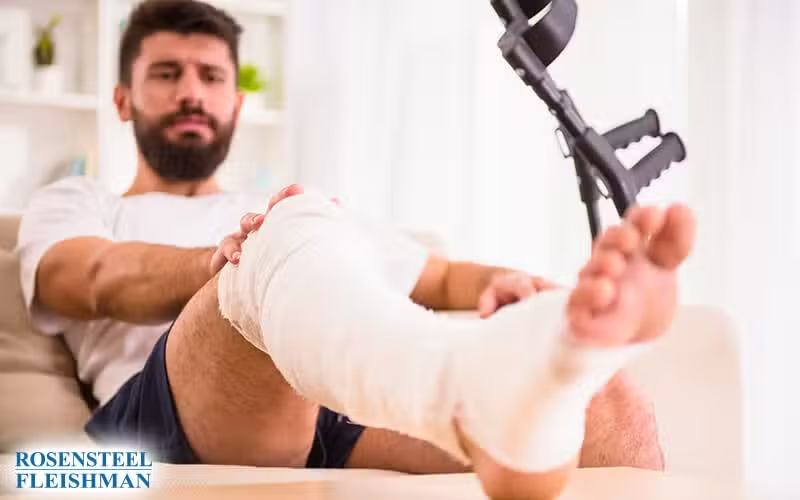

One work injury may acquire several body-part labels. A supervisor might write “leg,” an emergency note might identify the knee, an imaging order might name the ankle, and a workers’ compensation form might use a broader or narrower description. Those labels are not interchangeable merely because the locations are close.
A body-part crosswalk should trace every hip, thigh, knee, lower-leg, ankle, foot, or toe label to the exact source that used it without assuming that adjacent locations or broader form language describe the same condition.
Build the body-part crosswalk
- Create one row for each exact term: hip, groin, thigh, knee, calf, shin, lower leg, ankle, heel, foot, or toe
- Record right, left, bilateral, or unspecified precisely; do not supply a side that the source omitted
- Identify the document, author, date, page or field, and whether the term appears in text, a diagram, an order, a code, or a form
- Keep joint, bone, muscle, tendon, ligament, nerve, skin, vascular, and nonspecific descriptions separate unless a qualified record connects them
Trace each label to the record that created it
A first report, employer incident form, carrier notice, Commission filing, triage history, examination, imaging order, radiology report, procedure note, therapy evaluation, work note, and billing record serve different purposes. Copy the original wording and note who supplied it. A later precise diagnosis does not automatically correct or redefine an earlier general report.
Audit side and location changes
- Highlight every switch from right to left, unilateral to bilateral, or a named side to no side
- Flag movement from one region to another, such as knee to calf, ankle to foot, or hip to thigh
- Distinguish an added complaint from a correction, copied-forward text, coding choice, or clerical inconsistency
- Preserve both the original and corrected version, along with the request, response, and date of any amendment
The U.S. Department of Health and Human Services explains that, subject to stated exceptions, people may inspect and obtain medical and billing records held by covered providers and health plans and may request an amendment. The amendment process does not justify silently replacing the source that prompted the request.
Do not use “leg injury” as a medical conclusion
MedlinePlus explains that the leg includes bones, blood vessels, muscles, and other connective tissue and identifies multiple injury and disorder categories. That general information shows why a broad location label cannot establish a diagnosis, cause, severity, treatment need, or relationship to work.
Compare medical scope with claim-form scope
- List the body part and side stated on each employer, carrier, Commission, authorization, and medical record
- Record whether a document reports an allegation, acknowledges receipt, authorizes a service, disputes an issue, or reflects a ruling
- Do not treat an authorization for one region as a decision about every adjacent region
- Do not treat a form’s broad wording as proof that every diagnosis or symptom falls within the claim
Connect restrictions to the exact task and region
- Identify the restriction author, covered body part, activity, frequency, duration, device, weight or time limit, and review date
- Match standing, walking, climbing, kneeling, squatting, lifting, carrying, pushing, pulling, driving, or pedal use to the actual job demand
- Separate the written restriction from the employer’s job description, offered duty, worker’s response, and what occurred during a work attempt
- Leave a restriction’s scope unresolved when the author did not state which body part or task it addressed
Keep recommendation, authorization, treatment, and payment separate
G.S. 97-25 addresses medical treatment and supplies in North Carolina workers’ compensation matters under its terms. A recommendation for treatment, authorization request, response, appointment, completed service, bill, and payment are separate records. Each can use a different body-part label, so the crosswalk should show the mismatch instead of concealing it.
Preserve questions for qualified review
North Carolina Rule of Evidence 702 addresses qualified opinion testimony based on sufficient facts or data, reliable principles and methods, and reliable application. A crosswalk can locate wording conflicts. It cannot decide whether two locations reflect one condition, whether work caused or aggravated a condition, whether treatment is necessary, or whether impairment or disability exists.
Maintain an unresolved-label queue
- Exact conflicting terms and sides, with both source locations
- Missing diagram, image, final report, addendum, form page, or correction response
- Question requiring clarification from the record author, employer, carrier, Commission, or qualified clinician
- Resolution document and date, or a clear notation that the issue remains unresolved
The related guide to tracking work restrictions and job offers in a North Carolina workers’ compensation claim owns the return-to-work comparison. This page owns the underlying hip-through-foot body-region and medical-record map.
Rosensteel Fleishman Car Accident & Injury Lawyers provides general information about consulting a Charlotte workers’ compensation lawyer when lower-extremity records conflict. Medical care, claim coverage, causation, restrictions, disability, benefits, and work status depend on the complete record and current law.
Sources
Additional Personal Injury Articles
How Treatment Justification Affects an Injury Claim and the Review Process
Charlotte’s continued growth means more vehicles, changing traffic patterns, construction activity, and daily travel across busy roads, which can also create more situations where people are hurt in crashes or other unexpected incidents. When an injury claim follows, the insurance company may look closely at not only what happened but also whether the medical treatment […]
How Counteroffers Work in Car Accident Settlements When New Evidence Emerges
For families in Charlotte, North Carolina, the weeks after a car accident can bring new information that was not available when an insurance claim first began. Follow-up medical appointments may reveal that an injury is taking longer to heal than expected, additional treatment may become necessary, or a doctor may identify limitations that were not […]
Planning Skills After Fall Recovery and Returning to Everyday Responsibilities
Rebuilding a dependable routine after a fall often happens one responsibility at a time. Even an injury that initially appears minor may continue affecting concentration, stamina, mobility, or confidence, which can make ordinary planning more difficult. Charlotte residents facing these challenges may also need to organize records, manage missed work, and understand whether speaking with […]



