
Medical care can become one of the most important sources of information in a car accident claim because treatment records help show what injuries were identified, when symptoms appeared, and how those injuries affected everyday life. When someone in Charlotte, NC delays treatment after a collision, the delay does not automatically determine the outcome of […]
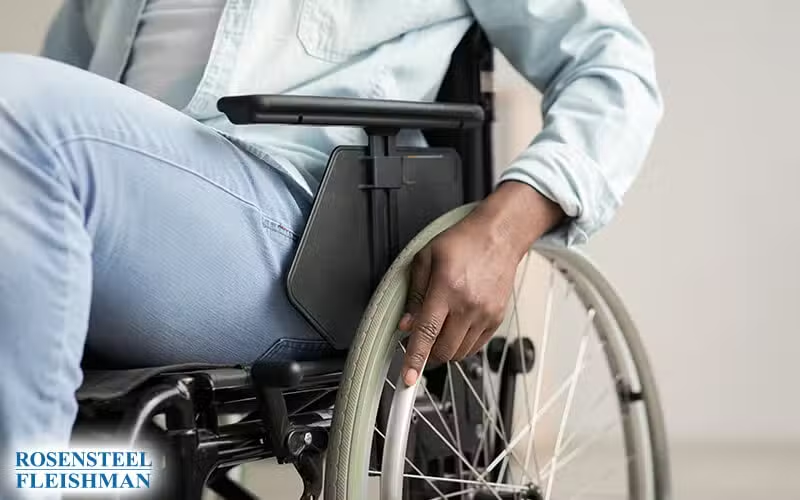

Care after a paralysis injury can involve family members, friends, home-health workers, nurses, therapists, transportation providers, and others. A calendar that merely says “care” cannot show which tasks occurred, how much help was provided, whether the task was part of medical treatment, or whether a person was only available if needed. A source-linked task record preserves those differences.
A caregiver record should identify the person receiving assistance, exact task, person providing it, date, start and end time, level of help, equipment used, instruction source, and any exception without assuming that presence in the home means continuous hands-on care.
Identify every caregiver and role
- Name, relationship or employer, contact information, paid or unpaid status, schedule, start and end dates, and backup role
- Family help, personal care, household assistance, transportation, nursing, therapy carryover, appointment coordination, and supervision labeled separately
- Credential, agency, order, care-plan assignment, or training record included only when a source supports it
- Overlapping shifts, shared tasks, cancelled visits, substitutions, and periods when no caregiver was available kept visible
Define the task before counting time
- Personal care such as dressing, bathing, grooming, toileting, eating, positioning, or another recorded activity
- Household work such as food preparation, laundry, cleaning, shopping, equipment setup, or supply management
- Transportation, appointment coordination, medication pickup, communication with providers, and record management
- Standby or cueing, setup help, partial physical assistance, full physical assistance, and two-person assistance kept as different levels
- Task begun but not completed, declined, changed, delayed, or completed by another person recorded with the reason if known
The National Institute on Aging’s caregiving overview gives general examples of personal care, household tasks, food preparation, health-care coordination, medication tracking, and transportation. Those examples help define record categories; they do not determine which tasks are medically required or appropriate for a particular person.
Connect each task to its instruction source
- Discharge plan, clinician order, nursing instruction, therapy instruction, care plan, equipment manual, agency plan, or family routine identified by source and date
- Person who demonstrated the task, person trained, date, location, materials used, return demonstration, and questions or limits recorded
- Later change, discontinued instruction, safety concern, equipment change, or retraining linked to the new source
- No medical procedure performed by an unqualified person merely because it appears in a suggested checklist
The National Institute of Neurological Disorders and Stroke explains in its spinal cord injury information that needs vary with the injury and can involve rehabilitation, assistive devices, activities of daily living, caregiver help, and caregiver training. The treating and rehabilitation team should define patient-specific care, precautions, and training.
Record time without double counting
- Start, stop, interruption, travel, waiting, active task time, standby time, and sleep period recorded separately when relevant
- Two tasks performed during the same interval linked rather than counted as two full time blocks
- Two caregivers assisting one task each given their own record without doubling the care recipient’s elapsed time
- Routine household activity separated from additional assistance attributable to the person’s recorded needs
- Estimated time labeled as estimated, with the method and period used to create the estimate
Track changes and exceptions
- Task frequency, assistance level, duration, equipment, provider instruction, and caregiver changed through dated entries
- Hospital readmission, new condition, temporary setback, caregiver illness, transportation failure, or supply problem identified as a separate event
- Gap between the scheduled plan and care actually delivered documented without speculating about the cause
- Unpaid family assistance and paid services preserved as different records even when the tasks are similar
The related guide to documenting accessibility and equipment needs after crash-related paralysis covers a different evidence track. A wheelchair, lift, transfer aid, bathroom change, or communication device can affect how a task is performed, but the equipment record should not be substituted for the caregiver’s task, time, and training record.
Preserve clinical records and opinion boundaries
The U.S. Department of Health and Human Services describes access to medical and billing records in its medical-record guidance. Clinical instructions, orders, therapy notes, and care plans should remain in their original source files. A caregiver log can cite them but should not rewrite an observation into a diagnosis, prognosis, or medical-necessity opinion.
North Carolina Rule of Evidence 701 addresses opinion testimony by lay witnesses, while Rule 702 addresses testimony involving scientific, technical, or other knowledge. A family caregiver can preserve firsthand facts about tasks and observations; qualified review may be needed for medical causation, future-care requirements, safety, and prognosis.
- Keep the original log and make later corrections through dated entries
- Use secure storage for health, financial, and identifying information
- Record the source of a copied schedule or agency record rather than presenting it as a firsthand observation
- Do not delay urgent medical attention to complete documentation
A North Carolina personal-injury matter involving paralysis and ongoing assistance may require caregiver, medical, equipment, employment, and financial records to be evaluated together. This article provides a documentation method, not a care plan, medical instruction, valuation, or prediction about legal responsibility or recovery.
Additional Personal Injury Articles
Understanding Nerve Damage Motorcycle Injuries and the Importance of Continued Medical Support
A motorcycle crash should be reported promptly to law enforcement and the appropriate insurance companies, even when pain or numbness seems minor at first. Nerve symptoms may develop gradually, and a timely report creates an official record connecting the incident to the circumstances in which the injury occurred. Missing a reporting deadline or giving incomplete […]
How Treatment Justification Affects an Injury Claim and the Review Process
Charlotte’s continued growth means more vehicles, changing traffic patterns, construction activity, and daily travel across busy roads, which can also create more situations where people are hurt in crashes or other unexpected incidents. When an injury claim follows, the insurance company may look closely at not only what happened but also whether the medical treatment […]
How Counteroffers Work in Car Accident Settlements When New Evidence Emerges
A counteroffer responds to a settlement proposal with different terms. When new evidence emerges during a North Carolina car accident claim, the useful question is what the new information changes: the account of fault, a documented loss, an unresolved medical question, or the available insurance coverage. Sending another total without explaining that connection gives the […]



