Work disruptions after a bicycle injury can involve more than missed paychecks. Separating employment support expenses, lost income, and future earning concerns helps make the financial picture clearer.
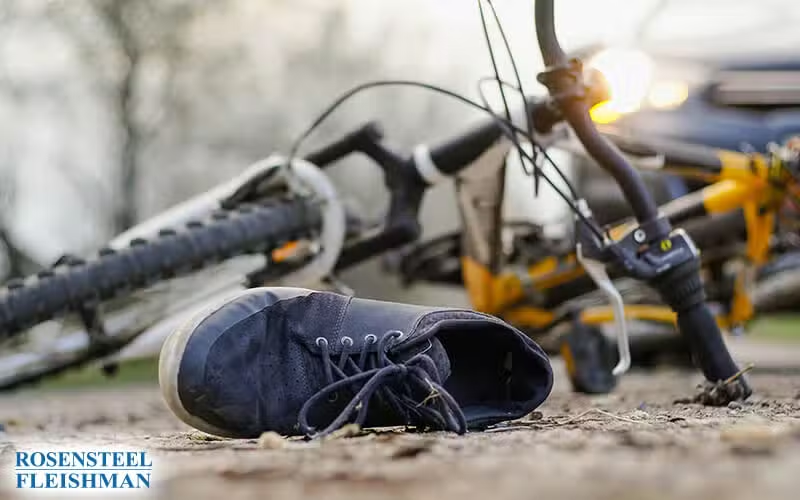

After Jacob Hill and Leonard “Lennie” Antonelli were killed and Griffin Tichenor was injured in a July 2025 collision on N.C. 251, western North Carolina cyclists pressed for roadway and vehicle-safety changes. The public discussion includes automatic emergency braking, but the current federal standard, proposed legislation, and equipment on the dump truck involved in that event must not be treated as the same thing.
A current vehicle-safety standard, a pending bill, a manufacturer feature, and a system installed on a particular vehicle are four different facts.
Start with the Asheville advocacy record
WUNC’s January 2026 report describes the N.C. 251 collision, Tichenor’s survival, and the local campaign for federal action. That reporting establishes the public-policy context. It does not establish what equipment was installed on the dump truck, how any system was configured, or whether a particular technology would have changed the collision.
FMVSS No. 127 applies to light vehicles and includes pedestrian testing
NHTSA’s summary of Federal Motor Vehicle Safety Standard No. 127 says the final rule requires automatic emergency braking, including pedestrian AEB, on nearly all new passenger cars and light trucks with a gross vehicle weight rating of 10,000 pounds or less. The agency’s announced compliance dates begin in 2029, with a later date for identified manufacturers and vehicle stages.
That scope matters. A dump truck may exceed the light-vehicle weight threshold. NHTSA’s summary also identifies a separate federal rulemaking path for heavy vehicles. Before describing any requirement, record the vehicle model year, configuration, gross vehicle weight rating, manufacturer, completed-vehicle status, and the rule that applied on the relevant production date.
Congressional proposals are not enacted requirements
The official BILLSTATUS record for H.R. 3649 shows its May 2025 introduction and referral. The official record for H.R. 7353 shows its February 2026 introduction and forwarding from a subcommittee to the full committee. Both records list an introduced bill rather than an enacted public law. A committee action is not passage by both chambers or enactment.
Bill numbers, titles, text, committees, and status can change. Record the Congress, bill number, version, action date, and tracker status each time the proposal is discussed. Do not describe a proposal as current law or assume that an earlier and later bill have identical language.
Identify the system actually installed on the vehicle
- Vehicle identification number, make, model, model year, body builder, completed configuration, gross vehicle weight rating, and ownership
- Original equipment and later-installed cameras, radar, lidar, warning, braking, fleet-safety, telematics, and driver-monitoring systems
- Software and calibration versions, service campaigns, recalls, updates, fault codes, disabled settings, warnings, and maintenance history
- Event data, diagnostic logs, video, telematics, dispatch, route, speed, braking, steering, and driver inputs preserved through technically sound methods
- System manual, stated operating domain, detection targets, speed range, weather and lighting limits, and any qualified inspection or testing
Do not turn capability into a causation conclusion
A marketing page, feature list, laboratory test, or federal proposal may describe a capability under defined conditions. It does not prove that the event target was detected, that the system issued a warning, that braking was commanded, that the driver could respond, or that the collision would have been avoided. Road geometry, vehicle path, cyclist path, closing speed, sight line, weather, system condition, and the preserved event record require separate analysis.
The related guide to passing a bicycle safely under North Carolina law covers the separate roadway rules for overtaking and clearance. This page owns the narrower federal AEB, cyclist-detection, and bill-status question.
Rosensteel Fleishman Car Accident & Injury Lawyers provides information about a North Carolina bicycle-accident claim involving vehicle-safety evidence. The vehicle, rule, system, event data, collision sequence, and claimed injury should be matched to their own sources.
Sources
Additional Bicycle Accidents Articles
How Insurers Evaluate Extra Work Breaks During Bicycle Injury Recovery
Extra breaks can change a workday without changing a paycheck. Clear records help distinguish interrupted tasks, unpaid time, and questions about responsibility for a bicycle accident.
Charlotte Street Lighting and Light Sensitivity After a Bicycle Injury
Street lighting at a crash scene and light sensitivity afterward raise different documentation questions. Clear records can help explain what happened, what changed, and what still needs legal review.
Using Bicycle Injury Recovery Reviews to Identify Lasting Limitations
Bicycle injury progress reviews can document continuing difficulties without proving that a limitation is permanent. Learn what to record and how to address conflicting accounts.