
Fine motor problems can be easy to miss after a truck crash because they often involve small changes rather than an obvious loss of movement. A person may still be able to move an arm or hand but struggle to button a shirt, type accurately, hold a key, or pick up a coin. Early photographs […]
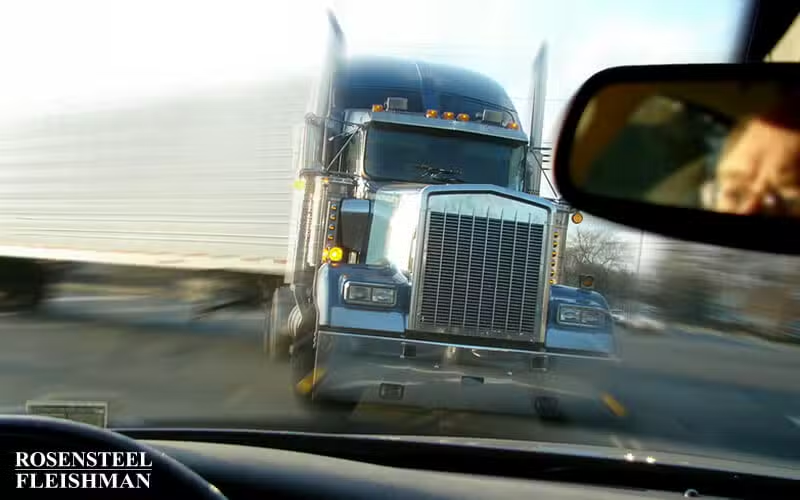

A trailer crash can involve separate questions about the towing vehicle, trailer, owner, operator, cargo, policy declarations, endorsements, and the evidence of what was connected and insured at the time of the event.
Start by preserving registration, title, lease or rental papers, bills of sale, photographs, coupling and loading condition, repair and inspection records, dispatch or delivery records, driver and owner communications, crash report, video, witness details, and each policy document in full. A declarations page is useful, but it is not the complete policy.
Keep the towing vehicle and trailer separate
Make one entry for the towing vehicle and another for the trailer. For each, record the owner, registration or serial identifier, rental or lease agreement, insurer and policy number shown in the available documents. Do not assume that a policy listing one unit also covers every use of the other.
Record whether the trailer was attached, being connected or disconnected, parked separately or moved after the event. Identify what you personally observed and what comes from a report, photograph or witness. A later photograph may not show the configuration at the time of the collision.
Preserve available photographs and records from a safe place. Do not reconnect, load, move or test damaged equipment to recreate the event. Any inspection should be arranged with the authorized custodian and appropriate qualified personnel.
Read the policy as a set of documents
- Identify the named insured, listed vehicles, trailer description, policy period, limits, endorsements, exclusions, definitions, and notices.
- Keep the original insurer correspondence, claim number, reservation-of-rights or coverage letters, and proof of when each document was received.
- Do not assume that ownership, towing, a premium payment, a traffic citation, or an initial insurance statement settles coverage.
G.S. 20-309 sets North Carolina financial-responsibility requirements, while the North Carolina Department of Insurance’s automobile-insurance overview explains common policy terms. Neither source substitutes for the actual policy, endorsements, facts, or current law.
Rosensteel Fleishman Car Accident & Injury Lawyers provides general information about discussing a vehicle-accident claim involving a towing vehicle and trailer.
Sources
Additional Personal Injury Articles
How Injury Settlements Are Evaluated When Injuries Disrupt Daily Life
The effect of an injury is not always clear in the first few days. A person may be focused on getting home from the hospital, arranging transportation, finding help with children, or figuring out how to miss work without falling behind on bills. Those immediate concerns matter, but settlement evaluation often requires a broader look […]
Accident Claim Changes over Time When New Information Becomes Available
A car accident claim can look straightforward at first, but the picture often becomes clearer as documents, medical information, repair findings, and witness accounts develop. For people dealing with a crash in Charlotte, the amount of information available during the first few days may be very different from what is known several weeks later. That […]
Discharge Criteria After Fall Injury and What Signals Readiness for the Next Step
Leaving a hospital, rehabilitation facility, or other care setting after a fall does not necessarily mean recovery is complete. Discharge usually marks a transition from one stage of care to another, with decisions shaped by documented function, safety concerns, available support, and the follow-up plan established by the treating providers. For someone injured in a […]



