In Charlotte, North Carolina, a motorcycle crash involving movement between lanes can quickly raise questions about visibility, road position, and each driver’s actions. Those questions become even more complicated when an injured rider waits to seek medical care, since an insurance company may examine both the circumstances of the collision and the timing of the […]
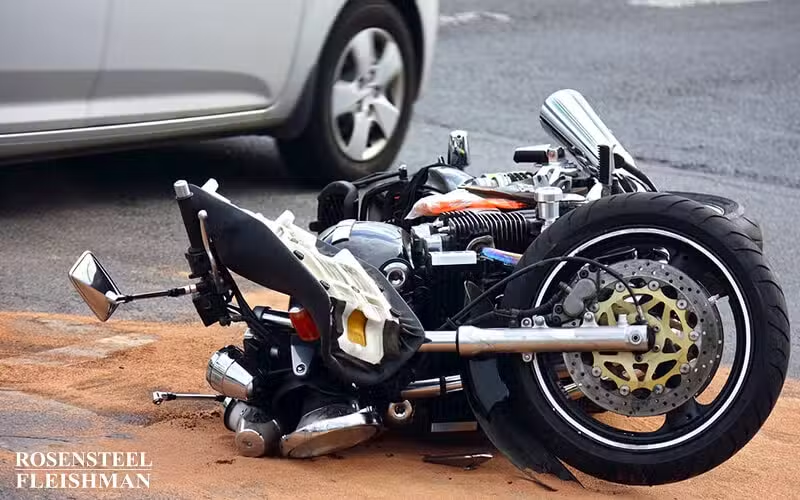

Motorcycle safety gear can reduce risk without making a rider invulnerable. When a helmet, guard, restraint, or protective garment allegedly fails, the investigation should distinguish the collision forces from the product’s design, warnings, condition, intended use, and claimed contribution to the injury.
A DOT label addresses compliance with a federal helmet standard; it does not promise that a helmet will prevent every head, face, or neck injury in every impact. Product-specific representations and limitations should be evaluated from the actual model, labeling, instructions, advertising, testing, and condition.
Howerton involved a motocross helmet and disputed technical evidence
In Howerton v. Arai Helmet, Ltd., an experienced off-road rider suffered catastrophic cervical injuries after being thrown over the handlebars during a motocross collision. He alleged that the helmet’s flexible chin guard broke and allowed excessive neck movement; the manufacturer disputed the guard’s intended protective function and causation.
The North Carolina Judicial Branch’s Howerton page identifies expert-witness, product-liability, and negligence issues and links the related Supreme Court opinion. The Supreme Court concluded that summary judgment should not have been entered on the record then before it after the plaintiff’s technical evidence was excluded under the wrong reliability approach.
Howerton is a procedural and evidentiary decision, not a finding that every flexible chin guard is defective or that the manufacturer was ultimately liable. Expert-evidence law has also changed since the case, so current Rule 702 and later decisions must govern a present claim.
North Carolina requires a compliant helmet on public roads
G.S. 20-140.4 generally requires motorcycle operators and passengers on highways or public vehicular areas to wear a properly secured helmet that complies with Federal Motor Vehicle Safety Standard 218. The statute also says that a violation is not negligence per se or contributory negligence per se in a civil action.
The road-use rule should not be confused with Howerton’s off-road product allegations. Location, intended use, product category, and the law applicable on the date of the event all require separate review.
What a DOT certification label means
NHTSA’s helmet guide explains that compliant helmets carry labeling identifying the manufacturer or brand, model, DOT, FMVSS No. 218, and certification. NHTSA does not pre-approve each helmet; manufacturers certify compliance, and the agency tests selected helmets and can pursue recalls when a product does not meet the standard.
North Carolina product claims require a specific theory
Chapter 99B governs North Carolina product-liability actions and expressly states that there is no strict liability in tort. A claim may instead involve manufacturing, design, warnings, warranties, representations, alteration, misuse, or seller responsibility, depending on the facts.
The related guide to North Carolina product-liability claims explains why “the gear failed” is a starting allegation rather than a complete legal theory.
Preserve the product and its history
- The helmet or gear in its post-collision condition, without repair, cleaning, destructive testing, or discarded parts
- Model, size, manufacturing date, serial information, labels, receipts, packaging, manuals, warnings, and accessories
- Purchase source, fitting, adjustments, modifications, prior impacts, storage, age, and maintenance history
- Advertising or representations the purchaser actually saw and relied upon
- Recall, compliance-test, complaint, design, and alternative-design evidence when legally obtainable
Reconstruct the impact before assigning causation
- Vehicle and rider motion, speed, impact direction, landing surface, body position, and sequence of contacts
- Helmet marks, fractures, deformation, detached components, clothing damage, and other physical evidence
- Medical imaging, operative reports, diagnoses, and biomechanical evidence connecting forces to the claimed injury
- Alternative causes, preexisting conditions, and what the product could reasonably have changed in that event
- Testing methods and assumptions used by every technical witness
Rosensteel Fleishman Car Accident & Injury Lawyers provides information about motorcycle-accident claims in Charlotte. A safety-gear matter may require coordinated review of crash responsibility, product law, technical evidence, insurance, and filing deadlines.
Sources
Additional Personal Injury Articles
How Witness Statements Support an Injury Claim After a Serious Accident
After a serious accident, the people who saw what happened can become an important source of information about the events surrounding an injury. A witness may remember the position of the vehicles, a traffic signal, a driver's behavior, road conditions, or what an injured person said and did immediately afterward. In Charlotte, where crashes may […]
Map and Diagram of Accident Scene Evidence When Photos Are Incomplete
Accident recovery rarely follows a perfectly straight path, especially when early symptoms change or new limitations appear after a person returns to normal routines. In Charlotte, someone injured in a collision may begin with goals such as reducing pain, restoring movement, returning to work, or safely resuming everyday activities, then adjust those goals as doctors […]
Protein Targets After Fall Injury and Supporting Physical Recovery
Poor lighting can make an ordinary walkway difficult to navigate, especially when shadows conceal a spill, uneven flooring, loose debris, or a change in elevation. In Charlotte, visibility problems may arise in apartment stairwells, parking garages, restaurants, retail stores, and other properties used by the public. When a fall causes an injury, the lighting conditions […]